Childe Harold's Pilgrimage
Canto Fourth, 79-84, 87-92, 112, 128-129, 145-146

The Niobe of nations! there she stands
Childless and crownless, in her voiceless woe;
An empty urn within her withered hands,
Whose holy dust was scattered long ago;
The Scipios' tomb contains no ashes now;
The very sepulchres lie tenantless
Of their heroic dwellers: dost thou flow,
Old Tiber! through a marble wilderness?
Rise, with thy yellow waves, and mantle her distress. (79)


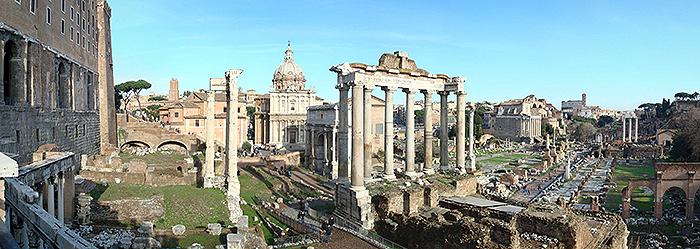
The Goth, the Christian, Time, War, Flood, and Fire,
Have dwelt upon the seven-hilled city's pride;
She saw her glories star by star expire,
And up the steep barbarian monarchs ride,
Where the car climbed the Capitol; far and wide
Temple and tower went down, nor left a site:
Chaos of ruins! who shall trace the void,
O'er the dim fragments cast a lunar light,
And say, 'here was, or is,' where all is doubly night? (80)

The double night of ages, and of her,
Night's daughter, Ignorance, hath wrapt and wrap
All round us; we but feel our way to err:
The ocean hath his chart, the stars their map,
And Knowledge spreads them on her ample lap;
But Rome is as the desert, where we steer
Stumbling o'er recollections; now we clap
Our hands, and cry 'Eureka'! it is clear--
When but some false mirage of ruin rises near. (81)

Alas, the lofty city! and alas,
The trebly hundred triumphs! and the day
When Brutus made the dagger's edge surpass
The conqueror's sword in bearing fame away!
Alas, for Tully's voice, and Virgil's lay,
And Livy's pictured page! but these shall be
Her resurrection; all beside--decay.
Alas, for Earth, for never shall we see
That brightness in her eye she bore when Rome was free! (82)

Oh thou, whose chariot rolled on Fortune's wheel,
Triumphant Sylla! Thou, didst subdue
Thy country's foes ere thou wouldst pause to feel
The wrath of thy own wrongs, or reap the due
Of hoarded vengeance till thine eagles flew
O'er prostrate Asia;--thou, who with thy frown
Annihilated senates--Roman, too,
With all they vices, for thou didst lay down
With an atoning smile a more than earthly crown-- (83)

The dictatorial wreath,--couldst thou divine
To what would one day dwindle that which made
Thee more than mortal? and that so supine
By aught than Romans Rome should thus be laid?
She who was named eternal, and arrayed
Her warriors but to conquer--she who veiled
Earth with her haughty shadow, and displayed,
Until the o'er-canopied horizon failed,
Her rushing wings--Oh, she who was Almighty hailed! (84)

And thou, dread statue, yet existent in
The austerest form of naked majesty,
Thou who beheldest, 'mid the assassin's din,
At thy bathed base the bloody Caesar lie,
Folding his robe in dying dignity,
An offering to thine altar from the queen
Of gods and men, great Nemesis! did he die,
And thou, too, perish, Pompey? have ye been
Victors of countless kings, or puppets of a scene? (87)

And thou, the thunder-stricken nurse of Rome!
She-wolf! whose brazen-imaged dugs impart
The milk of conquest yet within the dome
Where, as a monument of antique art,
Thou standest:--Mother of the mighty heart,
Which the great founder sucked from thy wild teat,
Scorched by the Roman Jove's ethereal dart,
And thy limbs black with lightning--dost thou yet
Guard thine immortal cubs, nor thy fond charge forget? (88)

Thou dost; but all thy foster-babes are dead--
The men of iron; and the world hath reared
Cities from out their sepulchres: men bled
In imitation of the things they feared,
And fought and conquered, and the same course steered,
At apish distance; but as yet none have,
Nor could, the same supremacy have neared,
Save on vain man, who is not in the grave,
But, vanquished by himself, to his own slaves a slave-- (89)

The fool of false dominion--and a kind
Of bastard Caesar, following him of old
With steps unequal; for the Roman's mind
Was modelled in a less terrestrial mould,
With passions fiercer, yet a judment cold,
And an immortal instinct which redeemed
The frailties of a heart so soft, yet bold,
Alcides with the distaff now he seemed
At Cleopatra's feet,--and now himself he beamed, (90)

And came--and saw--and conquered! But the man
Who would have tamed his eagles down to flee,
Like a trained falcon, in the Gallic van,
Which he, in sooth, long led to victory,
With a deaf heart, which never seemed to be
A listener to itself, was strangely framed;
With but one weakest weakness--vanity,
Coquettish in ambition, still he aimed--
At what? can he avouch or answer what he claimed? (91)

And would be all or nothing--nor could wait
For the sure grave to level him; few years
Had fixed him with the Caesars in his fate,
On whom we tread: For this the conqueror rears
The arch of triumph; and for this the tears
And blood of earth flow on as they have flowed,
An universal deluge, which appears
Without an ark for wretched man's abode,
And ebbs but to reflow! Renew they rainbow, God! (92)

Where is the rock of Triumph, the high place
Where Rome embraced her heroes? where the steep
Tarpeian, fittest goal of Treason's race,
The promontory whence the Traitor's Leap
Cured all ambition? Did the conquerors heap
Their spoils here? Yes; and in yon field below
A thousand years of silenced factions sleep--
The Forum, where the immortal accents glow,
And still the eloquent air breathes--burns with Cicero! (112)

Arches on arches! as it were that Rome,
Collecting the chief trophies of her line,
Would build up all her triumphs in one dome,
Her Coliseum stands; the moonbeams shine
As 'twere its natural torches, for divine
Should be the light which streams here, to illume
This long-explored but still exhaustless mine
Of contemplation; and the azure gloom
Of an Italian night, where the deep skies assume (128)

Hues which have words, and speak to yet of heaven,
Floats o'er this vast and wondrous monument,
And shadows forth its glory. There is given
Unto the things of earth, which time hath bent,
A spirit's feeling, and where he hath leant
His hand, but broke his scythe, there is a power
And magic in the ruined battlement,
For which the palace of the present hour
Must yield its pomp, and wait till ages are its dower (129)

'While stands the Coliseum, Rome shall stand;
When falls the Coliseum, Rome shall fall,
And when Rome falls--the World.' From our own land
Thus spake the pilgrims o'er this mighty wall
In Saxon times, which we are wont to call
Ancient; and these three mortal things are still
On their foundations, and unaltered all;
Rome and her Ruin past Redemption's skill,
The World, the same wide den--of thieves, or what ye will. (145)

Simple, erect, severe, austere, sublime--
Shrine of all saints and temple of all gods,
From Jove to Jesus--spared and blessed by time;
Looking tranquility, while falls or nods
Arch, empire, each thing round thee, and man plods
His way through thorns to ashes--glorious dome!
Shalt thou not last? Time's scythe and tyrants' rods
Shiver upon thee--sanctuary and home
Of art and piety--Pantheon! pride of Rome!