



|
|
Selections:
DURING the whole of a dull, dark, and soundless day in the autumn of the year, when the clouds hung oppressively low in the heavens, had been passing alone, on horseback, through a singularly dreary tract of country; and at length found myself, as the shades of the evening drew on, within view of the melancholy House of Usher. I know not how it was --but, with the first glimpse of the building, a sense of insufferable gloom pervaded my spirit. I say insufferable; for the feeling was unrelieved by any of that half-pleasurable, because poetic, sentiment, with which the mind usually receives even the sternest natural images of the desolate or terrible. I looked upon the scene before me --upon the mere house, and the simple landscape features of the domain --upon the bleak walls --upon the vacant eye-like windows --upon a few rank sedges --and upon a few white trunks of decayed trees --with an utter depression of soul which I can compare to no earthly sensation more properly than to the after-dream of the reveller upon opium --the bitter lapse into everyday life-the hideous dropping off of the reveller upon opium --the bitter lapse into everyday life --the hideous dropping off of the veil. There was an iciness, a sinking, a sickening of the heart --an unredeemed dreariness of thought which no goading of the imagination could torture into aught of the sublime. What was it --I paused to think --what was it that so unnerved me in the contemplation of the House of Usher? It was a mystery all insoluble; nor could I grapple with the shadowy fancies that crowded upon me as I pondered. I was forced to fall back upon the unsatisfactory conclusion, that while, beyond doubt, there are combinations of very simple natural objects which have the power of thus affecting us, still the analysis of this power lies among considerations beyond our depth. It was possible, I reflected, that a mere different arrangement of the particulars of the scene, of the details of the picture, would be sufficient to modify, or perhaps to annihilate its capacity for sorrowful impression; and, acting upon this idea, I reined my horse to the precipitous brink of a black and lurid tarn that lay in unruffled lustre by the dwelling, and gazed down --but with a shudder even more thrilling than before --upon the remodelled and inverted images of the gray sedge, and the ghastly tree-stems, and the vacant and eye-like windows.
I have said that the sole effect of my somewhat childish experiment --that of looking down within the tarn --had been to deepen the first singular impression. There can be no doubt that the consciousness of the rapid increase of my superstition --for why should I not so term it? --served mainly to accelerate the increase itself. Such, I have long known, is the paradoxical law of all sentiments having terror as a basis. And it might have been for this reason only, that, when I again uplifted my eyes to the house itself, from its image in the pool, there grew in my mind a strange fancy --a fancy so ridiculous, indeed, that I but mention it to show the vivid force of the sensations which oppressed me. I had so worked upon my imagination as really to believe that about the whole mansion and domain there hung an atmosphere peculiar to themselves and their immediate vicinity-an atmosphere which had no affinity with the air of heaven, but which had reeked up from the decayed trees, and the gray wall, and the silent tarn --a pestilent and mystic vapour, dull, sluggish, faintly discernible, and leaden-hued. Shaking off from my spirit what must have been a dream, I scanned more narrowly the real aspect of the building. Its principal feature seemed to be that of an excessive antiquity. The discoloration of ages had been great. Minute fungi overspread the whole exterior, hanging in a fine tangled web-work from the eaves. Yet all this was apart from any extraordinary dilapidation. No portion of the masonry had fallen; and there appeared to be a wild inconsistency between its still perfect adaptation of parts, and the crumbling condition of the individual stones. In this there was much that reminded me of the specious totality of old wood-work which has rotted for long years in some neglected vault, with no disturbance from the breath of the external air. Beyond this indication of extensive decay, however, the fabric gave little token of instability. Perhaps the eye of a scrutinising observer might have discovered a barely perceptible fissure, which, extending from the roof of the building in front, made its way down the wall in a zigzag direction, until it became lost in the sullen waters of the tarn.
While he spoke, the lady Madeline (for so was she called) passed slowly through a remote portion of the apartment, and, without having noticed my presence, disappeared. I regarded her with an utter astonishment not unmingled with dread --and yet I found it impossible to account for such feelings. A sensation of stupor oppressed me, as my eyes followed her retreating steps. When a door, at length, closed upon her, my glance sought instinctively and eagerly the countenance of the brother --but he had buried his face in his hands, and I could only perceive that a far more than ordinary wanness had overspread the emaciated fingers through which trickled many passionate tears. The disease of the lady Madeline had long baffled the skill of her physicians. A settled apathy, a gradual wasting away of the person, and frequent although transient affections of a partially cataleptical character, were the unusual diagnosis. Hitherto she had steadily borne up against the pressure of her malady, and had not betaken herself finally to bed; but, on the closing in of the evening of my arrival at the house, she succumbed (as her brother told me at night with inexpressible agitation) to the prostrating power of the destroyer; and I learned that the glimpse I had obtained of her person would thus probably be the last I should obtain --that the lady, at least while living, would be seen by me no more. .
The brother had been led to his resolution (so he told me) by consideration
of the unusual character of the malady of the deceased, of certain obtrusive
and eager inquiries on the part of her medical men, and of the remote and
exposed situation of the burial-ground of the family. I will not deny that
when I called to mind the sinister countenance of the person whom I met
upon the stair case, on the day of my arrival at the house, I had no desire
to oppose what I regarded as at best but a harmless, and by no means an
unnatural, precaution. At the request of Usher, I personally aided him
in the 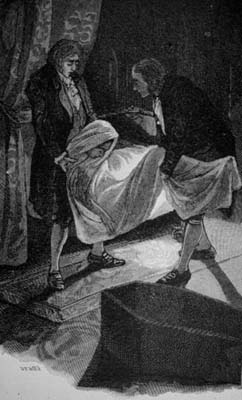 arrangements
for the temporary entombment. The body having been encoffined, we two alone
bore it to its rest. The vault in which we placed it (and which had been
so long unopened that our torches, half smothered in its oppressive atmosphere,
gave us little opportunity for investigation) was small, damp, and entirely
without means of admission for light; lying, at great depth, immediately
beneath that portion of the building in which was my own sleeping apartment.
It had been used, apparently, in remote feudal times, for the worst purposes
of a donjon-keep, and, in later days, as a place of deposit for powder,
or some other highly combustible substance, as a portion of its floor,
and the whole interior of a long archway through which we reached it, were
carefully sheathed with copper. The door, of massive iron, had been, also,
similarly protected. Its immense weight caused an unusually sharp grating
sound, as it moved upon its hinges. Having deposited our mournful burden
upon tressels within this region of horror, we partially turned aside the
yet unscrewed lid of the coffin, and looked upon the face of the tenant.
A striking similitude between the brother and sister now first arrested
my attention; and Usher, divining, perhaps, my thoughts, murmured out some
few words from which I learned that the deceased and himself had been twins,
and that sympathies of a scarcely intelligible nature had always existed
between them. Our glances, however, rested not long upon the dead --for
we could not regard her unawed. The disease which had thus entombed the
lady in the maturity of youth, had left, as usual in all maladies of a
strictly cataleptical character, the mockery of a faint blush upon the
bosom and the face, and that suspiciously lingering smile upon the lip
which is so terrible in death. We replaced and screwed down the lid, and,
having secured the door of iron, made our way, with toll, into the scarcely
less gloomy apartments of the upper portion of the house.
arrangements
for the temporary entombment. The body having been encoffined, we two alone
bore it to its rest. The vault in which we placed it (and which had been
so long unopened that our torches, half smothered in its oppressive atmosphere,
gave us little opportunity for investigation) was small, damp, and entirely
without means of admission for light; lying, at great depth, immediately
beneath that portion of the building in which was my own sleeping apartment.
It had been used, apparently, in remote feudal times, for the worst purposes
of a donjon-keep, and, in later days, as a place of deposit for powder,
or some other highly combustible substance, as a portion of its floor,
and the whole interior of a long archway through which we reached it, were
carefully sheathed with copper. The door, of massive iron, had been, also,
similarly protected. Its immense weight caused an unusually sharp grating
sound, as it moved upon its hinges. Having deposited our mournful burden
upon tressels within this region of horror, we partially turned aside the
yet unscrewed lid of the coffin, and looked upon the face of the tenant.
A striking similitude between the brother and sister now first arrested
my attention; and Usher, divining, perhaps, my thoughts, murmured out some
few words from which I learned that the deceased and himself had been twins,
and that sympathies of a scarcely intelligible nature had always existed
between them. Our glances, however, rested not long upon the dead --for
we could not regard her unawed. The disease which had thus entombed the
lady in the maturity of youth, had left, as usual in all maladies of a
strictly cataleptical character, the mockery of a faint blush upon the
bosom and the face, and that suspiciously lingering smile upon the lip
which is so terrible in death. We replaced and screwed down the lid, and,
having secured the door of iron, made our way, with toll, into the scarcely
less gloomy apartments of the upper portion of the house.
 speak!
And now --to-night --Ethelred --ha! ha! --the breaking of the hermit's
door, and the death-cry of the dragon, and the clangour of the shield!
--say, rather, the rending of her coffin, and the grating of the iron hinges
of her prison, and her struggles within the coppered archway of the vault!
Oh whither shall I fly? Will she not be here anon? Is she not hurrying
to upbraid me for my haste? Have I not heard her footstep on the stair?
Do I not distinguish that heavy and horrible beating of her heart? MADMAN!"
here he sprang furiously to his feet, and shrieked out his syllables, as
if in the effort he were giving up his soul --"MADMAN! I TELL YOU THAT
SHE NOW STANDS WITHOUT THE DOOR!" As if in the superhuman energy of his
utterance there had been found the potency of a spell --the huge antique
panels to which the speaker pointed, threw slowly back, upon the instant,
ponderous and ebony jaws. It was the work of the rushing gust --but then
without those doors there DID stand the lofty and enshrouded figure of
the lady Madeline of Usher. There was blood upon her white robes, and the
evidence of some bitter struggle upon every portion of her emaciated frame.
For a moment she remained trembling and reeling to and fro upon the threshold,
then, with a low moaning cry, fell heavily inward upon the person of her
brother, and in her violent and now final death-agonies, bore him to the
floor a corpse, and a victim to the terrors he had anticipated. From that
chamber, and from that mansion, I fled aghast. The storm was still abroad
in all its wrath as I found myself crossing the old causeway. Suddenly
there shot along the path a wild light, and I turned to see whence a gleam
so unusual could wi have issued; for the vast house and its shadows were
alone behind me. The radiance was that of the full, setting, and blood-red
moon which now shone vividly through that once barely-discernible fissure
of which I have before spoken as extending from the roof of the building,
in a zigzag direction, to the base. While I gazed, this fissure rapidly
widened --there came a fierce breath of the whirlwind --the entire orb
of the satellite burst at once upon my sight --my brain reeled as I saw
the mighty walls rushing asunder --there was a long tumultuous shouting
sound like the voice of a thousand waters --and the deep and dank tarn
at my feet closed sullenly and silently over the fragments of the "HOUSE
OF USHER."
speak!
And now --to-night --Ethelred --ha! ha! --the breaking of the hermit's
door, and the death-cry of the dragon, and the clangour of the shield!
--say, rather, the rending of her coffin, and the grating of the iron hinges
of her prison, and her struggles within the coppered archway of the vault!
Oh whither shall I fly? Will she not be here anon? Is she not hurrying
to upbraid me for my haste? Have I not heard her footstep on the stair?
Do I not distinguish that heavy and horrible beating of her heart? MADMAN!"
here he sprang furiously to his feet, and shrieked out his syllables, as
if in the effort he were giving up his soul --"MADMAN! I TELL YOU THAT
SHE NOW STANDS WITHOUT THE DOOR!" As if in the superhuman energy of his
utterance there had been found the potency of a spell --the huge antique
panels to which the speaker pointed, threw slowly back, upon the instant,
ponderous and ebony jaws. It was the work of the rushing gust --but then
without those doors there DID stand the lofty and enshrouded figure of
the lady Madeline of Usher. There was blood upon her white robes, and the
evidence of some bitter struggle upon every portion of her emaciated frame.
For a moment she remained trembling and reeling to and fro upon the threshold,
then, with a low moaning cry, fell heavily inward upon the person of her
brother, and in her violent and now final death-agonies, bore him to the
floor a corpse, and a victim to the terrors he had anticipated. From that
chamber, and from that mansion, I fled aghast. The storm was still abroad
in all its wrath as I found myself crossing the old causeway. Suddenly
there shot along the path a wild light, and I turned to see whence a gleam
so unusual could wi have issued; for the vast house and its shadows were
alone behind me. The radiance was that of the full, setting, and blood-red
moon which now shone vividly through that once barely-discernible fissure
of which I have before spoken as extending from the roof of the building,
in a zigzag direction, to the base. While I gazed, this fissure rapidly
widened --there came a fierce breath of the whirlwind --the entire orb
of the satellite burst at once upon my sight --my brain reeled as I saw
the mighty walls rushing asunder --there was a long tumultuous shouting
sound like the voice of a thousand waters --and the deep and dank tarn
at my feet closed sullenly and silently over the fragments of the "HOUSE
OF USHER."
