This is a SEO version of S12. Click here to view full version
« Previous Page Table of Contents Next Page »JZ
Tuesday February 7 th , Professor Eliot Cohen, the Robert E. Osgood Professor of Strategic Studies at the Johns Hopkins School for Advanced In-ternational Studies came to Skidmore to give a talk entitled “An Old Enmity: The Professional vs. the Citizen Solder, from Colonial Times to Today”. It was a topic that seemed at once familiar and unfamiliar as the lecture went on. It was information most of us had access to, but had never looked at in this light. A group of students, professors, and members of the broader Saratoga community were in attendance, eager to listen to Professor Cohen. He first began by defining the basic terminology, citizen and professional soldier, and what that really means. Citizen soldiers, for the most part, come from the National Guards of the states. The Guard’s origins date back to the state militias of the revolutionary era. These are part-time soldiers, who serve temporarily and then return to civilian life. Professional soldiers are those for whom military service is their career. Using his new book, Conquered into Liberty, Professor Cohen went through American history highlighting famous professional and citizen soldiers and important battles—highlighting instances where these two military types have come into conflict. A good portion of the talk and the question and answer session that followed focused on the two most famous profes-sional soldiers of our time, General David Patraeus and General Stanley McChrystal. General Patraeus especially embodies the idea of the modern profes-sional soldier. His career path has led him up the ranks of the military to become the top officer.
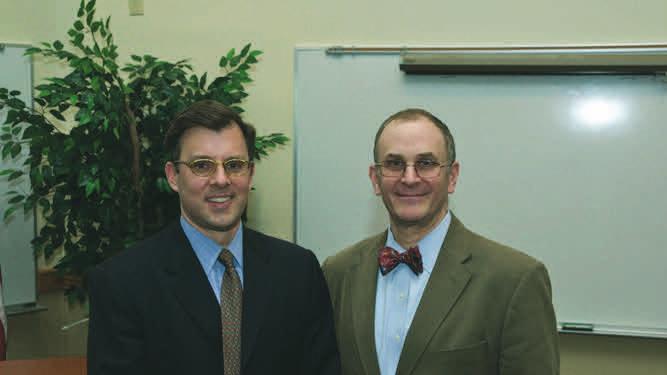
Dinner was an interesting affair, I found myself seat-ed across from Professor Cohen as the conversation ranged from the media and the armed service to the current Republican candidates for President. Profes-sor Cohen barely seemed to take a bite, before an-other student had a question or a counter-argument for what he just said. Conversation flowed quickly and easily, with everyone at the table contributing. The post-dinner discussion, led by Professor Ron Seyb, allowed Professor Cohen to expand on other elements and figures from his book. Professor Seyb noted the remarkable treatment of Benedict Arnold in Conquered into Liberty . Though now largely known
as a traitor to the American cause, Arnold played an undeniably indispensible role in the American victory in the war for Independence. Professor Cohen raised some interesting questions about national memory and the uses of history by comparing the treatment of Arnold with the treatment of another traitor to his country, Robert E. Lee. A kind of legend has developed around Lee, argued Cohen, which distracts us from the centrality of his fundamental betrayal. Arnold, however, has not received such a favorable hearing by subsequent generations, though his positive accomplishments are legion. History seems to have forgiven Lee his crimes, but never Arnold. It was an enlightening and thought provoking discussion.
A N O LD E NMITY
O LIVIA K INNEAR ‘15
PAGE 12
Attention Junior Government Majors!
Are you eligible to and interested in writing a senior honors thesis? If so, read our guidelines and timeline for this yearlong process on the web at
This is a SEO version of S12. Click here to view full version
« Previous Page Table of Contents Next Page »