This is a SEO version of S12. Click here to view full version
« Previous Page Table of Contents Next Page »P AGE 3
just trying to claim land that was rightfully his? Burr's trial for treason remains one of the most famous in American histo-ry, and it is still cited by presidency scholars as an important moment in the evolution of the doctrine of executive privi-lege. Was Burr "Man or Scoundrel?"
Professor Natalie Taylor: Who killed Judge Irwin? Judge Irwin is a central character in Robert Penn Warren's All the King's Men . He was an honorable man, who committed a cor-rupt deed that led to the death of an innocent man. Eventual-ly, Judge Irwin took a bullet in the chest as a consequence of his deed. Although the reader learns the facts of "the Case of the Upright Judge," the truth is more elusive. As the novel's narrator, Jack Burden, tells readers the truth and the facts are not always identical-- the truth is always much more diffi-cult to grasp than the facts. And, so, I would like to know the truth of "the Case of the Upright Judge." Robert Penn Warren is among the most thoughtful commentators on the na-ture American democracy. Knowing the truth of "the Case of the Upright Judge" would illuminate human nature and the limits of democracy.
Professor Turner: The two conspiracies I would like to know more about are the assassinations of Julius Caesar and Abra-ham Lincoln. How did Brutus and Cassius and John Wilkes Booth and Lewis Powell manage to build such large and elabo-rate assassination plots (there were at least 8 members of the Lincoln conspiracy)? What did they think the assassinations would achieve politically? What was their plan for post-assassination regime building? Did they feel any remorse or guilt over their actions?
Professor Vacs: There are many cases of political scandal or conspiracy that I would like to investigate (from the Maine explosion in the Havana harbor to Iran-Contra scandal pass-ing through the Zimmermann telegram and Operation Mon-goose) but I think I’ll wait until retirement before letting my historical political detection skills flourish. To mention only one of those cases that I find extremely interesting , I would like to find the truth behind the “Business Plot” of 1934 (also
known as the “White House Putsch”) in which it was alleged that a group of businessmen and right-wing operators attempted to or-ganize in combination with veteran organizations a coup to over-throw president Roosevelt. It had all the elements of a good politi-cal scandal combined with a complicated conspiracy: informers, spies, Gold Standard devotees, retired military officers, Conserva-tive businessmen, Fascist sympathizers, a popular president, Con-gressional investigations, cover-ups, media neglect, etc., as well as an interesting set of connections to current political, ideological and economic situations (from the “Tea Party” phenomenon to calls for restoring the gold standard passing through accusations of im-perial presidential ambitions and unconstitutional initiatives).
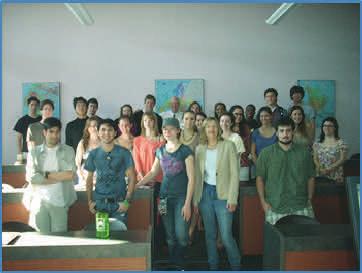
On Wednesday, March 21 st , Dr. Brigid Laffan, a Professor at University Col-lege Dublin in Ireland visited Skidmore and gave a lecture on the Eurozone crisis from an Irish perspective to students. Dr. Laffan also met with many clas-ses during her
stay, and answered questions on topics ranging from Irish public policy to larger international affairs questions. During her lecture, Dr. Laffan discussed in great detail how Ireland’s economic status went from being known as a “celtic tiger” to facing one of the largest economic crises since the great depression. Dr. Laffan answered many questions from the Skidmore community, and presented a realis-tic view on the future of the Eurozone that would ensure that would hold indi-viduals in financial areas more accountable to the people within their country.
“If you could…” continued from page 2
This is a SEO version of S12. Click here to view full version
« Previous Page Table of Contents Next Page »