This is a SEO version of S12. Click here to view full version
« Previous Page Table of Contents Next Page »P AGE 6
A T ASTE OF W ESTPOINT T RADITION
D OMINIC G REEN ‘12
As rumor has it, three items are stowed at the very top of West Point Military Academy’s highest flagpole: a grain of rice, a match, and a single bullet. Any well-versed West Point cadet will tell you that in the event of an enemy attack on West Point, the last defending cadet is to climb the flagpole and access the hidden treasures. The rice is there to sustain the cadet through his or her final courageous mission, the match to ensure no enemy can seize the American flag, and the bullet to finish the act, leaving no prisoners behind for the enemy!
West Point cadets are positively brimming with stories like this one, never hesitating to recount endless West Point trivia with pride.
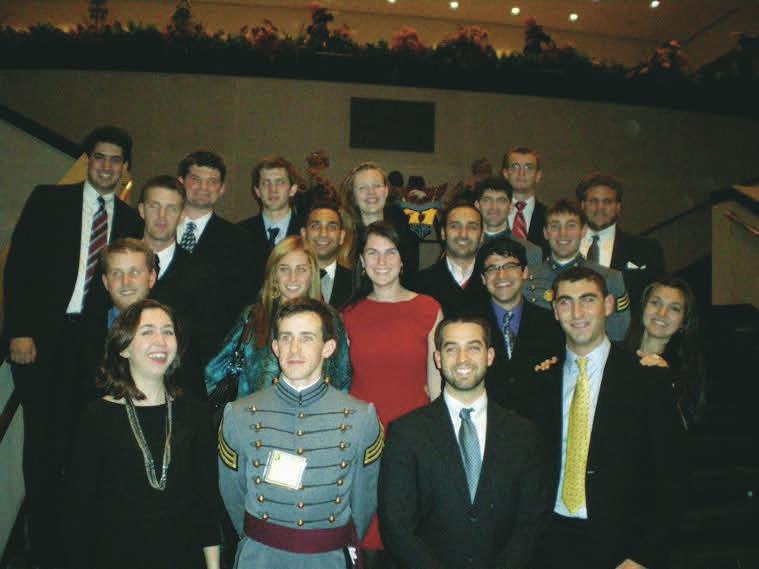
Only a visit to the military academy can truly illustrate the necessary role these stories play—in serving as the bedrock of West Point tradi-tion, the constant referral to legend and ritual keeps morale and com-mitment high in a tremendously demanding environment. Back in early November, I was fortunate enough to join 225 fellow political science nerds in the 63 rd annual four-day Student Conference on US Affairs (SCUSA) at West Point academy, where I got a taste of the tradition, mingled with cadets, and got to hold some pretty cool-looking guns. I came away from the conference with a newfound re-spect for the American military, an invigorated perspective on US foreign affairs, and a new strategy to protect the honor of the Skid-more flag if Middlebury ever invades us.
Along with Skidmore seniors Michael Kraines and Yinebeb Girma, I made the two and a half hour drive on a crisp Wednesday afternoon to West Point’s stunning campus on the Hudson River in Orange County, New York. After somehow managing to get our liberal arts haircuts through tight security, we entered the former fortress that is the United States Military Academy at West Point. As an historical landmark, West Point is most famous for its role defending the colonies from the British Royal Navy after 1778, and for Benedict Arnold’s infamous attempt to surrender the fort to the British. President Jefferson signed legislation to establish the United States Military Academy in 1802, and it has been an educational institution ever since.
The organizational capacity and strict decorum of the cadets was clear immediately upon our arrival, and the entire four-day confer-ence marched along to the same well-tuned, logistical beat. My civilian counterparts and I were consistently floored by the ability of the ca-dets running the conference to lead, herd, and arrange large groups of conference-goers with ease. From first-years to seniors, the cadets deftly ushered us to countless roundtable discussions and paraded us across the grounds and through the dining hall, all the while spouting military legend and West Point facts (apparently, the lawn of the Parade Ground is the second most expensive in the country, falling only behind the White House lawn in maintenance costs!). And yet, it didn’t just feel like a few days hanging out with a big group of school-sponsored tour guides—these guys lived for their traditions, boasted the accomplishments of their alums with pride, and attended to minute details of their daily regiment with utmost responsibility and fervor.
SCUSA was broken into many different roundtable discussions on US foreign affairs, which were conducted over the course of four days. Each group of 15 students (including both SCUSA attendees and cadets) worked throughout the duration of the conference to draft a mock US foreign policy proposal. My group was charged with analyzing the lasting effects of the Arab Spring on US foreign policy. Fortu-nately, I was enrolled last semester in Professor Hoffman’s course on nationalism and politics in the Middle East, so I found myself adequate-ly prepared for the discussions and policy drafting that ensued at SCUSA. Most of the students and cadets in my roundtable discussion exhib-ited incredible expertise in Middle Eastern studies (I had to sit out at times when the discussion evolved into Arabic language practice), so I am grateful to Professor Hoffman for his role in helping me prepare for the experience.
Continued on page 13
T HESIS P ROJECTS : I N THIS EDITION OF THE NEWSLETTER , SENIORS WHO ARE COMPLETING THESIS PROJECTS
HAVE SHARED A BIT ABOUT THEIR WORK
Property Politics: The Implications of Federally Legislated Land Exchanges.
Ali Wrynn ‘12
I am writing about the implications of conducting legislated land exchanges with regard to the U.S. Forest Service and the Bureau of Land Management (BLM). Every year, federal land agencies trade thousands of acres of government land for privately owned tracts to consolidate inholdings and improve management. I argue that these transactions have become contentious in recent years due to increased public awareness and intensified pressure from third party groups to reform the process. This scrutiny has, in turn, caused members of Con-gress to display hesitancy in announcing their outright support of many proposals. I hope to show how this niche land policy area provides insight into larger trends about government and stakeholder behavior.
This is a SEO version of S12. Click here to view full version
« Previous Page Table of Contents Next Page »