This is a SEO version of S12. Click here to view full version
« Previous Page Table of Contents Next Page »M ODEL EU A TTENDS E URO S IM 2012 IN P OLAND
E MMA K URS ‘12
This past winter break, the model European Union club travelled to Wrocław, Poland for the 2012 EuroSim con-ference. After having spent the whole fall semester preparing for the trip, seven of us students (made up of a wide range of majors—including Government, History, Economics, and International Affairs) were excited and anxious to see Poland and attend the conference. A European Union (EU) simulation is just like the (perhaps better-known) Model United Nations. At EuroSim, however, each student portrays a minister of an EU member state or a member of the European Parliament. This year, the debates centered around the EU’s Asylum Policy—which was interest-ing and pertinent given the large influxes of illegal immigrants and asylum applicants after the tumultu-ous Arab Spring. Aside from the knowledge we all gained from study-ing the EU, researching our role’s position, and acclimating to the nu-ances of this institution, the confer-ence was a great opportunity to meet other students from across the world. In an effort to educate both
American and European students about the EU’s structure, the program invites half of the participants from American universities and the other half from European ones. Even more, the conference is held alternately at an American or European University—meaning that biannually European stu-
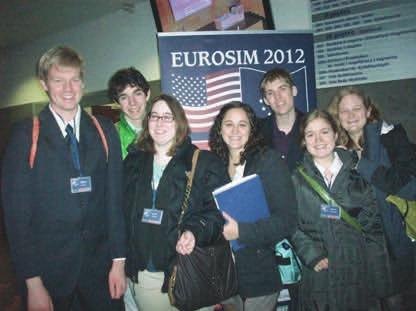
dents get to travel to America and vise versa. Next year, the conference will be in Pennsylvania, and the year after that in the Netherlands!
In addition to our three and a half day conference, we had a lot of time to explore Poland. We flew into Warsaw, where we spent a few days sightseeing and adjusting to Polish culture. The city was beautiful; it was still glowing with holiday lights strung everywhere and a Christmas mar-
ket overflowing with baked goods and Polish crafts. After spending a few days travelling around War-saw—visiting sites like the Warsaw Uprising Museum, the Old Town, and the Wilanów Palace—we hopped a train to Wrocław for the conference. Compared to the sprawling, metropolitan Warsaw, Wrocław had a much more intimate, student-friendly atmosphere. With our hostel located just minutes from the lovely main square, we could take in the city by foot and see the city’s sites before the con-ference began. Overall, the trip was a great success thanks to our solid preparation and the hard work of the model EU’s e-board. To find out more about the club and future confer-ences, contact president Claire Beihl (bbeihl@skidmore.edu) or just attend one of our meetings!
PAGE 7
T HESIS P ROJECTS
Beyond Multiculturalism: A New Approach to Germany's Integration Woes
Warren Bianchi 2012
As the starting point for my senior thesis, I took Angela Merkel's declaration in October 2011 that multicul-turalism had "utterly failed." Given the difficulties of Islam in Europe, this statement struck me due to its finality and extremity. Upon reflection, however, I became more perplexed. What exactly does Merkel mean by "multiculturalism," and in what ways has it "failed?" Surely, I thought, Germany can't be giving up completely on its Muslim populations! This is where my project began, and it has taken me in unexpected and fascinating directions.
I begin by showing the salience of the integration issue through demographic and immigration trends. Fine, Merkel, you can give multiculturalism up, but don't pretend that the marginalization of Muslims in your country is a petty issue or one that is likely to disappear. Next, I delve into the array of theories surrounding the immigration con-troversy, beginning with the more conservative, xenophobic approaches and then moving onto the liberal multicultur-alist theory that we are all, on some level, familiar with. These chapters provide a working definition for what multi-culturalism is , and the next chapters evaluate how German policy makers have or have not acted in ways that are
multicultural , whether or not consciously adhering to the recommendations of theorists. Finally, after providing a look at the state of Islam and xenophobia in Germany today, I hope to offer policy recommen-dations as to how Germany can ameliorate the problems of integration. Has multiculturalism failed? Per-haps not in theory, but it appears that its significance in political jargon has waned. My ultimate goal is to move beyond multiculturalism while not falling too far back into right-wing, xenophobic conservatism. Perhaps some aspects of multiculturalism can be salvaged in order to create an approach to integration that is pragmatic, just and humane.
This is a SEO version of S12. Click here to view full version
« Previous Page Table of Contents Next Page »