This is a SEO version of S12. Click here to view full version
« Previous Page Table of Contents Next Page »P AGE 8
A P OST FROM K AZAN , R USSIA
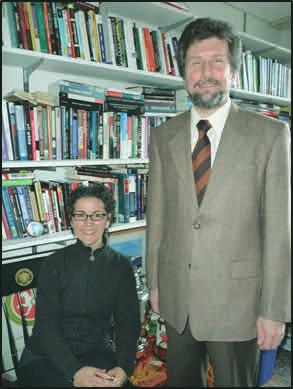
Skidmore was happy to welcome Professor Oleg Zaznaev to campus this past December. Professor Zaznaev is the chair of the Political Science depart-ment at Kazan State University in Tatarstan, Russia, and was visiting Skidmore on a Russian government sponsored trip. During his stay Professor Zaznaev ob-served classes taught by professors Ron Seyb, Roy Ginsberg, Aldo Vacs, and Pat Ferraioli. When asked about his impressions of the American classroom, Professor Zaznaev said that he was very impressed by the use of video in professor Seyb’s class, and simulation pedagogies, such as mock trials, in professor Ferraioli’s class. Professor Ferraioli remarked that Oleg had asked her numerous questions on how to best to run a mock trial so he could take the exercise back to Russia. Professor Zaznaev was able to gather material for an electronic textbook he is publishing on North American politics, as well as learn several new teaching methods he hopes to adapt for the Russian classroom. He chose to work at Skidmore in particular, due to its small size compared to Russian schools and because he had worked with Professor Graney in Russia when she was conducting research for her dissertation there in the 1990s. Matt Choi ‘14
My visit to Skidmore College on December 2-17, 2011 was sponsored by the Program of Development of Kazan (Volga Region) Federal University, Russia. The Program has given me a lot of great opportunities in the United States: to develop my course on American and Canadian government and politics, to gather new resources and curricula, to observe teaching techniques at Skidmore, to meet with American col-leagues, to talk to well-established professors, to take part in interesting discussions and express my view-points. These opportunities were realized successfully during my stay in Saratoga Springs.
I would like to thank Kazan University for the financial support. I am very grateful to the Government Department at Skidmore College and its chair and professor Katherine Graney for hospitality. She kindly agreed to accommodate me and provided me with office, computer, access to electronic resources and college's library. I really appreciate her advice on the development of my curriculum. I would also like to thank professors Ron Seyb, Roy Ginsberg, Aldo Vacs, Pat Ferraioli and Robert Turner who gave me opportunity to attend lectures and seminars and to speak to them. I would also like to thank Barbara McDonough who welcomed all my requests and was at the ready to help me at every minute. The Department granted me a lot of books on American, European and Russian politics, comparative government. I would like to ex-press my gratitude to professors for support in getting these books.
During my visit in Saratoga Springs I focused mostly on my curriculum development of the course "American and Canadian Government and Politics" and preparing an electronic textbook to support this course. This is a course which is offered for bachelors in Political Science at Kazan University. The major objective of the course is to acquaint students with contemporary Canadian and American government and politics. This course gives students the opportunity to under-stand the workings of two advanced democracies of the modern world. There are two ways to understand them. One is “to get inside” each of them, to get a sense of each country’s political institutions, processes, personalities, and politics. The other way is to compare countries using basic concepts of political analysis. I will point out ways in which the American political system is similar to or different from that of Canada. The course gives students some factual information on these nations and a conceptual understanding of politics within them.
I think that Skidmore College is one of the best liberal arts colleges in the United States. It is an elite college with high standards of education. The wealth of experience of the Government Department at Skidmore is very interesting for professors of my university. I would like to point out some moments of teaching of American colleagues: the creative atmosphere of the Department (interactive lectures and semi-nars, essays, interesting and nontraditional courses such as “From Genghis Khan To Gorbachev: Power And Politics In Russian History”,
T HESIS P ROJECTS
“Testing Twitter: The Role of Social Media in Defying Dictators”
Emma Kurs ‘12
Fascinated by an article I read this summer about two Bahraini dissidents that "tweeted" straight from their prison cells, I decided to write my thesis paper on the relationship between social media and authoritarian regimes. Given the abundance of praise for websites like Twitter and Facebook (for instance, sensationalist headlines touting "In Egypt, Twitter Trumps Torture”), I wanted to investigate whether or not citizens can employ social media as a tool to defy and destroy repressive states. To do this, my thesis analyzes the role of social media in two recent, prominent revolutionary moments: the Iranian uprisings of 2009 (the Green Movement) and the Egyptian revolution that toppled the Hosni Mubarak regime in 2011.
Given the newness of this debate over the efficacy of social media, I decided to first establish a rooted framework to contextualize this new technology. The outset of the paper will discuss the way that scholars have historically analyzed the causes and mechanisms of revo-lutions (i.e. does a revolution’s success stem from a weak state, the will of the people, or both?). I will follow with a discussion of what theo-rists predict about social media as a tool for creating opposition movements, mobilizing citizens, and undermining authoritarian regimes. With these two frameworks to work from, I will then apply the theories to my two case studies, one failed and one (at least partially) successful revolution, to analyze what social media’s role was and to determine whether it made a genuine difference in either of these uprisings.
Kazan continued on page 13
This is a SEO version of S12. Click here to view full version
« Previous Page Table of Contents Next Page »