


Bernard P. Possidente


Professor of Biology
 @ Skidmore since 1983


Address:
Dana Science Center   Room 343
Department of Biology
Skidmore College
Saratoga Springs, New York 12866

Telephone: (518) 580-5082

Fax: (518) 580-5071

E-mail: bposside@skidmore.edu


Education:
B.A., Wesleyan University
Ph.D., University of Iowa
Postdoctorate, Florida State University
Courses Taught:
Advanced Topics in Genetics (BI 352)
Genetics (BI 245)
Biological Clocks (BI 344)
Genes and Generation (SSP-008 First Year Seminar)
Human Genetics (BI 170)

Research Interests:

Dr. Possidente's general research area is genetic analysis of behavioral mechanisms. His research focuses on the function of biological clocks in controlling circadian (daily-endogenous) rhythms using mice and fruitflies as model systems: manipulation of rhythms in mice and fruitflies with genetic, pharmacological, and photoperiod treatments inorder to identify functional properties of circadian system components and their physiological mechanisms.


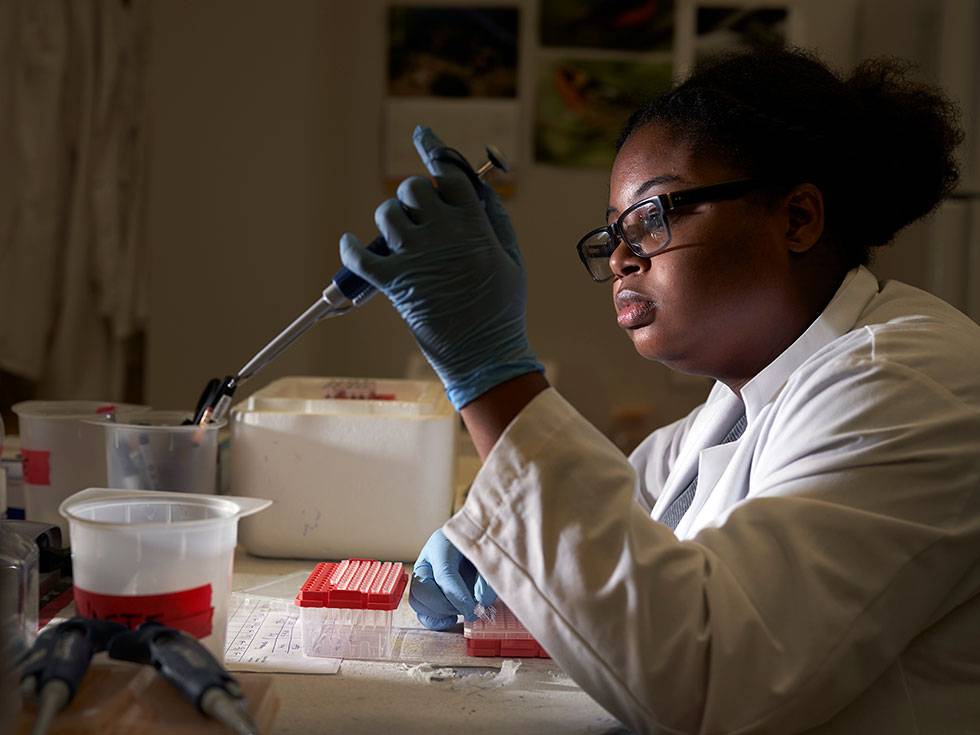
Tiffany Benway '08 and Bernard Possidente
Project: "Biological Clock Function in a Drosophila Model of Alzheimer's Disease"
This research is a collaboration with Dr. Damian Crowther, Cambridge University, UK Department of Genetics,
who made transgenic fly lines with copies of mutant human genes associated with Alzheimer's.
(Photo by Mark McCarty)

Recent Publications: (*Indicates student co-author):

Possidente, B. (2013) Rhythms and Sleep: Circadian and Seasonal Activity Patterns. In: Crusio WE, Sluyter F, Gerlai RT and S. Pietropaolo (eds.) Volume 1, Genetics of Behavioral Phenotypes Series: Cambridge Handbooks in Behavioral Genetics. Cambridge University Press, Cambridge, UK, in press.

Ahmad ST, Steinmetz SB, Bussey HM, Possidente B, Seggio JA. (2013) Larval Ethanol Exposure Alters Free-running Circadian Rhythm and per Locus Transcription in Adult D. melanogaster period Mutants.  Behav Brain Res. 241:50-55

HVB Hirsch, G Lnenicka, D Possidente, B Possidente, MD Garfinkel, L Xiangyi and DM Ruden. (2012) Drosophila melanogaster as a model for lead neurotoxicology and toxicogenomics research Toxicogenomics. Frontiers in Genetics, 3(May):article 68

Seggio J, Possidente B and Ahmad T.  Larval Ethanol Exposure Alters Adult Circadian Free-Running Locomotor Activity Rhythm in Drosophila melanogaster.  Chronobiology International.. 2012 Feb 29(1):75-81

Falsom Prison Clone (2012) Unpublished and not peer reviewed. "...I hear that clone coming.."

Hagenauer MH, King AF, Possidente B, McGinnis MY, Lumia AR,Lee TM. (2010) Changes in Circadian Rhythms During Puberty in Rattus Norvegicus: Developmental time course and gonadal dependency. Hormones and Behavior, 60(1):46-57.

Ruden DM, Chem L, Rasouli P, Wang L, Lu X, Garfinkel MD,Possidente D, Possidente B, Hirsch HVB, Page GP (2009) Genetical toxicogenomics in Drosophila identifies master modulatory loci that are regualted by developmental exposure to lead. NeuroToxicology, 30:898-914.

Hirsch HVB, Possidente D, Averill S, Despain J, Buytkins J, Thomas V, Goebel P, Shipp-Hilts A, Hollocher K, Wilson D, Possidente B and D Rudin (2009) Behavioral QTL after Developmental Exposure of Drosophila melanogaster to Lead. NeuroToxicology 30:305-311

Possidente, B. (2007) Genetics and The Sopranos. Letters, Science 317:596.

Possidente, B. (2007) Genetic Dialogs in The Sopranos in Six Parts. Science Creative Quarterly; http://www.scq.ubc.ca/ Issue 3, Commentary. September 7th-April8th.


.


Return to Faculty and Staff List

Return to Biology Department Home Page