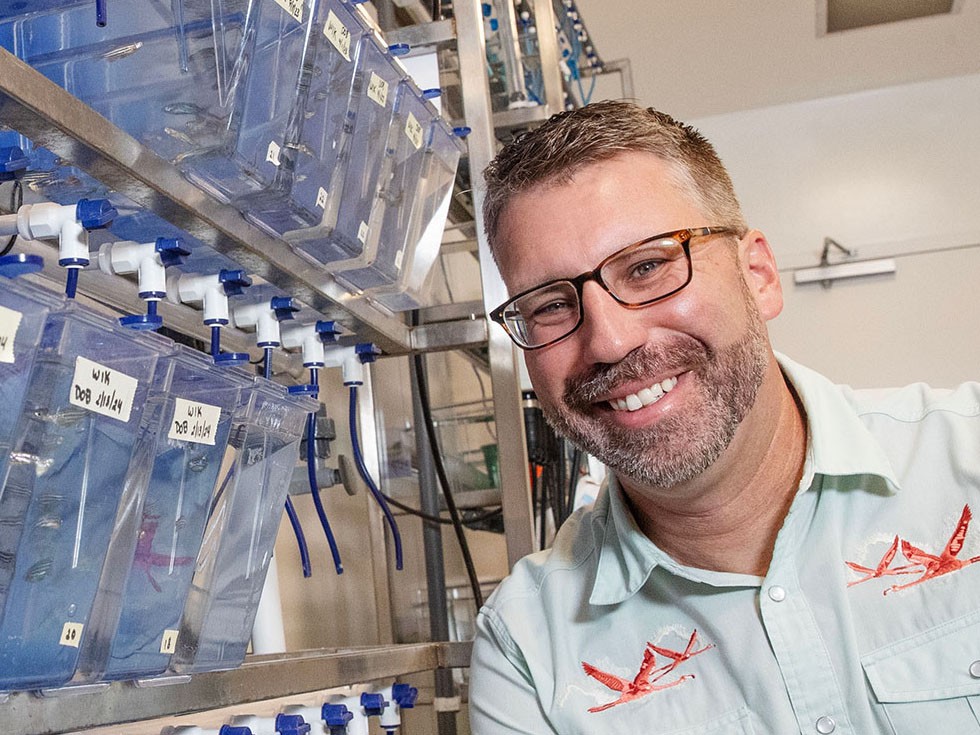
Josh Ness

Assistant Professor
@ Skidmore since 2005


Address:
Dana Science Center Room 319
Biology Department
Skidmore College
Saratoga Springs, NY 12866

Telephone: (518) 580-5080

Fax: (518) 580-5071

E-mail: jnessATskidmoreDOTedu


Education:
B.S., Biology, Duke University (1995)
Ph.D., Ecology, University of Georgia (2001)
Postdoctoral Associate, University of Georgia (2001-2002)
Postdoctoral Associate, University of Arizona (2002-2005)
Courses Taught:
Plant-Animal Interactions
Biological Invasions
Conservation & Use of Forested Landscapes
Diversity of Life
Research Interests:
    For many organisms, the most basic activities (e.g., reproduction, dispersal, resource acquisition, defense) are profoundly influenced by the assistance they receive from other species. I am interested in better understanding how the costs and benefits of these types of interactions change as a result of 1) encounters with differing partners, and 2) as the surrounding environments experience anthropogenic change (e.g., introduction of exotic species, habitat fragmentation, edge effects).
    This perspective points toward a wealth of research topics, including tritrophic interactions (three-way interactions between plants, herbivores, and carnivores), gradients between mutualistic and parasitic interactions, the influence of third-party mediators on 'pairwise' interactions, induced responses to mutualists, parasites, or predators, the distribution of mutualisms across habitats, and a more synthetic view of the forces that can regulate populations.
    I've been fortunate enough to address these topics with a variety of organisms, including cacti, invasive ants, field mice, and parasitic tapeworms that change the behavior of their fish hosts. My current research focuses on contrasting the ant bodyguards of cacti in the Sonoran Desert (with WF Morris and JL Bronstein of Duke University and the University of Arizona, respectively) and searching for "keystone species" that interact with spring wildflowers across the deciduous forests of the eastern US. I am also collaborating with students to build a 'wikipedia' focusing on the flora, fauna, and biotic interactions within the North Woods. Visit the North Woods wiki site.
 

Leaves of the Catalpa bignonioides
secrete sugar from extrafloral nectaries
(bottom left) after they are attacked by
Ceratomia catalpae caterpillars. These
nectaries attract ants and parasitic
wasps (cocoons shown) that attack
the caterpillars.

Specialized bees visit the
flowers of the Arizona barrel
cactus, Ferocactus wislizeni.
Although these pollinators benefit
the plant, they can be deterred by
overly-aggressive ants defending
the plant against herbivores.

Many ants collect seeds in order to eat the
attached elaiosome (the dark, lipid-rich
'handle' held in the jaws of this ant). Because
ants differ in where they take these seeds, and
in whether they eat these seeds or leave them undamaged, changes in ant community
composition influence seed dispersal dynamics.


Recent Publications: (* indicates an undergraduate)

Ness, J.H. and D.F. Morin* (2008) Forest edges and landscape history shape interactions between plants, seed-dispersing ants, and seed predators. Biological Conservation, 141: 838-847.

Ness, J.H., W.F. Morris & J.L. Bronstein (2006) Variation in mutualistic potential among ant species tending extrafloral nectaries of Ferocactus wislizeni. Ecology, 87: 912-921.

Ness, J.H. (2006) A mutualism's indirect costs: The most aggressive plant bodyguards also deter pollinators. Oikos, 113: 506-514.

Holland, J.N., J.H Ness, A. Boyle, & J.L. Bronstein (2005) Mutualisms as consumer-resource interactions. Pp 17-33 in (P. Barbosa and I. Castellanos, eds.) The Ecology of Predator-Prey Interactions. Oxford University Press, New York.

W.F. Morris, W.G. Wilson, J.L. Bronstein, & J.H. Ness. (2005) Environmental forcing and the temporal dynamics of a competitive guild of cactus-tending ants. Ecology 86: 3190-3199.

Ness, J.H. & K. Bressmer* (2005) Abiotic influences on the behavior of rodents, ants, and plants affect an ant-seed mutualism. Ecoscience 12:76-81.

Ness, J.H., J.L. Bronstein, A.N. Anderson, & J.N. Holland (2004) Ant body size predicts dispresal distance of ant-adapted seeds: implications of small-ant invasions. Ecology 85:1244-1250.

Ness, J.H. (2004) Forest edges and fire ants alter the seed shadow of an ant-dispersed plant. Oecologia 138:228-454.

Ness, J.H. & J.L. Bronstein (2004) The effects of invasive ants on prospective ant mutualists. Biological Invasions 6:445-461.

Holland, J.N., R. Wyatt, J.L. Bronstein, & J.H. Ness (2004) Relating the biology of flower-to-fruit survivorship to the ecology and evolution of fruit-to-flower ratios. Recent Research Developments in Plant Science 1:75-84.

Ness, J.H. (2003) Catalpa bignonioides alters extrafloral nectar production after herbivory and attracts ant bodyguards. Oecologia 134:210-218.

Ness, J.H. (2003) Contrasting exotic Solenopsis invicta and native Forelius pruinosus ants as mutualists with Catalpa bignonioides, a native plant. Ecological Entomology 28:247-251.

Ness, J.H. & S.A. Foster. (1999) Parasite mediated phenotype modifications in the threespine stickleback. Oikos 85:127-134.

Windsor, D., J. Ness, L.D. Gomez, & P.H. Jolivet. (1999) Species of Aulacoscelis Duponchel and Chevrolat (Chrysomelidae) and Nomotus Gorham (Languriidae) feed on fronds of Central American cycads. The Coleopterist Bulletin 53:217-231.


Back to the Faculty and Staff page

Back to the Biology Homepage