Skidmore College Search |  Calendar |  A-Z Index
Sun Apr 7 7:09 PM EDT
  Home  |   Prospective Students  |   Current Students  |   Faculty & Staff  |   Parents & Friends |  Alumni
Mission Statement

Faculty Coordinators


CONTACT INFO


Karen Kellogg
kkellogg@skidmore.edu
518-580-5198


STANDARD MAIL

Skidmore College
815 North Broadway
Saratoga Springs
New York, 12866


SKIDMORE PHONE

518-580-5000


septic system failure

Septic System Survey of Residents of Loughberry Lake
Elizabeth Amira Kennedy Streeter ’09

Unlike government run sewage treatment plants, septic system care and maintenance are the responsibility of individual homeowners.  Proper maintenance is essential to maintaining proper functioning and preventing water pollution.  To better understand behavior and septic maintenance practices, I conducted a survey of the residents who lived closest to the lake and also own septic systems.
wastewater

Rethinking Wastewater Treatment: An Examination of the Saratoga Wastewater Treatment Facility
Kathleen McConkey ’09 and Molly Nowak ’09

Most people rarely think about where their water goes after they use it.  We've taken a closer look at this important aspect of everyday life and environmental protection by examining the Saratoga wastewater treatment facility and putting it in context with other operations in New York State.
crayfish

Concentration and Distribution of Copper in Crayfish in Loughberry Lake
Benjamin Alley ’10

Copper sulfate is added to Loughberry Lake to control algae.  I examined the geographic distribution of crayfish copper concentrations in Loughberry Lake and looked for evidence of accumulation within the crayfish.  Crayfish from three locations on the lake were analyzed for copper to examine geographic distribution, and five crayfish of various sizes were examined from one location to examine accumulation.
hydrology

Changes to Saratoga Lake’s Hydrology after 20 Years of Development and Growth
Matthew Shrensel ’09

I used satellite imagery to examine shifts in land use in Saratoga Lake Watershed over the past 20 years.  I modeled hydrology for the watershed based on the land use from the imagery.  Despite large changes in population, land use change is low, and associated hydrological shifts are minimal.
leaf litter

Breaking it down:  The Influence of Relative Nitrogen and Phosphorus Availability on Leaf Litter Decomposition and Macroinvertebrate Communities in Two Small Streams within the Saratoga Lake Watershed
Alicea Cock-Esteb ’09 and Hannah Harris ’09

When leaves fall into streams, they are incorporated into the food web through consumption by microorganisms and macroinvertebrates. Our study examined how the relative availability of nitrogen and phosphorous influenced the rates of leaf litter decomposition via macroinvertebrate communities and microbial respiration in two small, wooded streams in the Saratoga Lake Watershed. We found that a higher relative availability of nitrogen and phosphorous corresponds to higher decomposition rates although the macroinvertebrate community seems to be more influenced by other factors.

education

Designing and Institutionalizing a Place-Based Watershed Curriculum in Ballston Spa
Hannah Phillips ’10 and Sarah Whateley ’09

We designed place-based lesson plans to complement the in-class ecosystem unit for a fifth grade classroom in Ballston Spa, New York and to increase students’ awareness of place. Our interviews with local teachers and administrators identified challenges to implementing such programs.  We also assessed the students’ prior environmental knowledge.

knotweed

Weather or Knot:  The Impact of Natural and Anthropogenic Disturbances on Japanese Knotweed
Daniel von Allmen ‘09, Peter Leipzig-Scott ‘09, and Erin Kenison ’09

Japanese knotweed is an aggressive invader of riparian habitats.  Our study investigates how natural and anthropogenic disturbances, including flooding, human land use and natural stream channel migration, affect the distribution of knotweed.  These disturbances had differing effects on knotweed presence. A large percentage of plants were damaged over winter months, which may contribute to plant fragmentation and subsequent dispersal.
lake survey

Saratoga Lake Landowner Survey:  Assessing Behaviors, Perceptions and Opinions
Andrew Clinard ’09, Jennifer Hubert ’09, and Bradford Nesbitt ’09

Our survey of Saratoga Lake residents revealed that most respondents think water quality is acceptable and affects property values, but is threatened by invasive species. While opinions varied on who should maintain the lake, most opposed land use regulations. Future studies and public outreach should focus on these subjects.
local planning

The Capacity for Smart Growth in the Saratoga Lake Watershed:  A Study of the Local Planning Process
Rose Anderson-Gips ’09 and Amanda Peterson ’09

Are municipalities in rapidly growing Saratoga County managing development to minimize environmental impact?  We reviewed comprehensive plans and surveyed and interviewed planning board members in twelve municipalities within the watershed and found a strong commitment to most smart growth goals, though a limited interest in regional planning.
implementation

The Uneven Implementation of the Saratoga Lake Watershed Management Plan:  Priorities and Perceptions of Municipalities within the Watershed
Ryan Bailey ’09 and Lyndsay Strange ’09

In 2002, a group of stakeholders created a Saratoga Lake Watershed Management Plan to protect and improve the watershed's resources. Despite this, implementation of the plan's recommendations has been very uneven throughout the watershed's municipalities. Through interviews with local town officials, we identify and explain the factors that affect the implementation of these programs.

rain garden

Current Stormwater Management in Saratoga Springs and the Challenges of Implementing Low Impact Alternatives
Allison Ruschp ’09, Caitlin Frame ’10, and Dani Rueter ’09  

We explored the feasibility of incorporating low impact design into Saratoga Springs stormwater management program.  We interviewed developers, public works officials, planning board staff, city engineers, and state stormwater engineers to discover the challenges facing the implementation of low impact stormwater management. Saratoga Springs is close to meeting current federal standards but has no funding mechanisms for stormwater management; low impact design is being encouraged for new developments.
beavers

The Influence of Beavers on Sediment Storage and Stream Turbidity in the Saratoga Lake Watershed
Stephanie Abrams ’09, Lindsay Bourgoine ’09, and Alexandra Furman ’09

This study examines the repopulation of beavers within the Saratoga Lake Watershed through pond density and how their ecosystem engineering has geomorphically impacted water bodies. The three beaver ponds investigated stored large quantities of sediment and the amount of suspended particles decreased downstream of the ponds. Therefore, increases in pond density result in changes in the way sediment is stored in the watershed.

waterways

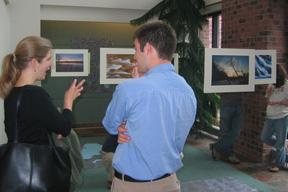
Waterways:  A Photographic Exploration of Human Presence in the Saratoga Lake Watershed
Andrew Plotsky ’09

Waterways is a photo essay of people in the Saratoga Lake Watershed. Using the style of environmental portraiture, Waterways features fourteen human subjects from various backgrounds to represent a cross section of the diversity of the watershed. The project illuminates the complex and nested relationships that exist within a watershed.

Summer Collaborative Research (2009)

Managing Drought in a Water-Rich Region
Ellen Agnew '11, Kelly McDonnell '12, and Kim Marsella, Environmental Studies Program Coordinator and Lecturer

Saratoga Springs, NY, though water-rich, has had a long-standing politicized debate over the future of its water supply. We analyzed the historical drought of record in the mid-1960s, the city’s response to this drought, and how it has affected water planning using archival data and interviews with local government officials and residents. Significant results of the 1960s drought include a severe drawdown of the reservoir and the implementation of Bog Meadow as a supplemental water source. While numerous studies have advocated for an alternative source and long-term water management policy, neither has been implemented to date.  A combination of factors ranging from additional supplementation, the passage of time since a severe shortage and local political dynamics seem to hinder the adoption of proactive drought policy.

A Statistical Analysis Comparing Water Chemistry Parameters in the Kayaderosseras Creek Watershed with Land Use Patterns
Daniel de la Puente Ranea, Visiting Graduate Student; Catherine Berheide, Professor of Sociology; and Judith Halstead, Professor of Chemistry

The relationships between land use patterns, geology and major solute concentrations in stream water were investigated for the Kayaderosseras Creek watershed (484 km2) in Saratoga County, NY.   A statistical analysis of water parameters indicated that the eight sites can be divided into three distinct groups. One group consisted of tributaries that are farther upstream near the headwaters of the watershed and which had the lowest values for all parameters. A second group of streams had intermediate values and the third group of tributaries, further downstream and adjacent to highways and development, showed higher solute concentrations.  Subwatersheds corresponding to each sampling site were delineated and land use patterns were determined for each of the eight subwatersheds using GIS.   The chemistry of the tributaries within the study area was explained by the percentage of urban development present in the tributary subwatershed, whose influence on stream quality is postulated to occur in three different ways: a natural spring water contribution, a road salt contribution, and an urban runoff contribution. The urban run off contribution may be due to municipal sewage pipe leaks, septic system leaks, lawn fertilizers and other anthropogenic sources.


Capturing and Preserving Historical Aerial Photography: Creating a GIS Database of Local Watershed Imagery
Joe Eisenberg '09 and Alex Chaucer, GIS Instructional Technologist

Aerial photography captures an important historic record of the surface of the earth at a specific date.  This snapshot in time can yield valuable information about both physical and human geographic activity, which in turn can help to inform research in environmental studies, biology, history, sociology, economics, anthropology, and other disciplines.  This project took a collection of over one thousand historic aerial photos from Saratoga County Soil and Water, taken between 1942 and 1986, and developed a digital system of access for local watershed research projects.


Impacts of Turbidity on Fish Foraging Efficiencies
Peter Liepzig-Scott '09 and Karen Kellogg, Associate Professor of Environmental Studies

Many human activities (e.g., agriculture, dredging, deforestation, construction, etc.) increase the suspended matter in surface waters (turbidity) and reduce water clarity.  Despite the fact that increasing turbidity is one of the most pressing issues for fresh- and saltwater fish communities worldwide, the study of the impacts of turbidity has been largely oversimplified to include only mortality levels.  In this study, we examined the foraging efficiencies of two visually orienting fish species, Etheostoma olmstedi (tessellated darter) and Lepomis macrochirus (bluegill sunfish), under varying turbidity regimes. Bluegills inhabit the water column in surface waters, and we found that these fish forage less efficiently at very low and very high turbidity levels.  Tessellated darters are benthic dwellers, and we found that their foraging efficiency is consistent across turbidity levels.


Landscape Migration Dictates Species Migration
Claire Superak '11 and Josh Ness, Assistant Professor of Biology and Environmental Studies

In terrestrial systems, landscape history influences susceptibility to invasion by nonnative species. We tested the hypothesis that riparian invasions of Japanese knotweed (Fallopia japonica) are disproportionately common and severe in portions of the Upper Hudson watershed where channel migration has occurred in last half century. We used USGS topographic maps to identify areas where new riparian habitat has been created in the Kayaderosseras and Battenkill river systems.  Knotweed has colonized all disturbed sites, and the proportion of the newly created habitat that was invaded increased with the extent of the channel migration. Invasions in undisturbed sites were more rare.  The histories of channel migration can indicate availability of susceptible habitat for invasion by Japanese knotweed and potentially other invasive species.


Independent Studies (2008-2009)


Creative Thought Matters.
Skidmore College · 815 North Broadway · Saratoga Springs, NY · 12866

Skidmore College Main Links
©2009 Skidmore College · Contact Information
Home | About Skidmore | Prospective Students | Current Students | Faculty & Staff
Parents & Friends | Alumni