 Features
Observations
Campus Scene
Connections
Who, What, When
Class Notes
Saratoga Sidebar
Picture This |
features
Handle with Care Dialogue and debate and cuator's canvas
Summer Jobs Faculty sweat the details even off duty
Handle with Care:
Dialogue and debate are curator’s canvas
by Mae G. Banner
winter06.jpg)
The patience of a diplomat, the vision of
an impresario, the persistence of a lobbyist—it takes
that and more to fill the job of curator at Skidmore’s Tang Teaching Museum and Art Gallery.
Ian Berry, the Susan Rabinowitz Malloy ’45 Curator of the Tang, practices these skills every day.
A specialist in contemporary art, with degrees from Bard College and SUNY-Albany and prior
experience as a curator at the Williams College Museum of Art, Berry has been with the Tang
since it opened in 2000. He knew from the outset that it was a museum of a different color.
“Most college museums act like art museums,” he says, sitting at his desk in a third-floor office
with scarcely a right angle to be seen. “They make great shows. But we are focused on teaching
and ideas. A lot of our choices are governed by dialogue, not solely by connoisseurship.”
When he says “dialogue,” Berry’s referring to the constant interplay among academic disciplines
that he stirs up as a free-range curator. For example,
a 2001 exhibition about mapping included
centuries-old atlases, street maps from the US Census, charts of the human genome, and many
other examples of ways to order spatial information. That show also crossed over from social and
natural science into art, with works including a quirky cut-paper tangle of New York City’s subway
lines by Nina Katchadourian—whose deliberately crisscrossed X rays of everyday life are on view
in a solo retrospective at the Tang through December.
Dialogue also refers to the conversations between curator and artist that can start years before a
show goes up and continue through the installation and beyond. “A show like Nina’s could take
two years to organize,” notes Berry.He recalls how many times he visited the artist’s Brooklyn studio,
her galleries in New York and San Francisco, the homes of private collectors who own her work, and
museums where it’s been shown. “I need to convince lenders to let us borrow particular works. Important
parts of my job are lobbying and fundraising,” he says.
After the research, Berry and Katchadourian constructed a checklist of what would go into the exhibition.
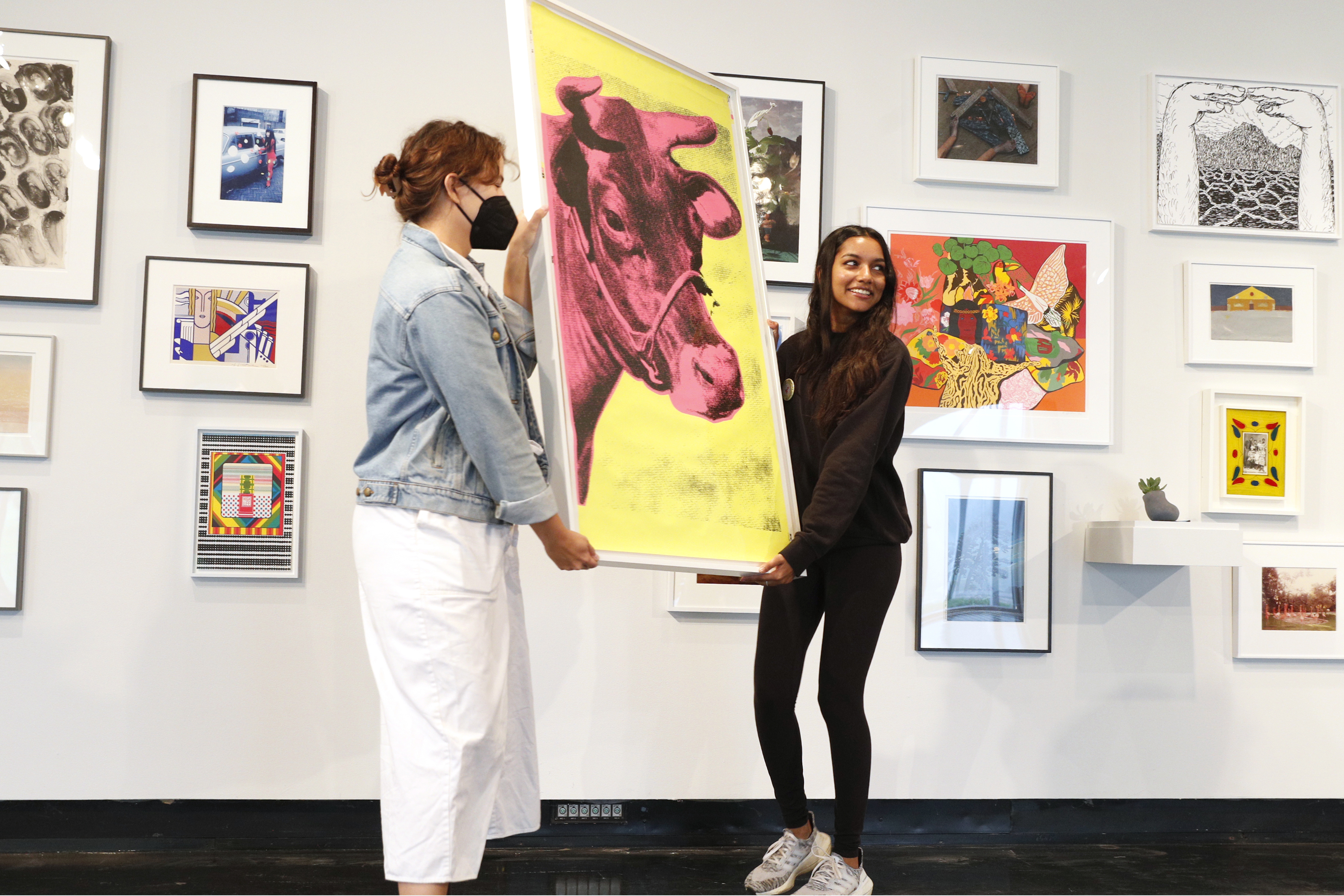
Then came the careful unpacking of shipped-in photographs, sculptures, and unclassifiable objects such as Katchadourian’s “Talking Popcorn” machine, and the creation of
a scale model of the gallery in which
miniature replicas of the artworks were placed and repositioned. The museum has tracks in the ceiling
for moveable walls to expand or contract the viewing areas. Will they need to move an interior wall?
Will some pieces need special support? How much text should accompany each piece, and where should
text panels be placed?
As they convene again to oversee the actual installation, Katchadourian says, “Ian and I are on
the same page. We have a style of working where we’re in contact throughout. Even today we
pulled out a few things; we prefer working on the spot.” Another issue for Berry is “how much you
overtly teach. In Nina’s show, we’re choosing not to include much editorial interpretation. When
you
walk in, we want you to feel you can make up your own mind what the work is about, to feel
empowered as a viewer.”
While artist and curator continue the editing, an installation crew preps the walls and floors.
They wheel in
carts piled with rolls of duct tape, a carpenter’s level, drills, nails, Velcro, latex
gloves, bubble wrap, Windex,
track lights, electric cord… Berry notes that the crew—two on the
Tang staff plus five freelancers hired for this
show—are all artists, most with MFA degrees.“We want them because they are sympathetic to what artists do,”
he says. “They’re
incredibly
generous,” Katchadourian observes. “For example, for one installation the crew
cut more than
250 Plexiglas mounts for my stitched travel postcards, to protect them and make them stand out
from the wall.”
At this point Berry is primarily an editor making aesthetic decisions. But his curatorial duties go
further. “I’m
also
serving as a liaison for the artist, to get her what she needs. I’m checking
hotel
rooms, tracking attendance
at the exhibition once
it opens, helping VIPs, organizing tours, and
communicating with the rest of the
team
at the museum. Also, I’m working
with faculty and students
who will
use this exhibition in their studies.” Yet
another
kind of dialogue he helps to facilitate are
the Dunkerley
Dialogues,
funded by an alumna, that bring
artists
to the
Tang for public
lectures
and discussions.
Every show is planned to connect with academic life. “Nina’s show is great for history, for exploring
questions like, ‘Who writes what? How do we compile information?’” Berry says. “It’s also about language,
identity, politics”—especially in the video Accent Elimination, in
which she interviews her parents.
Her mom speaks with a Finnish-inflected Swedish accent
and her
dad with an Armenian accent by
way of Turkey. The six-screen video installation documents
their family’s visits to a language and dialect
coach in Manhattan. It’s a mind-blowing and sometimes hilarious exercise that, through Katchadourian’s
shaking up of familiar verities,
insists we each become newly aware of our own and others’ personas.
(It’s no small coup that
her Tang exhibition was recently nominated for best monographic museum
show nationally by
the Association of International Art Critics/USA.)
Two fat Rolodex files on Berry’s desk bulge with names
and numbers of artists, collectors,
potential funders,
and collaborators. Two oversize file drawers are stuffed
with folders that, Berry says, “document my visits
with artists, owners, and other people—notes on what
they’re thinking about, what
they have to lend, what
we discussed.” Taped to his office wall are oversize
calendar pages, month by month
through 2011. Color-
coded
grids mark each semester; the museum’s
three
galleries are listed on one axis,
the weeks on the other,
with
exhibitions, lectures, and performances colored in,
plus a gray line of campus
and town events running along
the bottom
of the page. Berry explains, “We consider
hundreds of things
when we plan a show. We try to
think
of our potential audiences. In August, for example,
tourists come to
Saratoga Springs, so an idea
show like
Nina’s is perfect. Her use of everyday objects and events
as inspiration
is something we can all access.”
But if racetrack tourists don’t find their way to the Tang, Berry doesn’t fret. “That’s the benefit of
a college museum. We’re supported by the college and through grants and other funding, so we
can stick close to our mission rather than alter our programming to increase attendance.” Students
can conduct independent studies or internships, and have even curated shows. In 2003 the Tang offered
a small show on the death penalty, Artists’ Reflections on Crime and Punishment, that
was proposed by
students and professors Beau Breslin and David Karp, to complement a conf-erence they were organizing. “We want to be nimble like that, to accommodate those projects,” Berry says.
Berry is pretty nimble himself, traveling around the country and into every corner of the Skidmore campus
on the lookout for collaborative opportunities. “Part of my job is to be aware of what
people are interested in. ” He’s collaborated with faculty curators from art historian Penny Jolly (Hair: Untangling a Social History)
to physicist Mary Crone Odekon and fiber artist Margo Mensing (A Very Liquid Heaven). “I try to talk to a lot
of people, have lunch, have coffee, go to lectures. I try to be known, and to welcome people in.” It’s not merely
his job, he adds: “It’s being
a good community citizen.”
After all the traveling, circulating, training of gallery monitors, planning and mounting of
shows, writing of
essays for exhibition catalogs, fundraising, brokering of interdisciplinary collaborations,
overseeing and
expansion of the permanent collection, it comes down to this,
Berry says: “The Tang is a
place of crossroads—
different expertise, different ways of speaking
every day.” For him, “Mine is the most
fun job on campus.”
View the Tang's past, current and future exhibitions.
|