Summer 2003
- - - - - - - - - -
Contents
Features
Letters
Observations
Centennial spotlight
On campus
Faculty focus
Arts on view
Sports
Books
Advancement
Class notes |
|
|
|
Talking art and artistry
California artist Arline Fisch 52 makes large-scale metal body ornaments and jewelry that win international acclaim for the combination of metal and textile techniques. One critic described her work as bold, daring, overscale, colorful, elegant, subtle, architectural, sensuous, humorous. Her work is at Skidmores Tang Museum through September 28 (with a lecture by her on September 23).
In 2001 fellow metal artist Sharon Church 70 interviewed Fisch for the Smithsonian Archives of American Art. Church, who teaches at the University of the Arts in Philadelphia, has known Fisch since 1976. Here are a few excerpts of their conversation:
 |
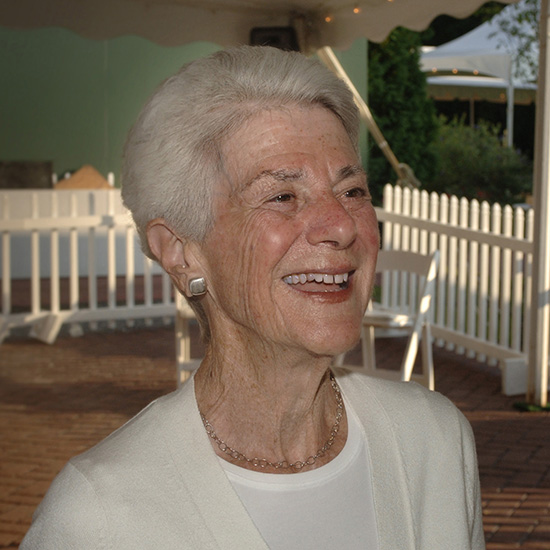
| Metal artist Arline Fisch 52 |
SC: I would like to hear about some of the work and influences that have been active in your art.
AF: I read books, go to museums, and travel to see things. And the things I look at suggest
more things that could adorn the body. [While in Denmark on a Fulbright grant] I discovered this wonderful collection of Mongolian jewelry, which was full-body adornment. Because the Mongols, at the time this material was collected, were nomadic, the women wore all the wealth of the family, and so they had hats with great hanging elements, great pectorals, and things that hung all the way down the back. Another of the Fulbright people that year was a marine biologist, studying jellyfish, hydra medusae. I looked at books of hydra medusae and made several hanging forms in silver because I felt so inspired by their form and the way they move.
SC: One of the stories Id like to capture on these tapes is how you developed the fiber textile techniques in metal.
AF: [At a museum in Peru] I saw this little tiny fragment of woven gold. And I thought, Oh, now, thats interesting. I didnt immediately do anything with it, but it certainly was in my head. In 1970, I was living in a little bedsitter in London, which was not a terribly comfortable, relaxing place. I thought, If I just had something to do
Why dont I try this? And thats where I made my first woven metal piece, because I could make the components at the workshop, and then I could work on it in my room. I also did a spool-knitted piece for the same reason. I had some 30-gauge 18-karat gold and I sat and did this little spool-knitted thing for hours on end in my little bedsitter.
SC: I sense the play thats in there for you as an artist, having fun with your work and responding to materials.
AF: You know, there was a period when I used feathersearly 70s, I think. A friend of mine
sent five beautifully matched parrot feathers. I made a feather brooch. I was really taken with the vibrancy of the color, the softness of the feathers, the sensuousness of the feathers, and I just wanted to use them.
SC: With regard to technique, how much is necessary and how much is too much? When do you know when to stop working on a piece?
AF: I dont consider myself a very good technician. Im not very patient. I want it to work, I want it to look good. If its not perfect, thats OK with me. If I stall on a piece, I simply put it aside. I dont sit here forever trying to figure out how to work it. And I abandon pieces. Sometimes pieces get thrown aside; maybe a year later, Im moving it from one place to another and I think, All right, why didnt I finish that? I could do that now.
Excerpted and reprinted with permission from the Smithsonian Archives of American Art. The original interview is part of the Nanette L. Laitman Documentation Project for Craft and Decorative Arts in America.
|
|