|
Winter 2000
- - - - - - - - - -
Contents
On
Campus
Sports
Books
People
Alumni
Affairs
and
Development
Class
Notes
|
|
|
|
From Broadview Lodge to
Skidmore's Surrey

Biannual house tours sponsored by the Saratoga Springs
Preservation Foundation are always a community favorite, but when the
tour includes the citys North Broadway mansions, its invariably
a crowd-pleasing sellout. On the most recent tour of North Broadway, the eye-catching
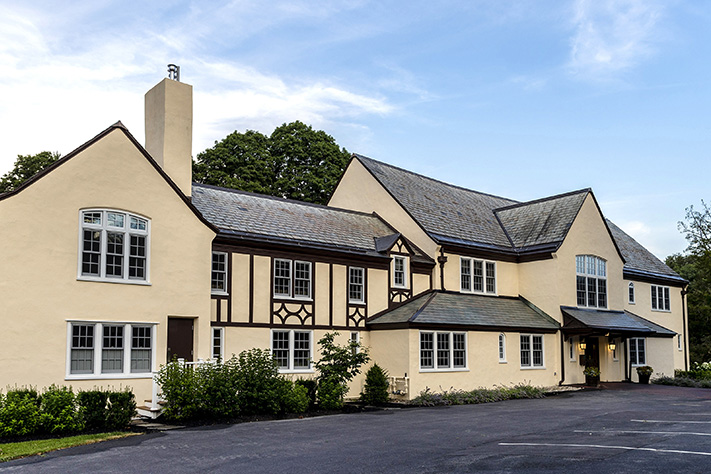
yellow stucco and slate-roofed building across from Skidmores main campus
was the last stop.
First called Broadview
Lodge, this English Tudor style house was later known as the Surrey Inn,
and for three years in the 1940s it was the Brown School for Boys. Broadview was
built in 1918 for E. Clarence Jones by the firm of William J. Case and Son. The
younger Case, who was the father of Esther Case Williams 24, died while
Broadview was being built. Jones, it is said, had shown the architects a photograph
of an old manor house in Englands Cotswolds district, instructed them to
replicate the house, and then departed for a trip abroad. Upon his return, he
stood some distance away to view the completed house and noted with dismay that
the roofline sloped toward the middle. The builders assured him that they had
gone to some trouble to replicate the roofline as pictured in the photo.
The property looked across
North Broadway to Henry Hiltons former Woodlawn Park (now the Jonsson Campus),
an abandoned estate that once consisted of handsome Queen Annestyle houses,
greenhouses, stables, 30 miles of carriage roads, and sheep to keep the vast lawns
under control. Jones apparently liked the romantic notion of being an English
country squire, and he spared no expense when designing his Saratoga estate, although
with only 10 acres he kept it to a smaller scale. The plans included a private
home, superintendents cottage, farm building, and garage. The former garage
and chauffeurs apartment are today the Colleges Eissner Admissions
Center. The superintendents quarters, aptly called Overlook Cottage, today
houses Skidmore development-staff offices and is renamed Colton House.
The main building was
designed as a private home for Jones, a New York City stockbroker, and his wife,
the English actress Marjorie Blossom. It had 21 rooms (12 of which were full baths),
a glassed-in breakfast porch, and a wide double staircase off the entranceway.
The service section on the ground level contained a kitchen, butlers pantry,
refrigerator room, servants dining room, flower room, and the butlers
bedroom and bath. The grounds were beautiful, half in woodland and half lavishly
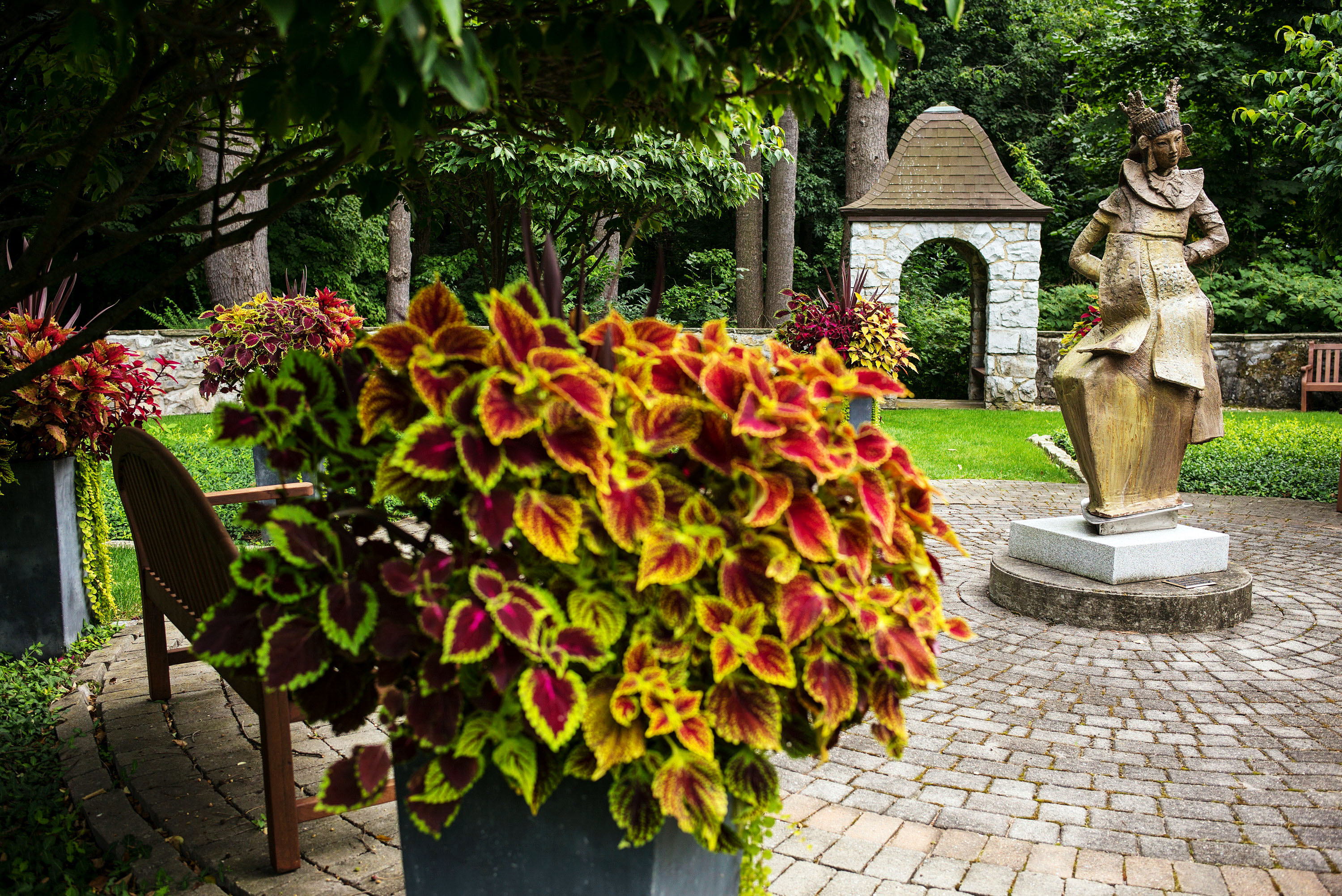
landscaped with stone walls, statuary, flower beds, a sunken formal garden, and
a goldfish pool. Summer houses provided shady resting places on warm days, and
a vine- covered pergola led to the tennis court.
Jones died in 1926, but
his widow did not sell the property immediately; she evidently enjoyed the whirl
of horse racing and social events every August in Saratoga. It was through her
summer connections that she found either a tenant or a buyer in a Mrs. Amscott
Wilson. A wealthy horse owner, Wilson used the estate as a summer home until it
was bought in 1945 by former State Senator Thomas Brown of Schenectady for his
daughter, Elinor, and her husband, Roy Wright.
The next year Wright, who
had been the principal at the North School in Herkimer, and Larry Pike, a teacher
at Albany Military Academy, opened the Brown School for Boys on the estates
grounds. They completely renovated Broadview Lodge and converted the garage for
recreational and dormitory usethe boys later dubbed it "the catacombs."
The school was designed to prepare boarding and day students in grades 10, 11,
and 12 for college, but over half the students were in their early 20s, World
War II veterans who needed a year of college prep before entering four-year colleges
on the GI Bill. (In 1946, Skidmores GIs, those veterans attending the Glens
Falls Extension, challenged the Brown School to what has gone down in Skidmore
annals as its one and only football game. In the winter of 1947, Skidmore "girls"
and Brown "boys" competed in a skiing meet at Alpine Meadows.) Brown
graduates were accepted at fine colleges including Yale, Georgetown, and St. Johns
in Annapolis; however, in 1946-47 Brown enrolled just 28 students, and in 47-48
only 22. The school held a total of three summer sessions and graduated two classes
before closing in September 1948.
In the summer of 1949
the Wrights opened the Surrey Inn in the former school and operated it as a 20-room
hotel. Roy Wrights daughter (coincidentally in the hotel business) recalls
that her father and stepmother "lost their shirts, as so many people do,
offering three meals a day. There was insufficient volume to carry a chef (so-called),
so they sensibly changed to a bed and breakfast operation." Later, when the
house and annex were offered for sale, a four-page illustrated brochure suggested
the property was suitable for "a fine restaurant, an old peoples home,
a quiet religious institution, or a hospital." It was offered, furnished,
at $65,500.
Robert Ducas bought the
property in 1964 and established the Surrey Inn Corporation. In January 1967,
under the leadership of President Joseph Palamountain, Skidmore College acquired
the main house and the former garage through a "gift-purchase" arrangement.
The College at that time was in the early stages of moving from its downtown campus
to the current site opposite the Surrey. The 50-year-old inn and its annex-garage
were ready-made quarters, but the Colleges plans, as reported in the Alumni
Quarterly, were "to continue the Surrey Inn as a commercial hostelry
for the present time." By the early 70s, the Colleges admissions
operation was moved from the old-campus library building on Union Avenue into
the annex-garage, called the Surrey Cottage. In 1981, an additionsans slate
roofmade the building more comfortable for the growing admissions staff.
Meanwhile, Anne Palamountain, the presidents wife whose portrait hangs in
the inns living room, obtained donations of furniture, carpeting, and draperies
for the main building; other antiques and furnishings came from the houses of
former presidents and of College founder Lucy Skidmore Scribner. Once refurbished
for College use, the Surrey living room became a popular venue for receptions,
faculty-staff events, board meetings, and academic symposia.
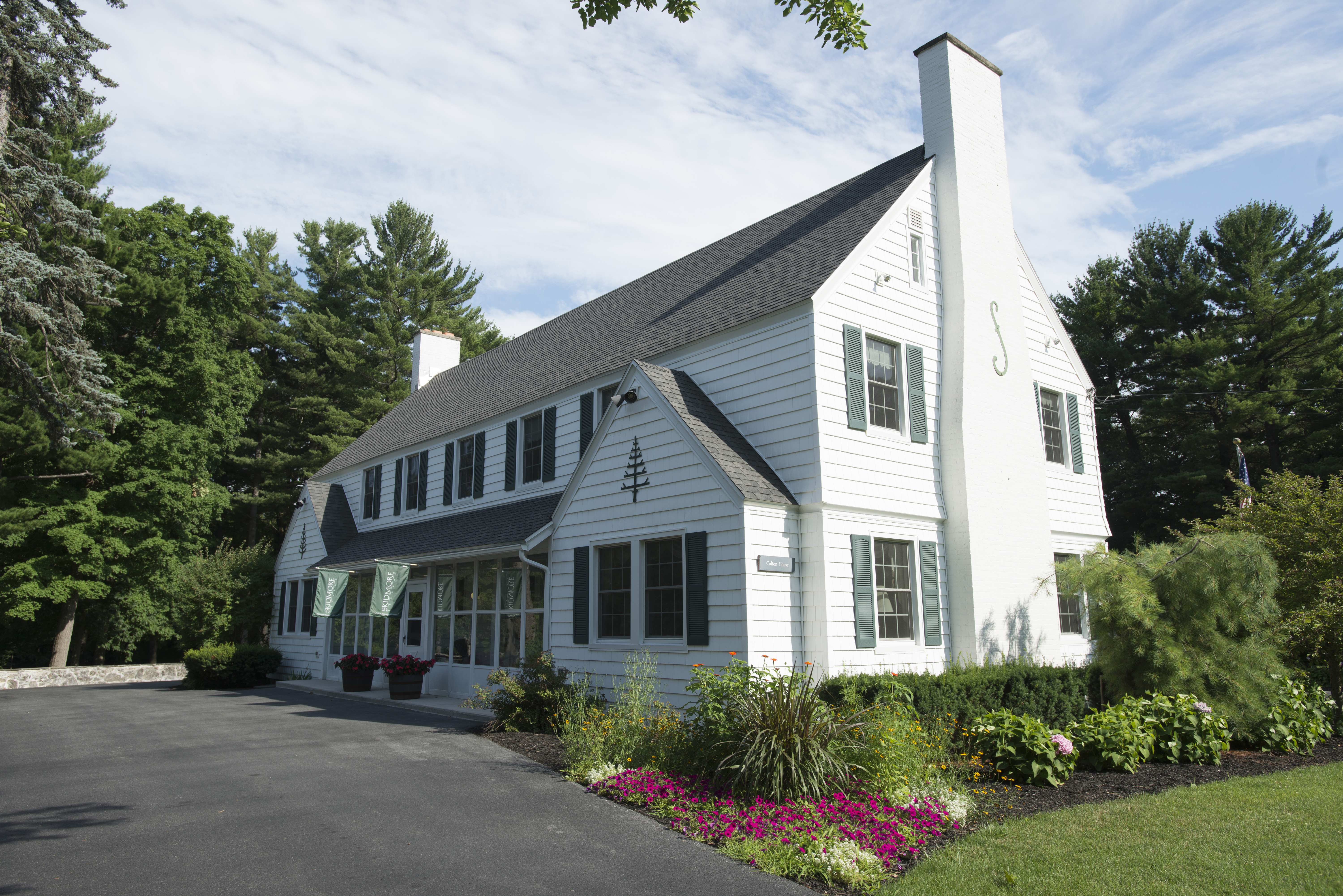
Today, the graciously appointed
rooms on the first floor continue to be used for College events and by Skidmore
community members for weddings and other gatherings. Guest rooms on the second
floor accommodate up to eighteen people: usually visiting alumni, trustees, or
guest speakers. In the summer of 1999, to honor longtime trustee and benefactor
Susan Kettering Williamson 59, Skidmore renamed the mansion the Surrey Williamson
Inn. ACH
|
|