|
|
|
|
|
|
Skidmore Home About Scope Editor's Mailbox Back Issues |
|
|
|
|
|
Features Observations Campus Scene Connections Who, What, When Class Notes Saratoga Sidebar Picture This |
features Outreach or sanctuary? Minority students ponder the role of identity-based clubs
Let's face the music and dance, write, research, manage...
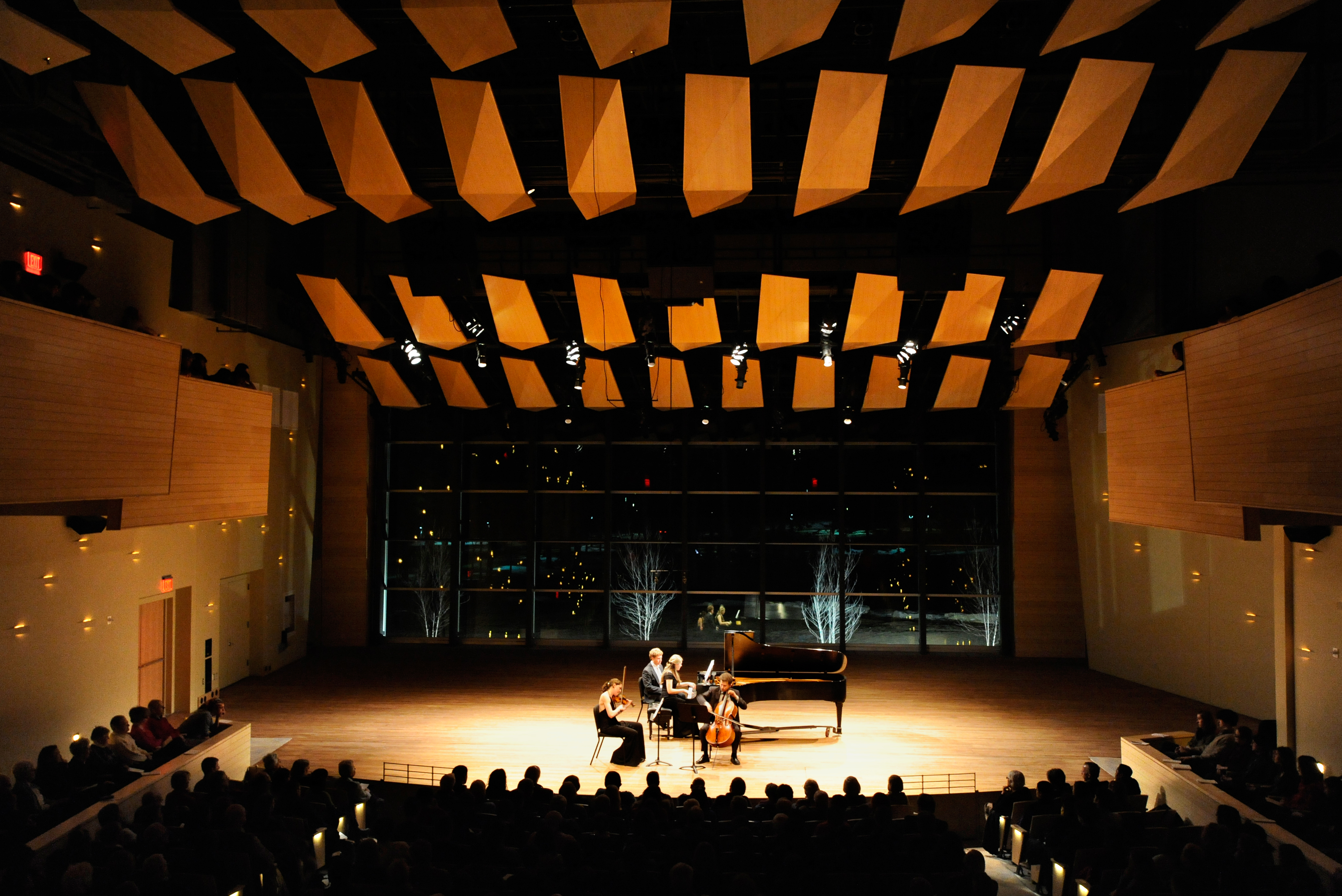
It fell to oboist Madeline Warner to get the concert under way, playing solo works by Paladilhe and Colin. Audrey Wronski—Skidmore’s first-ever Filene bassoonist—performed a classic baroque sonata by Telemann. Mezzo-soprano Victoria Lowe
sang convincingly in three different languages, performing art songs from three different centuries. And flutist Rebecca Rawling played an energetic Poulenc sonata, barely suppressing her smiles between tricky riffs in the concluding presto movement. Each enjoyed her first fifteen minutes of Skidmore fame—as did the proud families, and friends, scholarship donors, music faculty, and That must be music to the ears of those who crafted the scholarship program a quarter-century ago, and it is a warm tribute to the vision of key donor Helen Filene Ladd ’22, the alumna nonpareil who fondly called Skidmore her “other home.” Ladd supported the college broadly but had a special place in her heart for music. So when Skidmore started a new campus in the 1960s, she underwrote the Lincoln and Therese W. Filene Music Building, named for her parents. “My mother wanted to have a meaningful music program at Skidmore,” recalls Bob Ladd, a longtime Skidmore trustee and music booster. The bricks and mortar were just the beginning; soon Helen Ladd “wanted to breathe more life into her building,” says Tom Denny, music professor and department chair.
To find its first scholars, the program invited performance tapes from young musicians nationwide and brought ten finalists to the college for live auditions. The four scholarship winners were awarded grants of $5,000 per year, plus additional financial aid as needed. Denny arrived on campus as a new faculty member in the fall of 1982 when those first Filene Scholars—pianist Mark Brennan ’86, singers Tina Czepiel ’86 and Andrea Miller Weber ’86, and violinist Jonathan Wachtel ’86—performed in the now-traditional winners recital. “Helen Ladd flew in from Maine on a little puddle-jumper,” he recalls, and “she just radiated. She was so proud and engaged in the whole process.” All four of those original scholars graduated from Skidmore, but in the next several years a few transferred elsewhere. “It took us a while to understand that we needed to remind students we were not
Pianist Amy Briggs, a concert soloist and a regular with the Chicago Symphony Orchestra’s MusicNow series, majored in music but also developed a minor in Asian studies. Percussionist Molly Maxfield ’99, a PhD candidate in gerontological psychology at the University of Colorado, remembers: “I appreciated Skidmore’s emphasis on having variety in your college years. I could continue in music while also playing sports, exploring a number of disciplines, and studying abroad.” Every Filene scholar is required to contribute actively to Skidmore’s music scene—with what string-bass player Sarah Lyon-Callo ’88 calls “an obligation of high-quality musicianship”—and as a group they provide a critical mass that supports the college’s concert orchestra, chorus, opera workshop, and several ensembles and chamber groups. Many professors find that the music scholars contribute broadly to academic life as well. Indeed they earn departmental, college, and Phi Beta Kappa honors at a significantly higher rate than the student body as a whole. The scholarship program still supports four students in each class each year, but today the award is $10,000 annually. And the Filene Concert Series and Filene Artist-in-Residence program bring in legendary performers and match Skidmore students with top musical artists for lessons and master classes. Over the years, music students have studied with Anna Moffo and Vladimir Ashkenazy, Robert Mann and Paula Robison, the Western Wind Ensemble and the Los Angeles Guitar Quartet. This year renowned pianist André-Michel Schub added a special twist to his residency: he asked to have students perform with him in recital. In November eight students (including three Filene scholars) traveled to The chance to combine Beethoven and Bartok with business and biology has carried Skidmore’s name far—literally to the other side of the globe, where Mongolian violinist Mugi Ayurzana ’09 heard about the program and decided to audition. Lyon-Callo, the bass player who came in the program’s third year and is now an epidemiologist for the State of Michigan, remembers, “I had not heard of Skidmore prior
Filene winners’ fans include a lot of students who might not otherwise have been exposed to the world of classical music. That was a perk of attending a liberal arts college, says attorney David Joyal ’97, a trumpeter who majored in music. “My friends (and professors!) were always very supportive.” Boover’s most faithful were business majors. Briggs’s loyal following gave her a memorable send-off at her senior recital. When she took the stage, she says, “my closest friends unfurled a long banner made of toilet paper that said ‘Go Briggsy, Rock On.’” Like Briggs, Andrea Miller Weber ’86 made a career in music, singing with the New York City and Metropolitan Operas. Jessica Ivry ’94 is a freelance cellist and music instructor, Frank Heiss ’93 composes electronic music, and Christopher Sidoli ’01 has been in the Broadway touring production of Cats. Others have pursued advanced study, like Rachel Malinow Bergman ’92, who earned her PhD in music theory from Yale and now teaches at George Mason University. But the majority of Filene graduates found other career paths: violinist Jonathan Wachtel ’86 became an attorney, pianist Peter Wan ’95 an investment manager, pianist Kathy Byun ’95 a radiologist, guitarist Josh Chambers ’98 a theater director, oboe player Niav Conty ’95 a filmmaker. Lauren Engle-Lennon ’92 works with the US State Department as senior advisor at the Human Smuggling and Trafficking Center, and classmate Jonathan Brody ’92 has a PhD in pathobiology and conducts cancer research at Thomas Jefferson University, but both keep music their lives—percussionist Brody plays in a band with other doctors, and Engle-Lennon plays piano “to both relax and entertain.” As violinist Lisa Byun Forman ’00 sums it up: “I may be a lawyer in my daily life, but I suppose I’ll always be a musician at heart.” This fall Sylvia Stoner-Hawkins returned to campus as a voice teacher, and among her students was Victoria Lowe ’10, one of the freshman winners of the twenty-fifth Filene Music Scholarship competition.
The competition now runs like a well-oiled machine. Information is included in all admission application packets (as it is for the similarly styled Porter Scholarships in Math and Science), and 10,000 brochures go
to high-school guidance and music directors. Hopefuls submit recordings to Like all Filene scholars, Lowe started her first term with weekly lessons. She also began singing with the college chorus and vocal chamber ensemble and served as assistant stage manager for the opera workshop. She may minor in music, but she’s leaning toward a major in psychology or anthropology. Editor's addendum: Along with the first freshman contestants, there were three other Filene Scholar pioneers at Skidmore. When the scholarships began in 1982, music professor Isabelle Williams and others recognized that incoming freshmen weren't the only source of remarkable music talent—several top students were already enrolled and studying. So three of the best were chosen as Filene Scholars that year: soprano Laura Imperia '84, pianist Mark Gionfriddo '84, and pianist Elaine Schulte '83. |
| © 2006 Skidmore College |