All in the neighborhood
Nestled on the northern shore of South Portland, Maine, the Knightville neighborhood features a mix of 19th-century buildings, marinas, extensive shoreline, and quaint boutique shops and restaurants.
The neighborhood’s walkable streets, its proximity to Casco Bay and Portland’s Old Port historic district just across the Fore River, and a close-knit community characterize its bustling business district. Among the entrepreneurs, innovators, and creators in this pocket of the city, three Skidmore alumni have established thriving businesses within just a few blocks of one another. They are all friends, know each other’s families, and exemplify Skidmore’s Creative Thought Matters ethos.
“It’s fascinating to see how our paths have intertwined here in South Portland,” says Megan White Abercrombie ’98, owner of Bonny Read, which features an eclectic selection of midcentury and antique furniture and home décor.
A short walk from Abercrombie’s business on the same street is SoPo Seafood, a wholesale seafood market and restaurant co-founded by Luke Myers ’97. Around the corner, Laura Marston ’02 owns and operates GoGo Refill, a store dedicated to reducing environmental impact by offering sustainable, plastic-package-free household products.
“There is a strong Skidmore alumni connection here for sure, and there are so many of us who are entrepreneurs,” Marston says. “It’s nice to be able to reach out locally to collaborate and support each other’s businesses and families.”
Many more Skidmore alumni live and work throughout South Portland and the surrounding region. To learn more about who they are and what they do, Marston, Myers, and Abercrombie hosted a regional event at SoPo, where nearly 60 alumni and members of their families gathered to celebrate the creative professionals who help drive the local economy.
“It was great to see such a strong turnout,” Myers says. “Seeing so many alumni thriving as creators and entrepreneurs here really underscored the vibrant, creative spirit that was cultivated during our Skidmore days. It’s been wonderful to witness.”
Think big. Start small: Laura Marston ’02
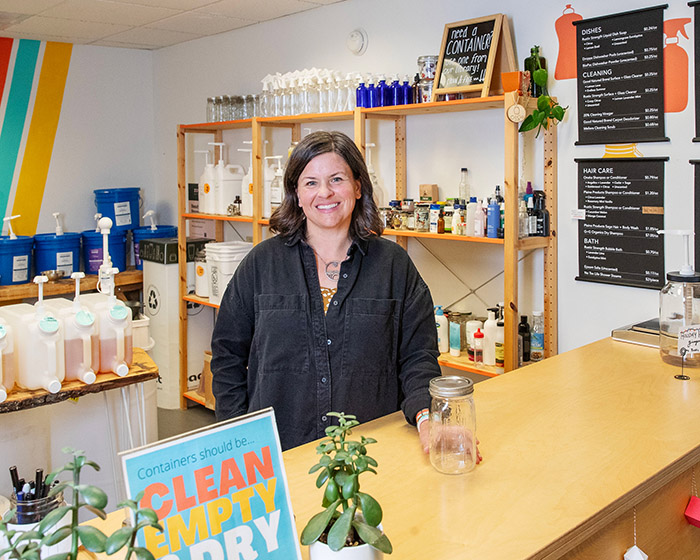
Prominently displayed in bold, black letters along the sidewall as one enters GoGo Refill are the words: “Think big. Start small.” The tagline embodies the mission of Laura Marston and the story behind her one-stop shop that sells plastic-free, earth-friendly household cleaners and personal care products. Those wares range from laundry detergent sheets and chewable toothpaste tablets to shampoo bars and lip glosses in cardboard tubes.
“GoGo Refill really evolved out of slow and steady changes over time to reduce single-use plastic in my household,” says Marston, whose entrepreneurial journey started with a New Year’s resolution to eliminate single-use plastic water bottles during car trips with her two young children. “Thinking big and starting small was a manageable way to move forward. We can all start with a focus on one or two things and develop a habit of reducing.”
Established in 2019, GoGo Refill also offers nearly 90 bulk items that customers can refill in their own containers, including liquid dish soap, liquid laundry detergent, nontoxic glass cleaner, shampoo, and a host of skincare products. And, if they don’t have their own jars or bottles to fill? No problem — feel free to take one out of the large bin filled with donations from neighbors for reuse.
“We fill mason jars, shampoo bottles, laundry detergent containers,” Marston says. “As long as it’s clean and empty, we will refill it.”
GoGo Refill obtains many of its bulk products from a Missouri manufacturer that sends 30-gallon barrels of laundry detergent, hand soap, dish soap, and all-purpose cleaner, among other items. “We ship those back when they’re empty. So most of our own packaging is also circular and refillable,” says Marston, who notes that GoGo Refill has reduced the use of hundreds of thousands of new plastic packaging pieces — a testament to the impact one committed individual can make.
Marston has been a strong advocate for sustainability policy in Maine, helping shape the 2021 Act to Promote Bulk Retail Purchasing, which encourages stores to allow reusable containers to reduce single-use plastic waste. She also played a key role in the 2021 Extended Producer Responsibility law, which requires producers to pay fees based on their packaging’s recyclability — funding municipal recycling, infrastructure improvements, and education initiatives.
An English literature major from Concord, New Hampshire, she followed her mother, Mary Hiersteiner Ruedig ’70, to Skidmore, where she also met her husband, Peter Marston ’02. The two settled in the greater Portland area, where they now live in Cape Elizabeth.
While working as a strategy consultant focused on custom software development — including mobile and web apps — for small and mid-sized businesses, Marston found herself at a crossroads. “My work involved extensive business research and design, aligning closely with my clients’ aspirations,” Marston says. “At the time, I was experiencing what I call my ‘plastic awakening,’ becoming increasingly aware of waste-related issues. I asked myself what my own business might look like if I focused on what really mattered most to me.”
Marston also operates an online shop. For her, founding GoGo Refill was not only to sell products that prioritize sustainability but also to create a community to share resources about waste reduction. Her Skidmore education taught her that meaningful change starts with communication, creativity, and a willingness to challenge the status quo.
“A good liberal arts education influenced me more than anything,” she says.
Visit GoGo Refill at gogorefill.com.
A treasure hunter with an artist’s eye: Megan White Abercrombie ’98
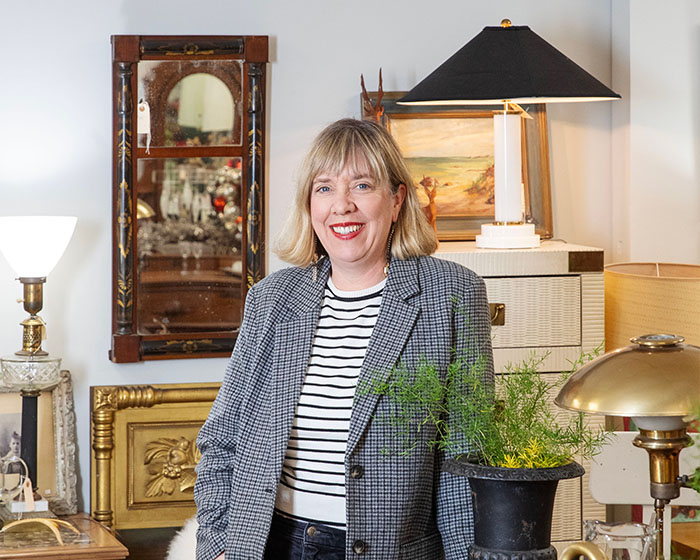
Inside Bonny Read, Megan White Abercrombie offers a treasure trove of midcentury and antique furniture. The 2,500-foot shop — named after legendary 18th-century female pirates Anne Bonny and Mary Read — evolved from her love of antiquing and working at a home décor gift shop in Portland while raising two young children.
“I saw an opportunity and started to buy antiques that I thought the owner would be interested in,” Abercrombie says. “I sold a lot to her, but she didn’t take everything. So I began thinking about what to do with the pieces left over.”
She began selling at Flea-for-All, a large antique and artisan market located in Portland’s Arts District, and through online platforms like Facebook Marketplace. “But I was spreading myself too thin across multiple platforms, so I decided to refocus my efforts,” Abercrombie says.
Real estate agent Kim Myers, the wife of SoPo Seafood co-owner Luke Myers, helped Abercrombie locate a shop in the Knightville neighborhood of South Portland. “It was tiny — maybe 700 square feet — but I opened the shop during the pandemic in 2020 using Instagram exclusively to sell, and the business really took off from there.”
The pandemic, surprisingly, turned out to be good for business: While many retailers faced long backlogs for new furniture, Abercrombie could immediately offer secondhand items.
Like Myers and alumna entrepreneur Laura Marston of GoGo Refill, Abercrombie highlights the sustainability aspect of her business. “It’s a pretty green business,” she says. “I’m giving old things a new life, and I mostly source locally around New England.”
Abercrombie spent the first decade of her life in rural Palermo, Maine, deeply rooted in a hands-on, sustainable lifestyle on her family’s small farm. “We were always making things, working with our hands,” she recalls. The family moved to Belfast, a larger Maine town known for its vibrant art community. Her mother, an elementary art teacher and artist who owned a gallery in town, introduced her to antiquing and craft fairs.
An art major at Skidmore, Abercrombie focused on painting and printmaking, delving into etching, relief printing, and lithography. From the beginning, she was impressed by Skidmore’s art facilities. “The spaces really wowed me — the printing presses and the entire lithography studio,” she recalls. “The substantial space devoted to the arts created a sense of place that was very appealing. It was exciting to have studios with natural light and a clear investment in the arts.”
She discovered metalsmithing in her senior year, and shortly after graduation, she set up her first business, Peridot Designs, selling sterling silver jewelry at craft fairs and boutique shops. She has fond memories of working in the print shop and studying with professors like Associate Professor of Art Kate Leavitt.
In 2024, Abercrombie moved her shop to its current location across the street. A favorite part of her work is arranging distinct displays in which brass candelabras might share space with sculptural lamps and rattan furnishings. “I think about line, texture, color — all the design elements I learned at Skidmore — and how they play off each other,” says Abercrombie, who is in constant search of antiques and other treasures to fill and curate her shop.
“It’s pretty addictive,” she admits. “But I wouldn’t want it any other way. It’s a labor of love and a creative process that I get lost in every day.”
Follow Bonny Read on Instagram @bonnyreadvintage.
On baseball, philosophy, and oysters: Luke Myers ’97
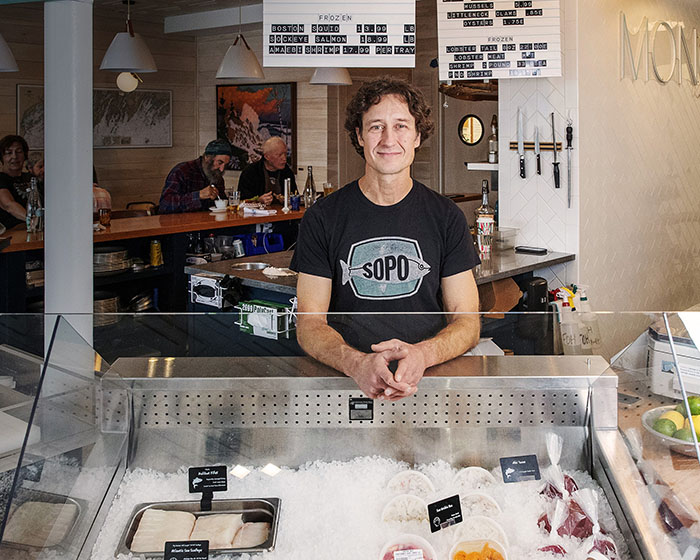
Luke Myers ’97 co-owns SoPo Seafood, a wholesaler, online market, and restaurant that specializes in locally harvested seafood ranging from raw-bar oysters and clams to lobster and caviar, plus a range of fish. His story is one about pivoting as an entrepreneur and how the business has evolved to where it is today.
Myers worked in the seafood industry for years before joining forces with two friends to launch SoPo Seafood in March 2020. The initial plan was to establish a wholesale warehouse, catering primarily to the restaurant industry. When the COVID-19 pandemic struck the same month and forced food establishments to shut down nationwide, Myers and his business partners quickly shifted online to a direct-to-home delivery model. They also organized curbside pickups. The emergency pivot not only kept the business afloat but also deepened community ties during a dark period of uncertainty.
“People still tell me how much they appreciated our deliveries,” Myers says. “We were also able to keep the partnerships we had recently established with the local harvesters.”
In 2021, a building that formerly housed a diner in Knightville became the ideal location for SoPo to set up its market, restaurant, and raw bar. SoPo, which has a warehouse on a wharf in Portland, has 25 employees and three trucks for deliveries across southern Maine. It also continues to maintain its thriving online business for home and restaurant deliveries across the country. About 95% of its seafood is caught in the Gulf of Maine.
“Individual harvesters and small, locally owned seafood businesses have been stewards of the Maine coast for generations, and it’s our privilege to support them,” says Myers, who also owns O’ Oysters, a mobile oyster bar service that delivers fresh oysters and shucks to order at events.
Sustainability and traceability stand at the core of SoPo’s philosophy. Myers is passionate about enabling customers to know exactly where their seafood comes from. Using modern technology like the BlueTrace software, SoPo enables customers to trace their seafood from catch to delivery, supporting informed and ethical consumption choices.
Myers was raised in Auburn, Maine, where recreational fishing was woven into the fabric of family life. “There was always fish on the table or in the freezer,” says Myers, who noted that the green clam sauce his mother made was a favorite dish.
His love of baseball is what initially drew him to Skidmore. “The conversations I had with Coach Tom Hanson and the chance to play college baseball in such a beautiful setting, coupled with the financial aid package I received from Skidmore, made my decision easy,” recalls Myers, who was recruited for the men’s baseball team and still plays the sport.
A philosophy major, Myers was inspired by creators and innovators and by the notion that he was reading the works that created momentous shifts in culture and politics. Over time, he realized that entrepreneurs, too, can create meaningful change.
“When I attended Skidmore College, I was surrounded by creators: ceramicists, dancers, musicians, athletes, painters, and amazing teachers,” Myers says. “I think business is also a creative act.”
“Running a business is a little like writing and directing a screenplay, although it’s not merely acting out scripted parts — it’s about the live, dynamic creation of something impactful,” he adds. “As I see the day’s activities winding down at SoPo, with people laughing and talking, it’s like watching a piece of art come to life.”
Learn more at soposeafood.com.
A version of this article first appeared in the fall 2025 issue of Skidmore College’s Scope magazine.