


Ginsberg updates EU volume to reflect new developments


The second edition of Demystifying the European Union: The Enduring Logic of Regional Integration,by Roy H. Ginsberg, Joseph C. Palamountain Jr. Professor of Government, was released Feb. 5 by Rowman and Littlefield.
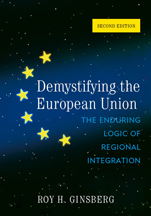 The publisher notes, "Written by one of the premier scholars on the European Union and hailed as the best
undergraduate text on the subject, this book has been thoroughly revised and updated
to include the entry into force of the Lisbon Treaty. Clear and comprehensive, it
'demystifies' one of the world's most important and least-understood institutions.
Roy H. Ginsberg contextualizes European integration through the foundation blocks
of history, law, economics, and politics. He then breaks the EU down into its components
so that they can be understood individually and in relation to the whole. Reconstructing
the EU as a single polity, Ginsberg evaluates the EU's domestic and foreign policies
and their effects on Europeans and non-Europeans alike. The author thus challenges
students to see what the European Union truly represents: a unique experiment in regional
cooperation and a remarkable model of conflict resolution for the world's troubled
regions."
The publisher notes, "Written by one of the premier scholars on the European Union and hailed as the best
undergraduate text on the subject, this book has been thoroughly revised and updated
to include the entry into force of the Lisbon Treaty. Clear and comprehensive, it
'demystifies' one of the world's most important and least-understood institutions.
Roy H. Ginsberg contextualizes European integration through the foundation blocks
of history, law, economics, and politics. He then breaks the EU down into its components
so that they can be understood individually and in relation to the whole. Reconstructing
the EU as a single polity, Ginsberg evaluates the EU's domestic and foreign policies
and their effects on Europeans and non-Europeans alike. The author thus challenges
students to see what the European Union truly represents: a unique experiment in regional
cooperation and a remarkable model of conflict resolution for the world's troubled
regions."
The first edition of Demystifying the European Union, released in 2007, earned notice from a number of scholars. John Peterson of the University of Edinburgh, said, "Roy Ginsberg has produced a terrific piece of work to mark the fiftieth anniversary of the Treaty of Rome, the European Union's birth certificate. This book really DOES demystify the EU for the interested beginner, while even the most grizzled veterans will learn things they didn't know. If there is another book on the EU that is this much fun to read, I've not yet found it."
And Stefan Fritsch of Bowling Green State University and the University of Salzburg commented, "One of the most accessible books I have ever used in a class on the European Union. What I liked most was the combination of historical overview and theoretical discussion so students could see how actual political events have shaped the theoretical debates. The book's language is easy to understand (especially for U.S. students who have almost no prior knowledge of the EU) and the content is well structured."
Click here for more information on Demystifying the European Union.