


Innovative Cuban artists to be featured in new Opener


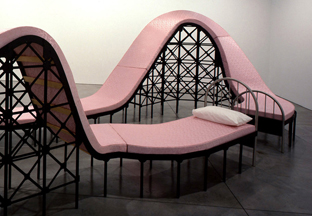
La Monta a Rusa, (detail) a 2008 mixed-media work by
Los Carpinteros
The Havana-based artists Marco Castillo and Dagoberto Rodriguez - also known as Los Carpinteros, or "the carpenters" - create works that provocatively intersect architecture, design, sculpture, and furniture. Their work has placed them "among the most innovative and internationally sought-after Cuban contemporary artists," according to Sculpture magazine.
Thirteen watercolor drawings and a recent large-scale sculpture by Los Carpinteros will appear in the exhibition, Opener 19: Los Carpinteros, opening April 10 at the Frances Young Tang Teaching Museum and Art Gallery (on view through Aug. 8). The artists will make a visit earlier in the week to install their work, meet with Skidmore students, and take part in a Tang Museum Dunkerley Dialogue beginning at 5:30 p.m. Thursday, April 8. Joining them in the dialogue will be Dickinson College Assistant Professor of American Studies Jerry Philogene, formerly a lecturer in American Studies at Skidmore College.
A highlight of the exhibition will be the monumental sculpture, La Montana Rusa (2008), which showcases a surreal mix of imagery. With undulating pink mattresses atop a structure of black latticework, La Montana Rusa fuses elements of a bed and a roller coaster. The piece's title, which translates in English as "the Russian mountain," is also the term for roller coaster in Spanish.
Filling the Tang's large Wachenheim gallery, La Monta a Rusa will be accompanied by 13 large, exquisitely crafted watercolor drawings from the past decade. These include Someca 2 (2002), which turns a well-known Havana skyscraper of the same name into a delicately rendered wooden dresser. The building's 18 stories are transformed into tiny drawers, some pulled out to resemble condo balconies. In Jardin Frances (2007), several beds complete with headboards and pillows are elongated and curved into a formal garden layout, a play on the everyday phrase "flower bed."
Born in Cuba in the early 1970s, Los Carpinteros grew up in Fidel Castro's post-revolutionary Cuba. They met in the early 1990s as art students at the Instituto Superior de Arte in Havana, a city whose economic divisions inspired their earliest works. The collective (which until 2003 also included artist Alexandre Arrechea) chose its distinctive name because, as Castillo has explained, "We wanted to investigate issues of the way art is made, the way that an object is fabricated. To speak of a carpenter is to speak of the way something is made." The name allied the young artists to the tradition of laborers' guilds, allowing them to explore timely sociopolitical issues under the apolitical guise of manual labor and skilled manufacturing.
"'Los Carpinteros' means much more than the name of a craft - it is a new way to make sculpture from everyday life," noted Moraima Clavijo Colom, director of the National Museum of Fine Arts in Havana. The collective's work appeared there in a 2003 exhibition titled Fluido (Fluid). Added Colom, Los Carpinteros's work is a means of "breathing poetry into the artists' versions of the objects that surround us."
Works by Los Carpinteros are part of the permanent collections of the Los Angeles County Museum of Art, the Museo de Bellas Artes in Havana, the Museo Nacional Centro de Arte Reina Sofia in Madrid, the Thyssen-Bornemisza Contemporary Art Foundation in Vienna, the Centro Cultural de Arte Contemporaneo in Mexico City, and the Museum of Modern Art, the New Museum, P.S.1, and the Guggenheim Museum in New York City.