


Kid-lit insiders


An overheard conversation, family pets, thin air, and procrastinating have sparked great ideas for children's books, according to Skidmore alumni who are kids' book creators. A few of them discuss the inspiration and perspiration of their work:

Beth Rose Stanton '75
Skidmore B.A. in art history and business, Columbia M.Arch., University of Washington
certificate in scientific illustration
Titles include Henny (2014), Peddles (2016)
www.penspaperstudio.com
Stanton told kidlit411.com, "Little did I know that my classic architectural training would, in fact, someday
come in handy 'building' picture books! All along I toyed with the idea of illustrating
for children and was spurred on when, a few years ago, a friend roped me into a class
on children's picture books. I got an overview of what was involved and promptly joined
the Society of Children's Book Writers and Illustrators..."
"If I have a thought or idea (and it seems the best ones come when I'm procrastinating),
I'll grab whatever is nearby and down it goes, so I end up with images and story snippets
scattered on everything from sketchbook pages to little scraps of paper. Eventually
it gets to a point where it begins to gel and I go straight to the manuscript. Then
I'll jump back to the images and start weaving them in.... For Henny, I did the drawings first on smooth-surface drawing paper and scanned them in. I
cleaned up the drawings in Photoshop and then printed them up very faintly on the
watercolor paper. That way, if I didn't like the way the painting was going, I could
just print it up and start again." Her advice: "Go at your own pace" and "seize the
ups and roll with the downs."

Michelle Sinclair Colman '94
Skidmore B.A. in sociology, University of Minnesota M.A. sociology, London School
of Economics M.Sc. in urban design and social science
Titles include Not That Tutu (2013); Urban Babies Wear Black (2005), Country Babies Wear Plaid, Beach Babies Wear Shades, Foodie Babies Wear Bibs, etc.
www.randomhousekids.com/authors-illustrators/detail/833
Colman says, "I wrote appropriately dark poetry in high school, but really I never
dreamed that writing would be my profession. When I was pregnant with my first son,
I wrote Urban Babies Wear Black. It was the perfect blend of my experiences with sociology, urban design, and becoming
a mom." She continues, "When I signed the contract, the publisher showed me some illustrators'
portfolios and I chose Nathalie Dion. They told me it would be 50% her book, which
at first was hard to accept, because the book was meant to be tongue-in-cheek and
the illustrations would be the twist. But I had nothing to worry about. Nathalie is
terrific!"
Colman confides, "Baby books are a lot tougher to write than they look. I compare
it to writing poetry, because you have to be so sparing with your words and make them
as powerful as they can be. Sometimes the words just flow out; other times, it can
be excruciating. But when you get it right, it feels so great!"

Tad Hills '85
Skidmore B.A. in art history
Titles include How Rocket Learned to Read (2010), Rocket Writes a Story, etc.; Duck & Goose (2006), Duck & Goose Go to the Beach, etc.; My Fuzzy Friends (1991), My Fuzzy Farm Babies, etc.
http://tadhills.com
As a father and author, Hills says, "Every day I wish that I could make art with the
simplicity and fearlessness that my kids do." His website also declares: "There is
nothing more exciting to me than building something from nothing without a blueprint
or directions."
He says he may build a book idea from an overheard conversation or dream one up while
cooking dinner. "The real trick is to take all those ideas, like chunks of soft clay,
and build something. Throughout the process the sculpture may hold itself upright,
or more likely it might sag in places, or even collapse completely. The tough part
is getting all that clay to stand up.... You have to make sure that it is fun and
interesting from all angles, because kids will be walking around it, squinting at
it, sniffing it, touching it..."
Hills got his start illustrating books when wife Lee Wade '81 was a book-jacket designer.
His Duck & Goose was the first book published by her Schwartz & Wade imprint. After the couple got
a puppy, he began his learn-to-read series starring Rocket the dog. As he told shelfawareness.com,
"I wanted to start with basic noises to help open up kids' ears to the many sounds
around them. I think it's really fun to hear sounds and try to attach letters to them
like wooooosh and grrrrrr. Those sounds lead to understanding how other words can
be built one letter at a time.... And kids are so tuned in and attentive; they don't
miss a beat. They see 'S-U-N' and 'M-E-L-T' and they say, 'That means spring is coming!'"
Lee Wade '81
Skidmore B.A. in English
VP at Schwartz & Wade, a Random House children's literature imprint
www.cbcbooks.org/ecc/2012/03/meet-the-imprint-schwartz-wade/
Wade landed a job in publishing right out of college, began designing book jackets,
and then supervised publishers' art departments. As she told childrensillustrators.com, "I noticed that on the days I was working with artists, I was happier, and I eventually
realized that it was time to leave the managerial part of my job behind." In 2006
she and colleague Anne Schwartz launched Schwartz & Wade Books for Random House.
Their philosophy: "We never sign up a book thinking that a great illustrator will
bring an OK manuscript to life ... so we spend a lot of time working with writers
on their stories before we ever approach illustrators.... When the dummy arrives,
we ... consolidate our feedback into what is usually a lengthy letter to the illustrator.
We try our hardest to communicate our suggestions so that they don't feel like mandates.
We firmly believe that the book belongs to the creators, and their best work comes
if we articulate clearly the issues that we see, but give them room to address them
as they see fit.... Being married to an author-illustrator definitely affects the
way I relate to creators in general. I really see both sides—the side of the publisher
and the side of the creator."
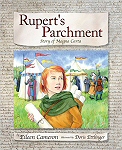
Eileen Kirwin Cameron '65
Skidmore B.A. in government, New York University M.P.A.
Titles include Rupert's Parchment: The Story of the Magna Carta (2015), G is for Garden State (2004), Canyon (2002)
http://www.eileencameron.com
Cameron writes on her website, "My father was an engineer who loved poetry and my mom a teacher who loved all literature....
When I was young I began writing stories about the adventures of my pets and dolls
('write what you know' is often the advice)." Now her young kids' picture books and
older kids' story books focus on "the natural splendor of our country, the canyons,
mountains, seas, and wildlife, and some celebrate the characters and events in the
history of our nation."
Early in her career, Cameron put her master's in public administration to work in
economic research and analysis. That, she notes, turned out to be "excellent training
for an author, since economic and business writing must be precise and concise!" Then,
while raising her own family, she took courses in writing for children and joined
"a great critique group of children's writers. We help each other with our manuscripts,
making suggestions on plot, characters, believability, language and style." She has
worked with community groups and with children in schools, scouting, and museums.
She says, "I especially love the Washington Association of New Jersey, which preserves
the legacy and leadership of George Washington at his Revolutionary War headquarters
in Morristown."