How Skidmore nurtured Melvin Alvarez’s environmental vision
For Melvin Alvarez ’15, environmental protection is as much about people as it is
about place. His work — beginning with his academic studies at Skidmore and extending
across policy, research, and philanthropy — is rooted in a conviction that sustainability,
equity, and community voice are deeply intertwined.
Alvarez serves as a grant program manager at 11th Hour Racing, a global nonprofit
headquartered in Rhode Island that partners with the sailing community and maritime
industries to protect ocean health. In this role, he designs and oversees grantmaking
strategies that support biodiversity conservation, climate solutions, and community-based
environmental initiatives.
His portfolio includes funding composting infrastructure to divert food waste from
landfills, supporting innovation to curb marine plastic pollution, and investing in
programs that introduce students of all ages — but especially high school and college
students — to marine science and environmental stewardship.
The value of a liberal arts education
Alvarez was drawn to Skidmore by the promise of a liberal arts education that encouraged exploration across disciplines. A first-generation college student originally from Honduras, he attended a large public high school in the Washington, D.C., area. He didn’t expect to attend a small liberal arts college, but that changed during a campus visit when he sat in on a discussion-based class.
The exchange between students and professors was completely different from anything I had seen at other colleges. It felt like a place where your perspective really mattered.”Melvin Alvarez '15On his first visit to Skidmore College
He credits several professors with helping him develop the intellectual confidence and rigor that has carried him through graduate school and into his career. In environmental studies, Associate Professor and Department Chair A.J. Schneller encouraged Alvarez to pursue a competitive fellowship that made graduate study at the University of Rhode Island (URI) possible.
Political science courses with Bob Turner, associate professor and department chair,
sharpened his understanding of immigration and environmental protection policymaking
and solidified his belief that enduring societal change often flows through policy.
That same expectation of excellence extended into his Spanish studies. Associate Professor of Spanish Grace Burton, who also chairs the Music Department,
became an equally formative teacher.
“She was a great mentor,” Alvarez says, recalling how she consistently pushed him
beyond what felt sufficient in his Spanish literature courses. Still learning English
as a second language, he already knew how to think and write critically in Spanish.
Burton recognized both his fluency and potential and held him to that standard.
Other Spanish faculty members, such as Professor Viviana Rangil, further strengthened
both his academic experience and his sense of belonging. Alongside the Opportunity
Program, which provided a welcoming space and wraparound support for him and other
diverse students, these relationships helped Alvarez build confidence, find community,
and fully claim his place at Skidmore.
From Skidmore to global environmental impact
The College’s emphasis on interdisciplinary thinking, combined with his lived experience
and Latino roots, allowed Alvarez to connect ecological systems with cultural, political,
and economic realities — an approach that continues to shape his work.
“Skidmore taught me how to think across silos,” says Alvarez, who graduated with a
double major in environmental studies and Spanish. “That’s essential in environmental
work, because the problems we’re trying to solve don’t fit neatly into one discipline.”
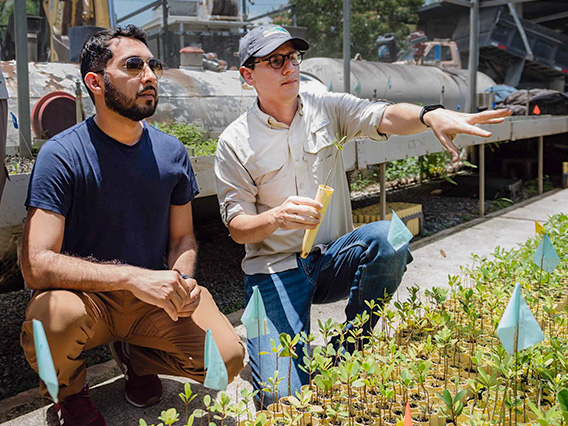
During a site visit to Protectores de Cuencas in Puerto Rico, Melvin Alvarez ’15 observes mangrove nursery and restoration work designed to support coastal resilience.
Alvarez learned this firsthand while completing his capstone project, Feeding Mouths,
Not Landfills: An Analysis of Food Recovery Efforts in Saratoga Springs, with classmates
Jordan Chang ’15 and Rebecca Fennell ’15. They examined how surplus food from grocery
stores and restaurants could be diverted from landfills and redistributed to local
food pantries. Through interviews with retailers, food banks, and community leaders,
the team identified logistical, economic, and policy barriers limiting the effectiveness
of local food recovery systems.
“I further examined how environmental work directly impacts communities,” Alvarez
says. “It was about reducing emissions and waste while supporting people who are often
left out of the conversation.”
That foundation followed Alvarez into his graduate studies. As a marine affairs graduate
student at URI, he conducted field research in the Dominican Republic on the socioeconomic
impacts of beach privatization and tourism-driven development on local livelihoods.
Alvarez then went on to join the UN Environment Programme (UNEP) in Washington, D.C.,
as an environmental policy consultant. Managing UNEP’s North America oceans portfolio,
he collaborated with governments in the United States, Canada, and Mexico on transboundary
marine issues. His work ranged from contributing to global environmental assessments
to advancing research and policy related to marine plastic pollution and food waste,
including contributing to legislation such as the Save Our Seas 2.0 Act of 2018.
During that period, Alvarez gained a clearer understanding of how environmental agendas
are shaped not only through policy but also through philanthropy and other funding
sources.
“There are different ways to drive meaningful change,” he says. “Policy is one route.
Funding and directing resources toward good work that is impactful and lasting is
another.”
That realization led him to 11th Hour Racing, part of the philanthropic network of
the Schmidt Family. Alvarez joined the organization at a moment of transition, as
it expanded beyond plastic pollution mitigation to develop new strategies addressing
equity in the outdoor and science education sectors, along with food systems and waste.
It was a full-circle moment for Alvarez that brought him back to his capstone project
as he helped elevate composting as a new core strategy — positioning marine protection
as a land-to-sea connection and challenge. By keeping food waste out of landfills,
composting reduces runoff into local waterways and climate pollution, reinforcing
the organization’s belief that ocean health is shaped as much by everyday decisions
on land as by what happens at sea.
For Alvarez, his work still ultimately comes down to how environmental solutions are
designed to serve both ecosystems and communities.
“Whether it’s food recovery or mitigating pollution in our oceans,” he says, “the
core question is the same: How do we design systems that work for the environment
and for the people who depend on it?”
It’s a question he first learned to ask at home, examined critically at Skidmore,
and continues to answer today.