|
Winter 2000
- - - - - - - - - -
Contents
On
Campus
Sports
Books
People
Alumni
Affairs
and
Development
Class
Notes
|
|
|
|
News Briefs
Snatchy
tunes
Malcolm presents Russia notebook
Taking shape
Honoring heritage
Listen and learn
Paulding bequest celebrated
Modeling
Mentoring program for gifted kids
East meets West
Snatchy
tunes
Bandersnatchers past and
present raise the roof in a 25th-reunion concert during Oktoberfest. Some 40 Banders
got in on the act, from freshmen to alumni of the 80s and 90s; five
grads came all the way from the West Coast. Andrew Lefkowits 01 says, "The
alums really enjoyed the chance to sing again in front of a big crowd"and,
for one weekend, "to forget about jobs and mortgages and all that adult stuff."
For current members, "it was nice to meet some of the legends and see where
the group and its traditions came from. It gave us a better sense of what the
group is, what it has been, and what it should be." For more photos, news,
and album orders, visit the Bandersnatcher's web
site.
Malcolm presents Russia notebook
October 5, 1999, marked
the day that President Jamienne S. Studley first performed one of the duties shed
heard about at "new presidents school": she conferred an honorary
degree. The recipient of the Skidmore doctorate of letters was author Janet Malcolm,
the 1999 Steloff Lecturer. In the degree citation, Associate Professor of English
Linda Simon told Malcolm, "You have pinched, prodded, and poked us. You have
taken as your subjects nothing less than truth and power, secrets and lies, morality
and responsibility. . . . You have proved an intrepid and uncommonly reflective
investigator."
Born in Prague, Malcolm
and her family left Czechoslovakia in 1939. She grew up in New York City, where
she now lives. Malcolm began her writing career as photography critic at the New
Yorker and has been a staff writer at the magazine since the 1960s. In seven books
and numerous articles published regularly in the New Yorker and the New York Review
of Books, she has written on issues as diverse as the aesthetic of photography,
the world of psychoanalysis, and the moral ambiguity of journalism. Her accounts
of these and other contemporary topics are both controversial and critically acclaimed.
In her Skidmore lecture
titled "In Chekhovs Footsteps," Malcolm blended travel writing,
memoir, and literary biography, circling around the figure of the Russian writer
Anton Chekhov, pursuing his shadow from Moscow to St. Petersburg and Yalta, and
reflecting on what is entailed in the effort to tell "life stories"
and to "understand" them.
Frances Steloff, the late
founder of New York Citys Gotham Book Mart, endowed the lecture series in
1967 as a way to bring outstanding literary and artistic talent to Skidmore. The
most recent Steloff Lecturers have been Robert Pinsky, Mary Gordon, and J. M.
Coetzee.
Taking shape
Steel and concrete begin
to give shape to the Tang Teaching Museum
and Art Gallery, slated for completion in the fall. For years it was a "hoped-for"
museum, then a "proposed" teaching museum and gallery, then the "future"
Tang. But now theres nothing prospective or iffy about it: its here.
With its dramatic roofs sloping down toward the ground and wide angular walls
studded with high windows, its already making statementsabout inspiration
and ambition, about meeting spaces and crossroads, about innovation and interaction.
And thats emptyjust wait until it fills up with exhibits, like the
challenging multimedia opener Scenes of Sound.
For photos of the construction
progress, visit the Tang web site.
Honoring heritage
Two student groups celebrated
their distinctive cultures this winter.
Skidmores observance
of Latino Heritage Month opened with a candlelight vigil, a dance performance
by Magdalena Solomon and Company, and a Day of the Dead exhibit. A traditional
Mexican end-of-October ritual in which families prepare food and decorate shrines
for their deceased relatives, the Day of the Dead has roots in both indigenous
Mesoamerican cultures and Catholicisms All Saints and All Souls
Day. The exhibit in Scribner Library was a collaboration of anthropology, art
history, and studio-art students in the courses "Mesoamerican and South American
Art" and "Mexican Cultures."
Other Hispanic cultural
events included Cafe con Leche, an evening of student performances in a coffeeshop
setting; a workshop on Latino women; and a keynote address by Sandra Guzman, editor
of Latina magazine.
In December, black students
gathered for a Kwanzaa celebration. With organizational (and culinary) help from
Skidmores multicultural affairs coordinator Patricia Trosclair, the event
featured a candle-lighting ceremony, a historical reading, and a traditional African-American
dinner complete with barbecued chicken, cornbread, peas and rice, and pralined
bread pudding.
And February is Black History
Month, with a full slate of campus events, including a visit by Atallah Shabazz,
daughter of slain Black Muslim leader Malcom X; the traditional student fashion
and talent show, this year featuring the return of several alumni participants;
a Caribbean celebration with music and food; a faculty lecture; and Food for the
Soul, a dinner-and-movie event.
Listen and learn
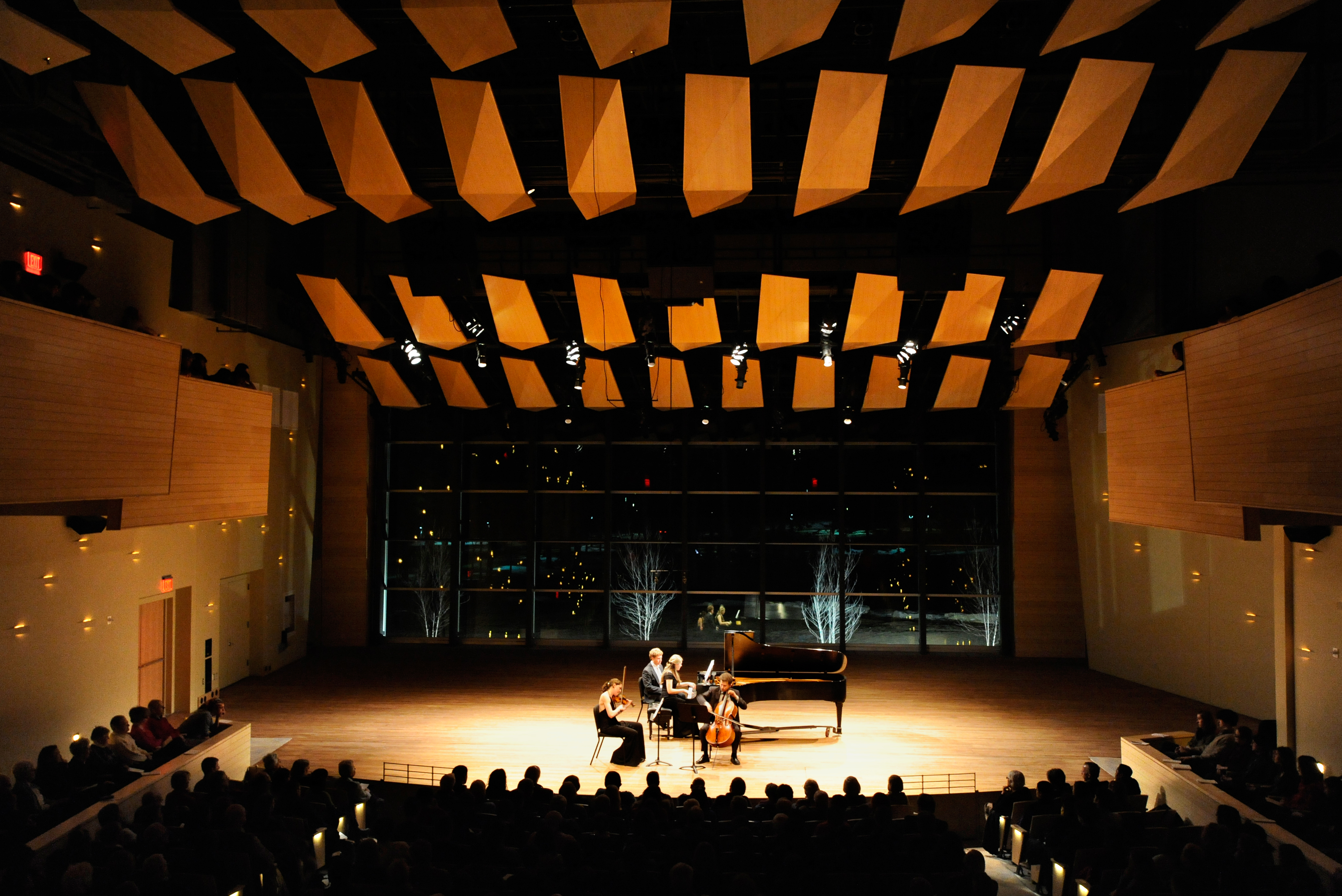
The
Triple Helix threesome are this years Sterne Artists-in-Residence at Skidmore.
In one of their lecture-recitals, Lois Shapiro (piano), Rhonda Rider (cello),
and Bayla Keyes (violin) discussed the developing interest in the self, subjectivity,
and the psyche in 19th-century culture, particularly in piano trios by Brahms,
Schumann, and Dvoràk. Among other musical highlights last semester was
a weekend visit by internationally acclaimed mezzo-soprano Phyllis Pancella, who
gave a master class for voice students and inaugurated the Filene Concert Series
with a public recital.
Paulding bequest celebrated
Many who gathered in the
Sports and Recreation Center in December to honor the late Margaret Paulding,
and to celebrate her bequest of nearly $500,000 to the College, remembered her
as larger than life. The recollections were both literal (she was a tall woman)
and figurativethe Skidmore professor of physical education universally known
as Miss Paulding was a legendary teacher, "a beloved and occasionally fierce
model and mentor," as Dean of the Faculty Phyllis Roth said.
In a 36-year career that
spanned the 40s, 50s, and 60s, Paulding was honored by half
a dozen collegiate athletic associations for the excellence of her teaching. A
faculty leader on both the old and new campuses, she served as department chair
and sat on every one of the Colleges major faculty committees as well as
two presidential search committees. Skidmore awarded her an honorary degree in
1975.
Among the ceremonys
speakers were Athletics Director Timothy Brown and several of Pauldings
longtime faculty colleagues, including Nancy Davis, Anne Fairbanks, Isabel Brown,
and Beverly Becker. "Margarets specialities were kinesiology and body
mechanics," recalled Becker, "but she was also instrumental in developing
Skidmores dance program." A host of other memories, personal and professional,
were fondly shared by all. Even after she retired in 1973, Pauldings unfailing
presence at Skidmore dance performances was "an inspiration to mea
dancer, not a phys-ed personwhen I was a young faculty member in the 80s,"
said Mary DiSanto-Rose, director of the Colleges dance program. She told
the group: "Miss Paulding would be thrilled to see how its all coming
together."
Modeling
Clay artist Toshiko Takaezu is especially well known for her "closed forms"sealed
pots, some of them very large, often suggesting hearts, torsos, boulders, or moons.
Takaezu was on campus in November as this years Raab Lecturer. The founder
of the ceramics department at Princeton University, where she taught for 25 years,
Takaezu has won numerous awards and honors; her work is in the collections of
major New York, Boston, and Philadelphia museums. Named a "living treasure"
by her native state of Hawaii, Takaezu is a treasure to Skidmore as well: she
has taught in the Summer SIX art program since 1970, and a number of Skidmore
art students have apprenticed with her over the years. The Raab Lectures at Skidmore
are made possible by Roseanne Brody Raab 55.
Mentoring program for gifted kids
Skidmores Education
Department has launched an innovative program matching Skidmore student mentors
with gifted fifth graders at a New York City elementary school. The initiative
is funded through a $10,000 grant from the John Ben Snow Memorial Trust via the
Independent College Fund of New York.
According to Education
Department Chair Ruth Andrea Levinson, the program developed as a creative response
to "increased mandates for diversity in field experiences in teacher education."
Communicating largely through the Internet (e-mail exchanges and Web sites), five
Skidmore students are teamed one-on-one with five pupils at PS 6 in Manhattan.
Each pair has chosen a topic in science or mathematics to investigate together;
the Internet allows team members to share information and materials as their projects
progress during the school year.
Despite her initial apprehension
about the long-distance, technology-mediated aspects of the program, Sarah Higgins
02 has found the experience practical and valuable. "Im able
to apply what Im learning about childhood development and gifted children
in a concrete setting," she says.
Using a "service learning
approach," Levinson explains, the students engage in "a process of experience,
dialogue, research, reflection, and action. The mentors need to remain flexible
and open to what the needs of the pupils areso there is continued experience,
reflection, and relearning." In fact, she sees benefits for all participants:
not only are the fifth graders enjoying an enriching academic project, but the
teachers at PS 6 are learning how to provide for independent students in their
classrooms, and the Skidmore mentors are learning about the excitement and motivation
of students eager to study new material.
East meets West
|
Students from the Japanese
college Showa Boston enjoy a visit to Skidmore, hosted by Sean McGuire 00
and other students of Masako Inamoto, lecturer in Japanese. It all began when
Showa staffer Suzanne Klein 94 invited Inamoto and students for a day of
cultural exchange: the two groups enjoyed origami, bowling, and shopping at Japanese
stores in Cambridge. The next month, Inamotos group welcomed 23 Showa students
for Thoroughbreds basketball, a chamber-music concert, and pizza. Apart from the
huge academic benefit of conversation with native speakers, says Dan Burrowes
00, "communication makes the world a little bit smaller, and you find
that everyone else also deals with things like quirky roommates, final exams,
and being scared in a new place." Klein says her group was especially impressed
with the rapport between Inamoto and her students. On every level, the exchange
was so valuable that e-mails in Japanese have been whizzing between Boston and
Saratoga ever since.
|
|