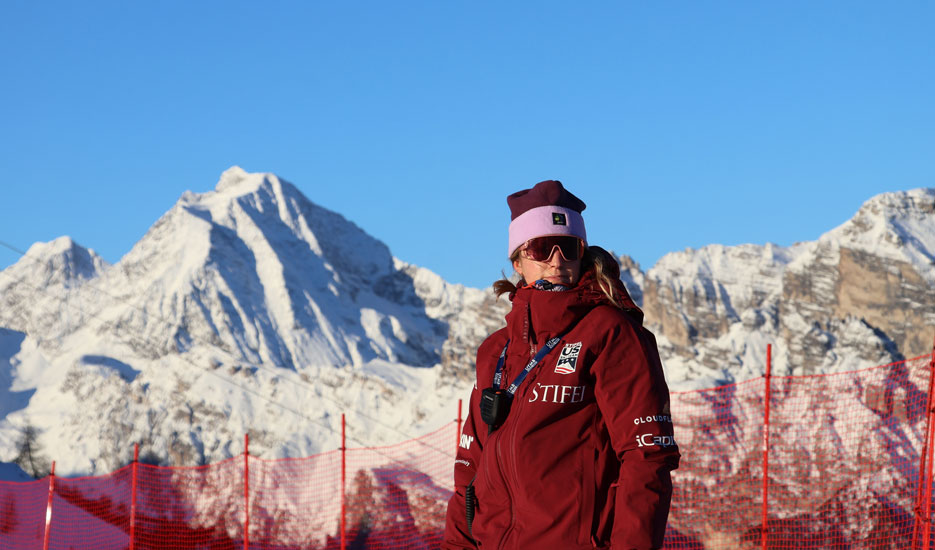
Skidmore alumna Lyndsay Strange ’09 coaches Team USA for 2026 Paralympic Games
While studying environmental studies and competing on Skidmore College’s women’s lacrosse and club ski teams, Lyndsay Strange ’09 laid the groundwork for a career that would eventually take her to the world’s biggest stage.
Now, the Skidmore College alumna is headed to Italy as an assistant coach for the 2026 Paralympic Winter Games in Milano Cortina, where she will represent Team USA as part of the U.S. Paralympic Alpine Ski Team — her third appearance at the Winter Games.
Since graduating in 2009, Strange has coached at the highest levels of international alpine ski racing, including two Olympic Winter Games. Over the past three seasons, she has worked with the U.S. Para Alpine team, helping athletes prepare for elite international competition across multiple alpine disciplines.
Strange credits Skidmore’s Creative Thought Matters ethos with shaping her approach to coaching in a sport that demands both technical precision and the ability to adapt in constantly changing conditions. As she prepares for the 2026 Paralympics, Strange reflects on her journey from Skidmore student-athlete to elite coach — and on the lessons she’s learned along the way.
Q: What are you most excited about heading into these Games, personally and professionally?
The Paralympics are a new experience for me. I’ve done two Olympics before with Team Mexico, where I coached my dear friend Sarah Schleper, an absolute legend who represented Mexico at the last two Games and is competing again this year.
The past three years have been my first experience working with para-athletes, so it’s really meaningful to head into these Games after three full seasons of growing and building with this team.
It also feels like the 2026 Games have brought unprecedented visibility to para-athletes. You’re seeing them on magazine covers, in advertisements, across marketing campaigns and social media. It’s really exciting to be part of that momentum.
Q: What’s something you’ve learned as a coach over the past three years that you carry into these Games?
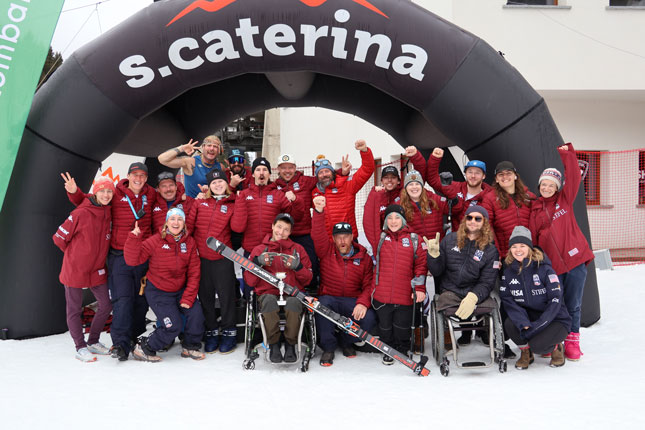
I've learned so much, especially with the Paralympics. It's all ski racing, but there are so many more variables with Paralympics and with each individual athlete. We have a big team — 12 athletes, all with their own individual strengths and weaknesses.
Taking that all on board has taught me so much about patience and about tailoring my coaching to each individual. Skiing is a sport that has so many variables. It's constantly changing, not just every day, but throughout the day and throughout the slope.
It's a lot, but it's also been an amazing experience to roll with that and push the athletes to their highest and best. It's been really hard but also really rewarding. And I feel like I've gained so much as a coach from it. But not without mistakes — and highs and lows.
Q: What does the Olympic spirit mean to you?
I feel so lucky that I've actually been able to experience it twice before. And participating in the Olympics is the biggest honor in any athlete's career. The result doesn’t even matter; getting there is the dream of all athletes.
In ski racing in particular, people are super intense. It's an individual sport, after all. But you quickly discover there’s a good person behind that facade. At the Olympics, I was blown away by how easy it was to approach literally anyone. Everyone is so friendly and open — just ecstatic to be there.
There’s also the tradition of trading country pins — it’s an instant icebreaker. It's electric. Even celebrity athletes want to trade pins. It showed me what an honor and how exciting it is to be there for everyone. Everyone is just so honored, proud, and happy to be there.
Q: Was there a specific moment this season that reminded you of why you chose this path?
This is a difficult sport and seeing the athletes achieve personal bests or overcome whatever obstacle they face and just working really hard — that’s why I'm a coach. The athletes put in so much energy, both emotional and physical. Then when it pays off, we're all so stoked.
Throughout the season, we've had some personal bests from our athletes, and we expect a lot out of them. And to see them get the result they’re striving for is what it's all about.
We're all happy for that individual, but we're all part of the team. And we all work together. That energy is pretty cool.
Q: What is something about Paralympic skiing that most people might not realize?
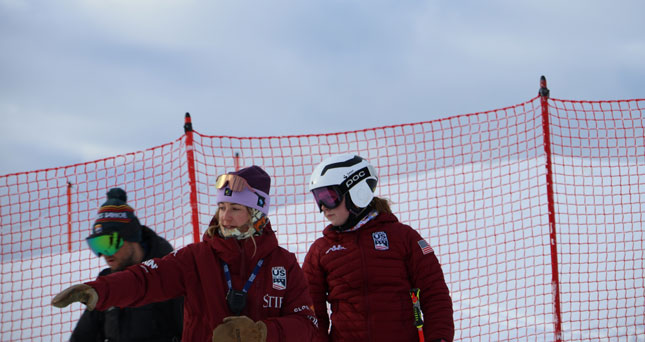
I think just how similar it is to Olympic skiing. We're on the same exact slope as the Olympic Alpine, the women's venue at Cortina. It's the same downhill, super-G, giant slalom, and slalom.
Para-athletes are doing the exact same sport — just doing it with a disability. They're moving incredibly fast and getting that ski on edge, just like able-bodied ski racers.
There's obviously so much nuance with each individual's disability, but it's the same goal of going as fast as you can from point A to point B. It's the same sport.
Q: Looking back, what from your time at Skidmore helped shape your approach to coaching and leadership?
Creative Thought Matters applies to every job and life situation. I've carried that with me throughout my career.
I started a free ride ski camp and it offers an alternative vibe to a traditional ski camp. Coaching the Para Alpine team also requires so much creativity. The ability to think outside the box is important when working with a disability and working toward the same goal as an able-bodied ski racer.
A liberal arts education teaches you to think critically and it’s what I took away from my time at Skidmore. Taking classes outside my major gave me a diverse set of skills — something I will never regret in a million years.
I loved my time at Skidmore. I love the fact that I could explore diverse interests — not just ski racing.
Q: What advice would you give to Skidmore students who want to build a career that combines their passion and purpose?
To be honest, I never took a class at Skidmore on how to be a professional ski coach. I came in with a unique skill set and developed my athletic career there — playing lacrosse and racing on the club ski team throughout college.
When I graduated shortly after the 2008 recession, I felt a lot of pressure to get a “real job” with my degree. That’s just what you do, right? I got an amazing internship that turned into a full-time job at a wind power company.
But then winter came, and I was miserable in the office. I wanted to be on the mountain. Taking that risk changed everything — and I was so much happier.
I’ve always tried to stay open to opportunities — networking, putting myself out there, exploring what’s possible — and doors opened that I never could have imagined.