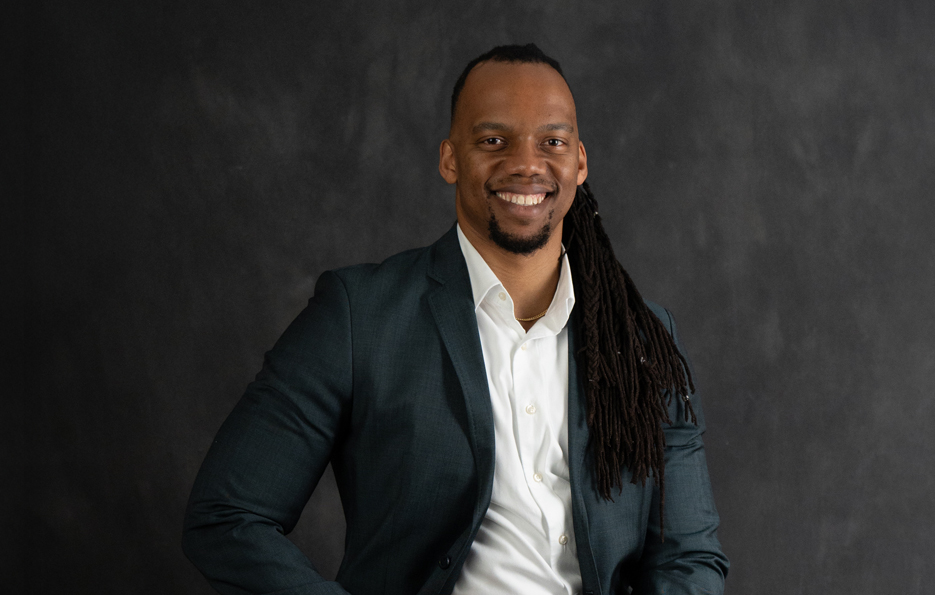
A Google software engineer on charting his own course at Skidmore
When Theko Lekena ’16 arrived at Skidmore College, he knew he wanted to be a software engineer. What he didn’t yet know was how many directions that ambition could take him — or how much he would come to value defining success on his own terms.
Today, Lekena is a software engineer at Google in New York City.
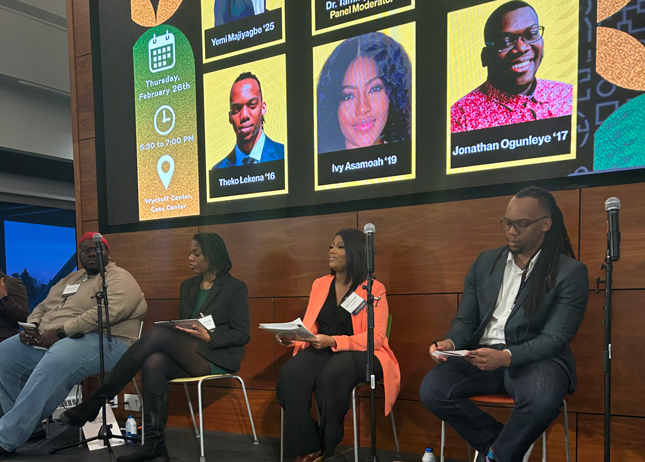
Lekena returned to campus earlier this year to participate in the Black Excellence
Panel, organized through the Career Development Center and held in Wyckoff Center in celebration of Black History Month. He joined fellow
alumni to share reflections with students on career, purpose, and resilience.
His message was both practical and philosophical: Chart your own course. His advice
echoed lessons from his own path — one shaped by curiosity, recalibration, and persistence.
Especially in the era of artificial intelligence, he says, these attributes are increasingly
important.
A crash that sparked curiosity
Growing up in South Africa, Lekena and his twin brother played on what he describes
as a “janky old” cartridge-based video game system. One day, after making hard-won
progress in a game that didn’t allow players to save, the screen suddenly filled with
gibberish.
“It was just this feeling of dismay,” he recalls. “But at the same time, I thought,
somebody out there in the world must know what happened and can fix this. And I realized
I desperately wanted to be that person.”
That mix of frustration and curiosity sparked a lasting desire to understand how technology
works — and to build it better.
Lekena arrived at Skidmore College as a computer science major. Immersing himself in everything from theory to systems, he found something
he hadn’t necessarily expected from a small liberal arts college: “an excellent computer
science program” led by deeply committed professors and defined by small, rigorous
classes.
“You hear about these engineering powerhouse universities like Georgia Tech, Carnegie Mellon, and Caltech. But I had incredible computer science professors at Skidmore. That’s something that deserves far more recognition.”- Theko Lekena ’16, Google software engineer
Building skills for the real world
Hands-on experiences on campus and beyond deepened that learning, allowing him to
apply theory in real-world settings and refine his understanding of the profession
he hoped to enter.
As a student staff member at Skidmore’s IT Help Desk, he learned what it meant to
apply technical knowledge in real time. He troubleshot malfunctioning laptops and
helped classmates navigate digital crises under deadline pressure. The role demanded
not just technical skill but also communication, patience, and empathy. The job would
prove unexpectedly formative later on.
Lekena also interned as a software developer at Odd Networks, a newly created startup
at the time that developed streaming service technologies. The internship helped clarify
the distinction between writing code and engineering software systems.
“Studying computer science from a classroom perspective can make you a very good programmer,”
he explains. “But the elements that ultimately make you a good software engineer are
things you learn while working with other people to build complex systems.”
A strategic first step
That blend of academic rigor and practical experience proved critical after graduation,
when Lekena attended a National Society of Black Engineers career conference and interviewed
with Google. The role was to work within a yearlong IT residency program, which focused
on internal technical support, much like the work he did for Skidmore’s IT Help Desk
but on a global scale.
Crucially, he leaned on his Skidmore IT Help Desk experience during the interview
process. The troubleshooting, user support, and steady communication translated directly.
The position placed him on a team supporting Google employees across operating systems
and devices, helping maintain the technical infrastructure that keeps a global company
running. Although it wasn’t the engineering role he had initially envisioned, he recognized
it as a strategic entry point into one of the world’s leading technology companies.
While rooted in IT support, the residency emphasized continuous learning. Participants
were encouraged to identify technical areas they wanted to explore and to build new
skills alongside their daily responsibilities. That push toward self-directed growth
shaped his trajectory.
Lekena soon rotated into a software engineering role in California, working within
Google’s compiler infrastructure, the foundational systems that translate human-readable
programming languages into machine instructions. He later spent two years engineering
blockchain infrastructure at financial technology company Axoni before returning to
Google.
Defining success on your own terms
Today, Lekena works on an infrastructure team within Google Search, building developer
tools that support the engineers who create features used by millions of people. His
team develops systems that help product teams measure how new features perform once
released, from updates to search results and navigation tools like Google Maps to
the latest features that include AI shopping and planning tools.
Artificial intelligence is increasingly shaping that landscape, he notes. For Lekena,
that means maintaining a mindset of constant learning and adapting to new tools and
approaches as technology evolves.
At the Black Excellence Panel, he encouraged students to think intentionally about
their own definitions of success, noting that success is not handed out fully formed.
It is refined through experience and pursued with intention, strengthened through
iteration, resilience, and a willingness to keep learning.
“Be willing to start climbing,” he advises. “It might not be a straight line, but
there will be a path upward.”