


Science center to make Skidmore even greener


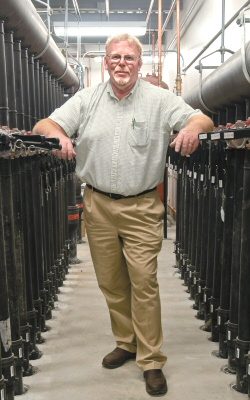
Lundberg at a campus geothermal hub
This summer Skidmore begins the installation of geothermal wells for the college's future Center for Integrated Sciences. The work will include blasting through and removing rock and drilling some 240 wells nearly 500 feet deep (currently, there are 430 wells operating on campus.)
Bad news: It'll be inconvenient for some building and parking access. Good news: It'll raise to more than 50% the amount of campus building space being heated and cooled geothermally—a very sustainable and cost-effective system.
"No other college in our region has reached the 40% geothermal mark," according to
Paul Lundberg, a project manager in Facilities Services. "But what makes Skidmore
truly distinct is our district approach to capturing and distributing geothermal energy.
No one else in the area is doing this.
A district field supplies heating and cooling energy to multiple buildings, unlike
stand-alone systems that serve a single building. By creating district systems, Skidmore
has reduced the number of wells required to support the associated campus buildings,
as well as the associated infrastructure. The college has installed two district fields
and related "energy nodes"-one behind the Janet Kinghorn Bernhard Theater building,
the other on the south side of the Tang Museum. This summer's CIS project will be
the third.
Did you know…
- 12% of campus electricity comes from a large solar array and 18% from a small hydroelectric dam
- Skidmore already has 430 geothermal wells, serving the Zankel Music Center, Filene Music Building, Saisselin Art Center, Northwoods and Sussman Village apartments, Murray-Aikins Dining Hall, Wiecking Hall, Tang Museum, and Dance Center
- 40% of campus electricity comes from renewable sources (10 % comes from direct purchase of green power from Skidmore's supplier), with a goal of 60% by 2025
- Six rooftop solar hot-water projects offset natural gas and electricity use
- Since 2000, Skidmore's energy use for campus heating and cooling, both per student and per square foot, has dropped by 50%; the goal is 60% by 2025
- Skidmore's greenhouse-gas emissions fell by 48% between 2000 and 2013; stats to be gathered soon could show the drop to be nearly 75%, the 2025 goal.
- Soon more than half of campus building space will be heated and cooled through geothermal energy, with a goal of 60% by 2025