The Declaration’s unfinished promise and the responsibilities of citizenship
Political philosopher Danielle Allen challenged Americans to view democracy not only as a system of government or a set of inherited rights, but as an ongoing project requiring active participation, engagement with differing perspectives, and a commitment to continuous improvement.
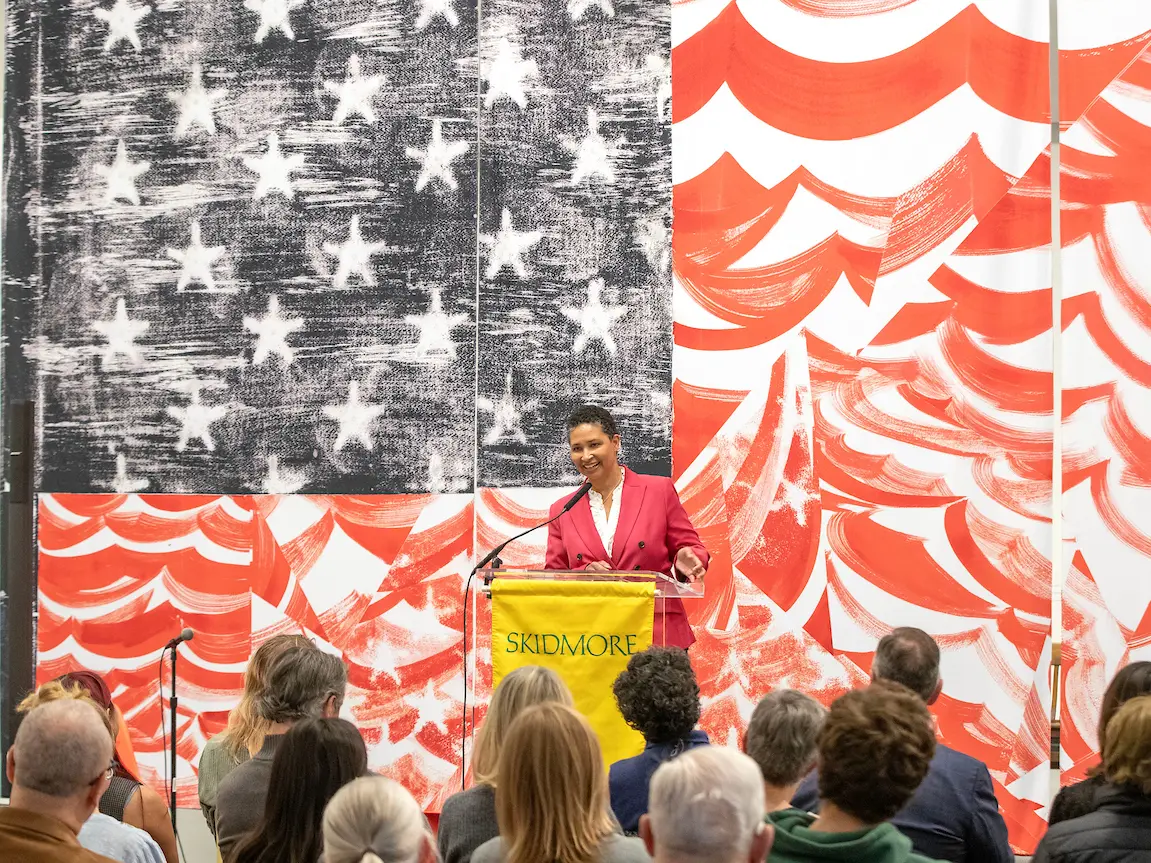
Allen discussed the responsibilities of citizenship and the enduring promise of American democracy during “America at 250: The Declaration’s Unfinished Promise,” the 11th Kuroda Symposium in Early American Politics and Culture, on Oct. 23 at Skidmore College's Tang Teaching Museum and Art Gallery.
“Democracy requires perpetual engagement, perpetual commitment, a daily practice, just like exercise,” Allen said.
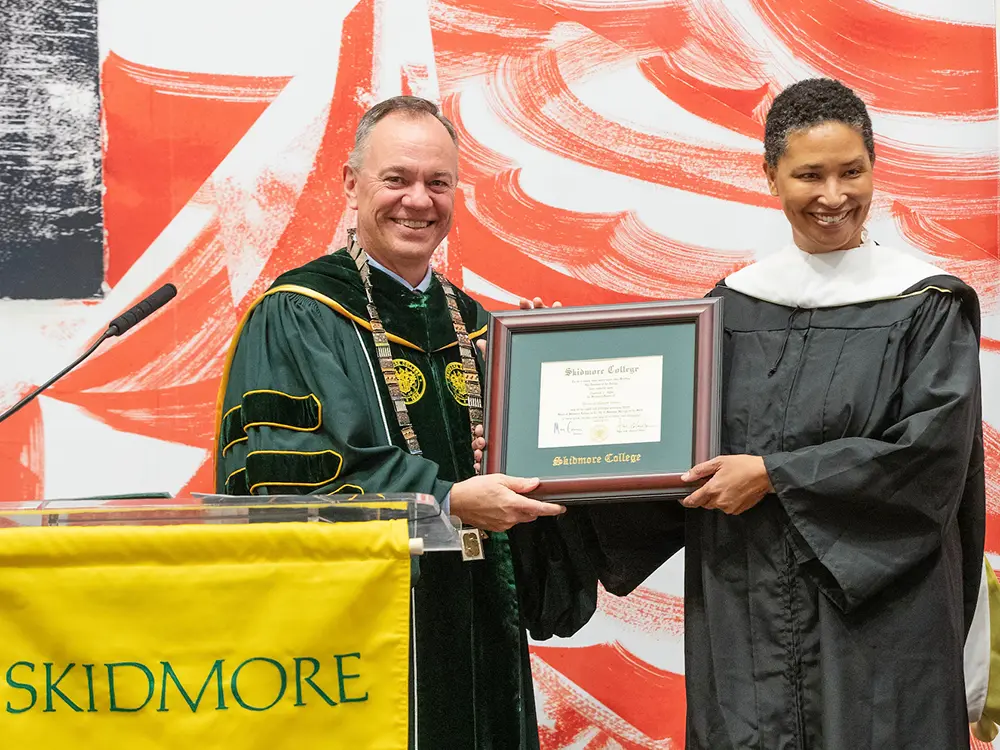
Allen, a Harvard University professor and author of “Our Declaration: A Reading of the Declaration of Independence in Defense of Equality,” also received an honorary doctorate of humane letters from Skidmore, conferred by President Marc C. Conner.
In presenting Allen for the degree, Natalie Taylor, interim dean of the faculty and vice president for academic affairs and associate professor of political science, praised Allen's contributions to democratic thought and civic education, including her commitment to the promise of American democracy despite its shortcomings.
As the United States marks the 250th anniversary of the Declaration of Independence, Allen argued in her lecture that the founding document’s central promise lies in its recognition of human equality and the ability of individuals to shape their own lives and communities.
Allen recalled how she came to that conclusion while teaching the Declaration to working adults in a University of Chicago humanities evening program. Many of those students, Allen recalled, were balancing jobs, families, and other responsibilities and recognized in the Declaration a statement about human agency and the ability to chart a better future.
“Everything that I think about the Declaration of Independence, I gained from my night students,” she said.
She also explored the contradictions between the Declaration’s ideals and the political institutions established by the founders, which excluded women, enslaved people, and others from exercising political power.
She argued that fulfilling the Declaration's promise of equality requires not only protecting individual rights but also ensuring that all people have opportunities to share political power and responsibility.
“Government will only be for the people if it is always by the people,” she said, drawing on Lincoln’s Gettysburg Address.
During a Q&A with the audience, Allen emphasized that democracy requires more than voting. She called for openness to differing viewpoints, careful listening, and a willingness to compromise without abandoning core values.
“I talk a lot about cultures of pluralism and the way in which we need to foster that. It goes back to the idea of debate being at the center of who we are and what we need to be able to do. So in colleges and universities, for example, I think it's really important for us to be able to learn and hear each other,” she said. “Repeat back what somebody said to you before you respond to it and check whether you heard them right first before you respond."
“Compromise has become a dirty word. It needn't be. It doesn't mean giving up core values. It means finding a negotiated settlement that actually protects the value space of the two parties.”
Allen also encouraged colleges to make civic education a shared experience for all students, pointing to first-year programs that foster discussion of democracy, citizenship, and civic responsibility.
Her remarks echoed Skidmore's commitment to preparing students for democratic citizenship, reflected in President Marc C. Conner's participation in College Presidents for Civic Preparedness (CP2), an initiative promoting civic engagement, free expression, and dialogue across differences.
Before the public lecture, Allen met with Skidmore students who had read selections from “Our Declaration.” The Kuroda Symposium, sponsored by the departments of History, Political Science, and American Studies, honors the legacy of longtime Skidmore history professor Tadahisa Kuroda and his commitment to liberal education.
Allen delivered her remarks in the Tang exhibition “Mark Thomas Gibson: We Are a Constellation,” which explores how art and historical memory can encourage citizens to reflect on the nation's past and take responsibility for the future.