A Skidmore tale of Robin Hood
Before Thomas Rivera-Patterson was forging philanthropic partnerships for one of New York City’s largest anti-poverty organizations, he was a first-generation college student from the South Bronx stepping into an unfamiliar world.
Today, the Skidmore College alum serves as an individual giving and engagement leader at Robin Hood Foundation, where he builds partnerships that expand economic opportunity for New Yorkers.
He is also helping current first-generation Skidmore students build the relationships, networks, and sense of community that helped him find his own footing.
“People talk about low-income communities mostly in terms of what they lack,” says Rivera-Patterson, who attended All Hallows High School, where he found structure, mentorship, and a balance of academic discipline and service to others. “But I remember community. I remember sharing. I remember helping your neighbors and learning how to be a good person.”
What he did lack, however, were resources — both educational and financial. He would not fully recognize that disparity until he arrived as an Opportunity Program student at Skidmore, where scholarship support and access to a nationally recognized liberal arts college opened doors.
The power of mentorship
At Skidmore, Rivera-Patterson majored in management and business and quickly emerged as a student leader. By sophomore year, he was the Student Government Association’s vice president for academic affairs. At times, he found himself navigating spaces where representation among students and faculty felt limited.
“I didn’t always feel like I belonged,” he acknowledges.
At the same time, Rivera-Patterson credits Skidmore with profoundly shaping his worldview and expanding his sense of possibility.
Two relationships, in particular, left a lasting impression.
Through his work with student government, he met Susan Kress, then vice president for academic affairs, who challenged students thoughtfully while making them feel heard and supported.
“Susan was like a second mom to me on campus,” Rivera-Patterson says. “You find your people. Susan was one of mine.”
Kress says meeting Rivera-Patterson was a highlight of her time as a vice president.
“I admired his leadership, his inclusive vision, his ability to see the big picture, his generosity, and his honesty,” Kress says. “A good mentoring relationship is always about shared learning, and I certainly learned a lot from him.”
Meg Jacobs ’63, whose scholarship support helped make Skidmore financially possible, also became both a mentor and friend. The two met at a campus scholarship dinner, and they still catch up in person in New York City.
“It wasn’t just about writing a check. It was mentorship. It was consistency. It was showing up,” Rivera-Patterson says of Jacobs.
Jacobs says Rivera-Patterson has inspired her as well.
“Watching Thomas come full circle has been incredibly meaningful,” Jacobs says. “I’m proud of his perseverance, the choices he’s made, and the way he’s using his experience to help other students find opportunity and confidence in themselves.”
Believing in belonging
Rivera-Patterson worked in corporate partnerships before dedicating his career to the nonprofit sector. He first returned to All Hallows as its director of development and alumni relations. The position allowed him to combine relationship building, fundraising, and community engagement in the service of the school that had shaped him.
He went on to serve as a major gift officer at New York University and later as executive director of Thrive Scholars, which supports high-achieving students from underserved communities through college.
Today, he works with donors and partners at Robin Hood Foundation to support programs that expand opportunity and economic mobility for New Yorkers.
“There’s a throughline of Skidmore throughout my life” Rivera-Patterson says. “When I think about the relationships, mentorship, and opportunities that shaped my path, so many of them trace back to my time there.”
His renewed involvement with Skidmore grew out of a desire to help students navigate the kinds of questions he once faced himself.
Looking back, he is encouraged to see that Skidmore has continued to evolve with a stronger focus on helping students feel welcomed, supported, and valued.
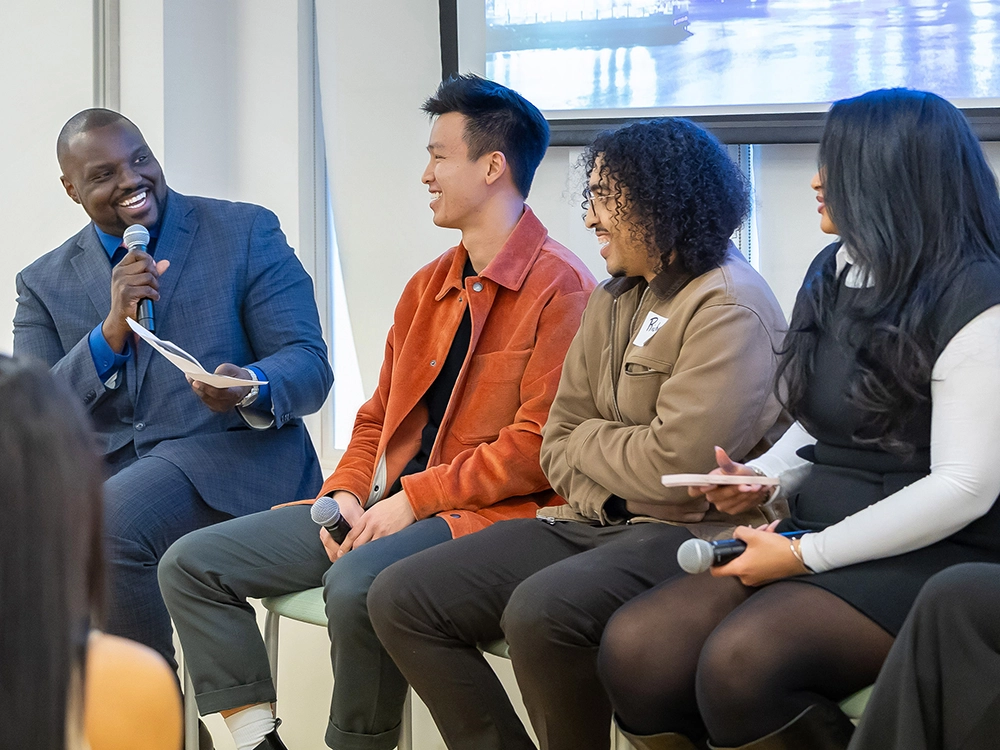
A turning point came when he returned to campus for a Black Excellence Career Panel organized by the Career Development Center, the student club Ujima, the Office of Alumni Engagement, and other campus partners.
Afterward, several students approached him to say they connected with his story and perspective. A short while later, he began organizing weekend mentorship sessions, focusing on networking, internships, postgraduate opportunities, further education, and confidence building.
“Thomas had already been where many of us were,” says Prince Shyllon ’26. “He understood the challenges of being a first-generation student at Skidmore, and he showed us that building relationships and learning from people with different experiences could open doors we didn’t even know existed.”
Shyllon was among the students who connected with Rivera-Patterson after the panel and later joined the mentorship sessions. He also attended two First to Future events that Rivera-Patterson hosted at Robin Hood. The events brought together first-generation students and alumni to build relationships, exchange advice, and expand professional networks.
“Being a first-generation student, you don’t know what you don’t know,” says Shyllon, who graduated in 2026 and is now an investment banking analyst at M&T Bank in Maryland. “Thomas had already been through that journey at Skidmore, so having someone who understood those experiences — and could show us how relationships and mentorship open doors — made all the difference.”
At a First to Future gathering earlier this year, Rivera-Patterson emphasized that authentic relationships are one of the most powerful forms of social capital. Connections rooted in mentorship, trust, and mutual support, he said, can create opportunities throughout a lifetime.
“Before anything else, you have to believe that you belong,” Rivera-Patterson says. “If you intentionally build relationships with people who are kind and willing to share knowledge, you can become unstoppable.”
It’s a lesson that helped him navigate an unfamiliar world and one he is now passing on to a new generation of students.
Issa Siby ’27, a management and business major whose family immigrated from Mali to the Bronx, first met Rivera-Patterson at the Black Excellence Career Panel. He stayed connected through mentoring sessions and programs Rivera-Patterson organized in New York City. The relationships and networking skills Rivera-Patterson encouraged helped Siby build professional connections and secure an internship with Harlem Children’s Zone, another nonprofit dedicated to fighting intergenerational poverty.
But Siby says Rivera-Patterson’s greatest impact was the confidence he inspired.
“He gave me the confidence to believe I belonged in rooms that I once thought were out of reach,”
Siby says of Rivera-Patterson. “His mentorship has shaped not only my career aspirations but also the kind of leader I want to become. One day, I hope to mentor students from backgrounds like mine just as he has mentored me.”
This story originally appeared in the fall 2026 issue of Skidmore College’s Scope magazine.