Beyond business as usual: A new perspective on global capitalism
A first-year seminar at Skidmore College inspired Professor Pushkala Prasad to embark on an eight-year research project spanning centuries of world history and ultimately produce a book that challenges conventional ideas about global capitalism.
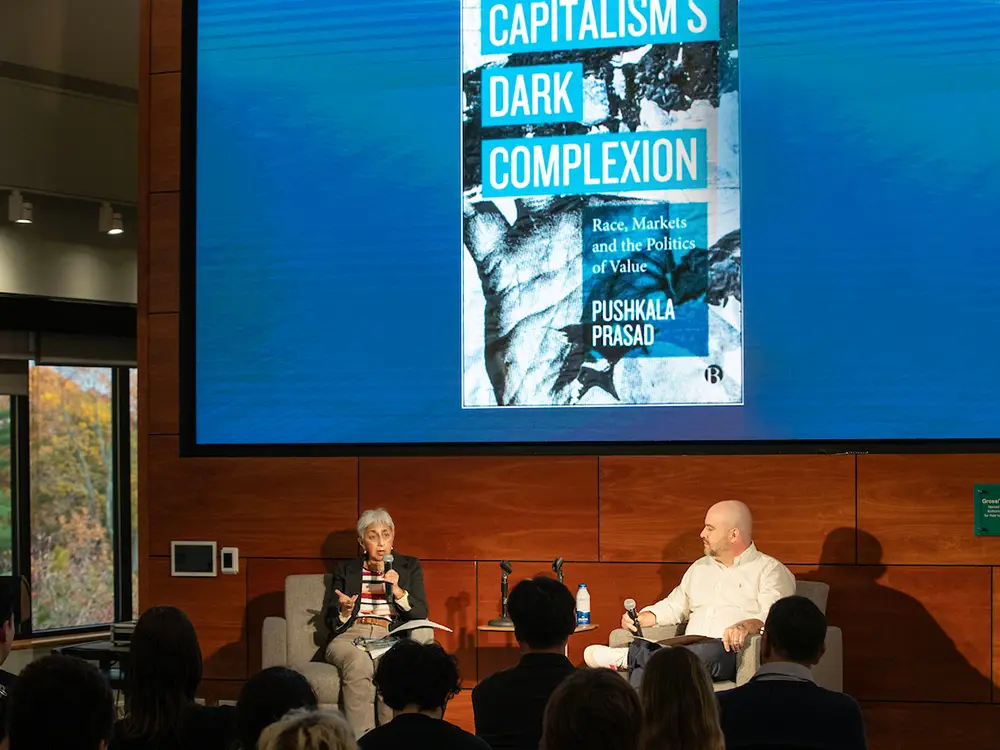
The Zankel Professor of Management for Liberal Arts Students traces origins of “Capitalism's Dark Complexion: Race, Markets and the Politics of Value” (Bristol University Press, 2026) to questions posed by students in her Scribner Seminar Life, Liberty, and the Pursuit of Capitalism.
As Prasad and her students explored the ideas of influential thinkers such as Adam Smith and Karl Marx, they began asking questions that traditional explanations of capitalism did not fully answer. Students also questioned whether these theories adequately explained how capitalism actually operated in different societies.
How did capitalism develop outside Europe? How have race, colonialism, and unequal access to power shaped markets? And how do those historical forces continue to influence business today?
For Prasad, who grew up in India, these questions also reflected her commitment to bringing a broad range of perspectives into the classroom. She recognized that traditional accounts of capitalism often emphasized European thinkers while overlooking the experiences of people in Asia, Africa, and other parts of the world.
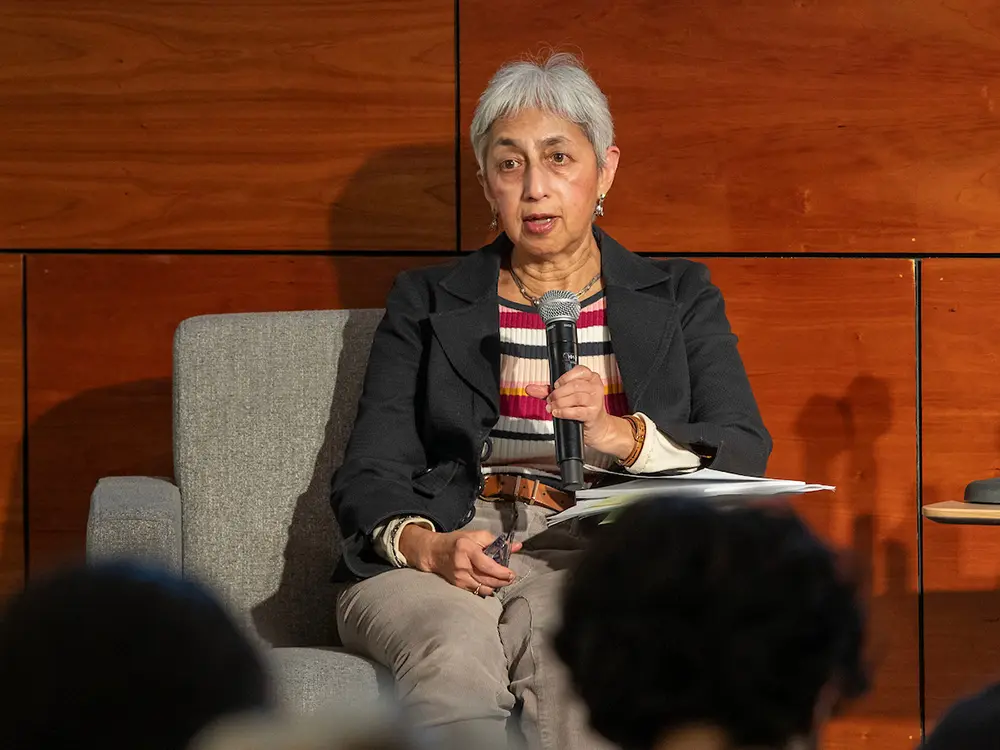
Her approach reflects the distinctive liberal arts character of Skidmore's Management and Business Department, where students connect business concepts with history, politics, culture, and other fields. Rather than studying markets and management in isolation, they are encouraged to question assumptions, consider different perspectives, and understand the broader consequences of business decisions.
Prasad, who also teaches in Skidmore’s International Affairs Program, discussed her book during an Oct. 26 campus conversation with Jonathan Lohnes, assistant professor of management and business, in the Wyckoff Center.
She examines what scholars call racial capitalism — the idea that racial distinctions have helped shape economic opportunities, determine whose labor is valued, and influence who benefits from trade and commerce.
Her book argues that racial inequality has not simply existed alongside capitalism but has also played an important role in its development.
“It's an extraordinary work, both in its geographical and historical scope and in the breadth of its intellectual contributions,” Lohnes said, praising the book for challenging conventional assumptions about how capitalism works and how racial inequalities are created and perpetuated.
Prasad illustrates her argument through examples from around the world. She examines how commercial interests contributed to the displacement of Indigenous peoples in North America, including through the fur trade and the destruction of bison populations in North America. Other chapters explore discrimination against Chinese workers in the United States and Australia, exploitation in global labor markets, and the marketing of skin-lightening products in India.
Together, these examples encourage readers to consider questions beyond traditional measures of business success: Who benefits from economic activity? Who bears its costs? And how do historical inequalities continue to shape today's economy?
That intellectual curiosity also informs her teaching at Skidmore. In courses such as Faces and Phases of Global Capitalism, Foundations of Business in the International Environment, and Diversity and Discrimination in the American Workplace, she challenges students to examine how business decisions intersect with culture, history, identity, and social responsibility.
“Capitalism is complicated. It defies disciplinary containment,” Prasad said. “We should draw on the work of others, especially in a liberal arts setting.”
Lohnes' own background offers another example of the department's approach. His graduate degrees are in Middle East history, and he completed postdoctoral research in medical anthropology and critical global health.
Their academic backgrounds illustrate how Skidmore faculty bring a range of interdisciplinary expertise to the study of management and business, helping students develop the critical thinking skills needed to understand complex challenges.
A social scientist by training, Prasad earned her doctorate in management, specializing in organizational studies, from the University of Massachusetts Amherst. Before coming to Skidmore, she taught at the University of Calgary in Canada and held an endowed professorship in Sweden. She continues to serve on the Nobel Prize in Economics nomination committee in Sweden.
She has held the professorship endowed by Arthur Zankel at Skidmore for more than two decades. Her scholarship explores workplace diversity, organizational culture, and global capitalism, and she has published extensively in academic journals and books.
Known to colleagues as “Pushi,” Prasad received the 2026 Ralph Ciancio Award for Excellence in Teaching, Skidmore's highest teaching honor.
In 2017, she delivered the Edwin M. Moseley Faculty Lecture — the highest honor Skidmore faculty can bestow on a colleague — on the topic “(Ir)resistible and (Dis)reputable Empire: Racialized Capitalism and the Tainting of Brand USA.”
During the book discussion, Prasad reflected on how her experience reversed the usual relationship between teaching and scholarship: Rather than bringing her research into the classroom, she found herself pursuing research inspired by her students' questions.
“This is completely the opposite,” she said, explaining that the project originated in the classroom. “Skidmore allows me to break out of the disciplinary mold and pursue what is important while connecting directly with students.”
Prasad isn't alone. Professor of Political Science Beau Breslin's book “A Constitution for the Living” (2021) similarly grew out of a first-year Scribner Seminar.