Revolutionary perspectives
Graham Beers ’26 knew almost nothing about Charles James Fox when he volunteered to spend a semester being the 18th-century British politician.
Early in the semester, Professor of History Tillman Nechtman presented historical figures whom students could study as part of the course The History and Political Thought of the American Revolution, co-taught with Natalie Taylor, associate professor of political science and interim dean of the faculty and vice president for academic affairs.
“Who wants a scoundrel?” Beers recalls Nechtman asking the class wryly.
Benedict Arnold was already taken, so Beers raised his hand.
Fox turned out to be an illuminating choice. The British politician supported the American Revolution and championed liberty while grounding his ideas in the traditional rights of Englishmen. He later opposed the slave trade but did not reject Britain’s empire in India, instead arguing that it should be better governed.
Beers described Fox as a colorful character who liked to have a good time and frequented racetracks.
“I’m sure he would have a great time in Saratoga,” Beers joked.
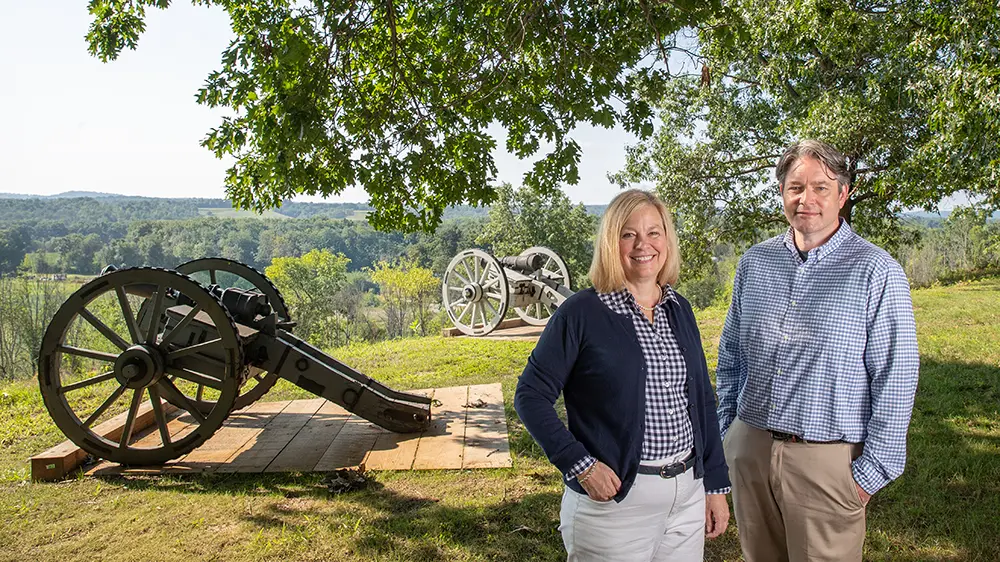
As Americans observe the nation’s semiquincentennial, the course — jointly taught by a historian of the British Empire and a political theorist — offers Skidmore students a unique window through which to reconsider the American Revolution in a place close to some of its most dramatic moments. Saratoga National Historical Park, site of battles that helped turn the course of the Revolution, is a short drive from Skidmore’s campus.
Years ago, Nechtman and Taylor inherited the course from an earlier generation of faculty, including Erwin Levine, the late professor emeritus of government, and Tad Kuroda, the late professor emeritus of history. It is a remnant of a time when history and political science, formerly government, were part of the same Skidmore academic program.
But Nechtman and Taylor have also made the course their own, integrating their distinctive scholarly perspectives and an imaginative approach that asks students to inhabit the worldviews of historical figures.
The course, Nechtman says, “grew up in the soil of Skidmore.”
Early in the semester, each student is assigned an individual touched by the revolutionary struggle. Some are Americans, others British; some Patriots, others Loyalists. Many deliberately defy simple categories.
Students spend the semester researching their person, eventually producing a substantial biographical paper examining the Revolution from that historical figure’s perspective. Along the way, Taylor and Nechtman encourage students to consider how that person might respond to the documents, ideas, and events under discussion.
As their research deepens, students increasingly see the Revolution through multiple perspectives. They sometimes find themselves speaking as their figures, challenging one another by making arguments their 18th-century counterparts might have made.
The professors intentionally ask students to explore figures whose roles in the American Revolution may not be as well known. This year, Martin Heidebrecht ’28 researched Benedict Arnold; Olivia Kagan ’26 studied Samuel Johnson; Simon Stephenson ’26 studied Phillis Wheatley; and Mariama Dabo ’28 took on John Dickinson.
“We try to stay away from the really big names,” Taylor explained.
Lesser-known or complicated figures allow different questions and perspectives to emerge. Wheatley, who was enslaved and brought to North America, offers a way to consider the tension between slavery and the principles of the Declaration of Independence.
Arnold, a hero of the Battle of Saratoga best remembered for later abandoning the American cause, presents another challenge: He made one choice at one moment and another later. Students must consider political ideas alongside ambition, relationships, careerism, and changing circumstances.
That complexity is the point.
“We want the students to understand all the angles people approached the conflict from,” Nechtman said. Rather than pushing students toward one side or another, he wants them to understand why people disagreed strongly enough about political ideas to end up “behind different fences shooting at each other.”
“That’s where the history and the political theory really meet,” he added.
For Taylor, the Revolution raises enduring questions about human nature, freedom, equality, and government. Ultimately, she wants students to understand that ideas matter in politics.
“The debate over what it means to be free is the reason that the war was fought,” she said.
While Skidmore’s proximity to the Saratoga battlefield and other historic sites can help make the Revolution tangible, Nechtman situates the war within the much larger British imperial world.
Britain was trying to govern not only its North American colonies but an empire that stretched to India. Even the tea dumped into Boston Harbor came from India through the East India Company.
“I happen to be the British historian who teaches closest to the battlefield at Saratoga,” he explained, adding that Skidmore’s location allows the course to put the British Empire “in everyone’s backyard.”
Nechtman regularly assigns a student to research Warren Hastings, governor-general of India. He wants students to imagine someone in Calcutta following events across the Atlantic and wondering why Britain was losing control in Boston or New York while British power was expanding elsewhere.
The result is a Revolution that looks considerably larger, with consequences extending far beyond the emerging United States.
Asking students to inhabit unfamiliar perspectives also encourages intellectual humility — a quality with relevance beyond an 18th-century battlefield.
As contemporary American politics has grown more polarized, Taylor says, the professors have devoted greater attention to helping students recognize that “there are always two sides to the story, and two things can be true.”
The British and American colonists who ultimately went to war, she noted, shared a great deal even as their political differences became irreconcilable.
The comparison allows students to approach contemporary political disagreement indirectly — and perhaps with less certainty about their own assumptions.
Two hundred and fifty years after independence, that may be one of the Revolution’s most enduring lessons.
For Beers, spending a semester with Fox complicated his understanding of the past. He came to see a privileged, roguish British politician who could nevertheless take seriously the claims of people fighting for liberty.
“He had this complicated relationship with fighting for what you believe in,” Beers said. “There’s something completely not admirable about that, but he still got there.”
This story originally appeared in the fall 2026 issue of Skidmore College’s Scope magazine.