Polar Athletics captures top prize at 2026 Freirich Entrepreneurship Competition
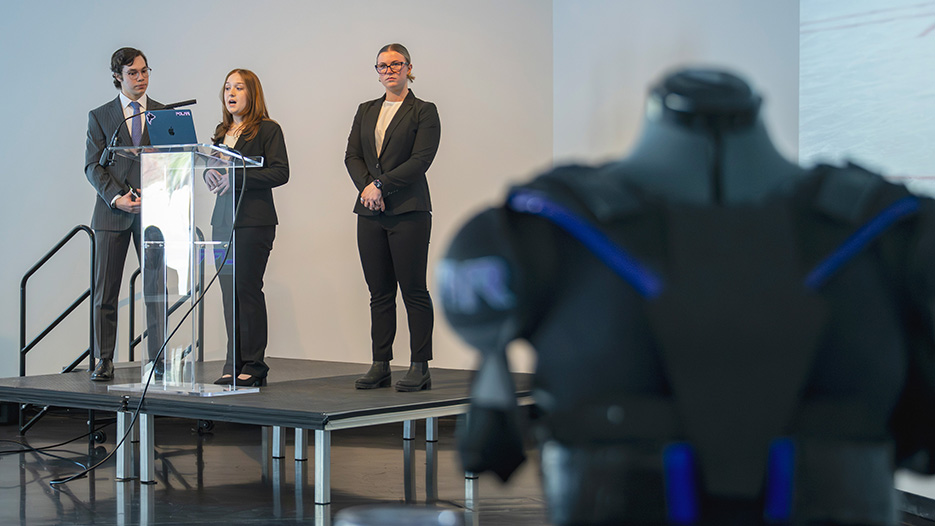
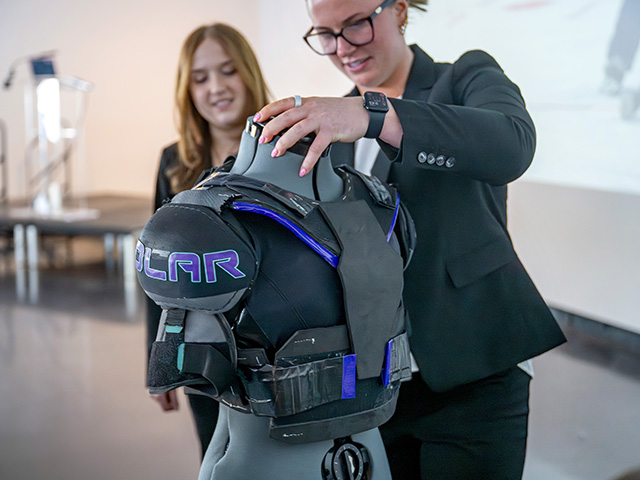
Management and business majors Liala Cryer ’26, Justin Shafritz ’26, and Molly Smith ’27 claimed first place and a $20,000 prize at Skidmore College’s 2026 Kenneth A. Freirich Entrepreneurship Competition for Polar Athletics — anatomically tailored, modular hockey gear designed specifically for female athletes.
Held Feb. 27 in the Payne Room at the Tang Teaching Museum, the finals featured eight student teams presenting refined business plans and prototypes before a panel of alumni judges.
Polar Athletics’ victory marks a notable return: Members of the team placed third in last year’s competition and spent the past year further developing their product — even participating in the Rev: Ithaca Startup Works Hardware Accelerator, where they built multiple prototype iterations and had female athletes test their designs.
Sara Burr '25, who participated in last year's competition and graduated with a degree in biology, has remained active in Polar Athletics. The team also worked with alumni mentor Mark Josepheson ’94 P’27 — an executive coach and former CEO of Bitly — to refine their manufacturing strategy and market positioning.
“Since competing last year, we've made significant progress in customer discovery and product design,” said Liala Cryer, who is also pursuing an entrepreneurship minor in addition to her management and business major.
“Being paired with a mentor and receiving feedback from alumni entrepreneurs was invaluable; both pushed us to think bigger, communicate more clearly, ask stronger questions, and build more intentionally.”
"We’re so grateful to Skidmore and for this competition, and we’re excited to keep building Polar Athletics and bring better-fitting gear to female athletes.”
Polar Athletics addresses a longstanding gap in the sports equipment market by designing high-performance hockey gear built for women’s bodies rather than adapting existing men’s equipment.
Second place and a $10,000 prize went to Cody Jones ’27 for Amoeba, a keychain-mounted minimalist phone designed to reduce social media use while preserving essential tools such as navigation, ride-sharing, music, and banking apps. A standalone device with a SIM card slot and custom app store, Amoeba is built on a miniaturized Android platform and positioned as a lower-cost alternative to existing minimalist phones.
The computer science major has completed a working prototype, secured a patent-pending design, and obtained manufacturing quotes for an initial pilot run. The venture also benefits from an existing marketing pipeline, including a social media series that has generated millions of views. Amoeba was mentored by Max Walker ’13, founder of Piton Labs and a former Freirich competitor.
The $5,000 third-place prize went to Rally, an all-in-one travel planning and booking platform for friends created by Will Duxbury ’26, Milo Flamenbaum ’26, Tom Fuller ’26, and Adam Tieu ’26. Designed to simplify group travel, Rally integrates itinerary building, in-app messaging, bill splitting, document storage, and AI-supported decision-making tools into a single platform. The team’s business model includes a premium subscription option and affiliate commissions from partner booking platforms. Rally was mentored by Tal Chitayat ’03, CEO of Full Circle Brands.
Endowed by entrepreneur and alumnus Ken Freirich ’90, the annual competition underscores Skidmore’s commitment to fostering creativity, innovation, and entrepreneurship across disciplines. The program is open to students of all majors.
This year's finalists are pursuing multiple majors, including physics, neuroscience, economics, and international affairs. Their projects also spanned multiple industries, with products ranging from adaptive clothing and 3D-printed protheses to AI-powered call center agents and tennis workouts.
The competition challenges participants to develop viable business plans, refine prototypes, and respond to rigorous questioning from experienced alumni investors and executives.
The eight finalist teams presented to a distinguished panel of alumni judges: Dan Allen ’90, co-CEO of Mycor Capital; Sara Nolan Arnell ’82, branding and marketing executive and founder of Salt Stone; Bill Caleo ’99, co-founder of The Brooklyn Home Company; Winnie Wan ’74, biotech executive and entrepreneur; and Rich Wartel ’91, founder of One Lab Innovation.
This year’s finals opened on a somber note following the unexpected death on Feb. 1 of Senior Teaching Professor of Management and Business Cathy Hill, a champion of entrepreneurship at Skidmore who had served as faculty coordinator of the program since 2020. Executive in Residence Colleen Burke stepped in to coordinate this year’s finals and led participants and attendees in a moment of silence for Hill.
Pointing to Hill’s enduring impact, Cryer noted Polar Athletics started as an academic exercise in Hill’s Entrepreneurship and Small Business course and “has turned into a project I never want to stop building.”