


For women only


When you think of Chinese characters, probably what come to mind are beautiful works of calligraphy, the form of writing that is at once language and art. But there is another form of Chinese writing crafted exclusively by women in a once-remote corner of Hunan Province, and while it could sometimes be beautiful, it was for social communication: writing letters and autobiographies, celebrating marriages, offering condolences, and telling favorite stories, all in formulaic verse to be sung or chanted in haunting melodies.
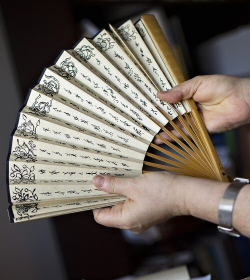
Fan with nüshu text
This nüshu, or women's script, was stumbled upon in the early 1980s, and Skidmore professor
Cathy Silber has been fascinated by it since 1986, when she was teaching English in
Inner Mongolia. "I had recently completed a master's thesis translating a Chinese
woman poet," she recalls, "so I was already interested in women's writing and women's
issues." By 1988, she was living down the lane from one of nüshu's last surviving writers and studying with her daily.
Unlike the standard Chinese script, where each character represents a syllable with
a distinct meaning, nüshu is both syllabic and phonetic, with each syllable representing a distinct sound that
may have several meanings. The writing, which likely dates from the late 19th century,
is now virtually extinct, says Silber, who is the only Western scholar to have worked
extensively with nüshu's last writers.
Nüshu has been called a secret language, but it is actually a written form of local speech.
Men could understand it when spoken, but not on paper. That gave women their own means
of communicating with each other: "In a sex-segregated society, it was a 'girl thing,'"
Silber explains. Truth is, she adds, "men were not exactly clamoring to be let in
on the secret, just as they were not storming the lofts demanding to learn embroidery."
Silber, who teaches Mandarin Chinese at Skidmore, is writing a book on the script
and compiling her translations of the writings of her teacher, Yi Nianhua, who died
in 1991.
Silber has debunked any preconceptions she had that nüshu was a marker of women's liberation. "It was not a weapon to change patriarchy," she
says. Rather, it was a way for women to express themselves and, through that process,
understand themselves. Of course, she adds, "they definitely wrote about gender-based
oppression." After all, the beautiful sanzhaoshu—cloth-bound missives from female relatives and friends to new brides—offered condolences
as well as good wishes.
Nüshu texts have disappeared over time—some burned or buried with their writers for enjoyment
in the afterlife, others destroyed during the Cultural Revolution or gathered up by
scholars from other parts of China. The local language is still spoken, but its only
writers these days are official transmitters in a Ford Foundation-funded museum, keeping
it alive for tourists and calligraphers. "Nobody's really writing it for personal
reasons," Silber says.
But it is those personal reasons that continue to fascinate Silber, who has some 40
precious copies of nüshu texts, some on newsprint, some on cloth, some on fans. Tucked into the pages of a
lovely sanzhaoshu might be bits of embroidery floss and paper patterns—and on the pages themselves,
revealed in the long thin lines and careful dots of the script, rare glimpses into
women's lives in a small corner of rural China over the last century.