Finding a homegrown community through Gardenside
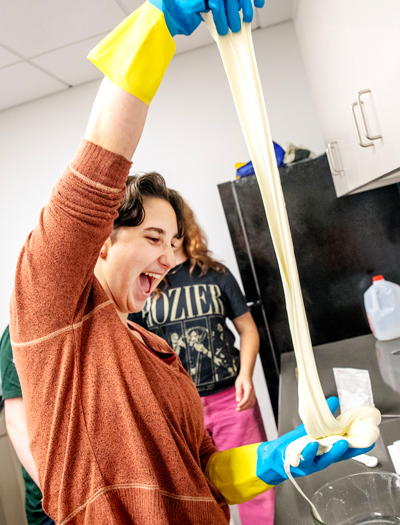
What do mozzarella-making, recycling, and vertical farming have in common?
They were all part of the curriculum for the 16 first-year students who participated in Skidmore’s Gardenside Living-Learning Community this fall.
Bryn Appel ’29, who applied to Skidmore with an environmental studies and sciences focus in mind, saw the housing option as an opportunity to build a community of friends right away.
“I thought, this seems like a great way to meet other people who are interested in
the same things as me, and I wanted to learn about how Skidmore is being sustainable.”
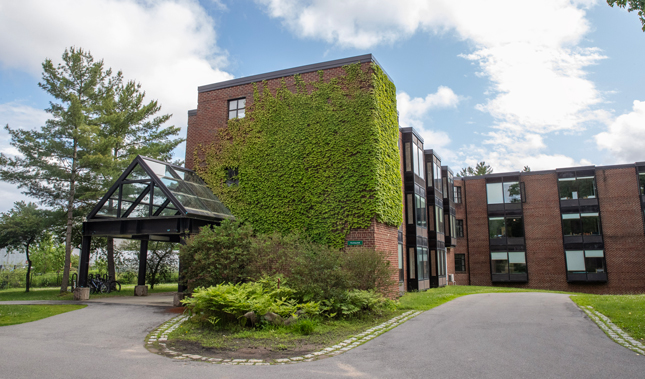
The Gardenside Living-Learning Community, a special interest option offered to first-years through Residential Life, is housed on the first floor of Wiecking Hall, next to the Skidmore Community Garden.
The program is among many at Skidmore — like the First-Year Experience — that help
students find their niche. It’s also an example of how students’ residential experience
is an integral part of a Skidmore education.
“The dorms are quite nice, and because we all live together, we’re able to just knock
on each other’s doors, go for a hike together, hang out and do the homework together,
and nerd out,” says Nora Carroll ’29, who plans to study environmental science with
a minor in music.
Jenna Loveman ’27, an environmental science major who participated in Gardenside during
her sophomore year, says being so close to the Community Garden was a big draw for
her. “I like to help out in the garden, and there were a lot of opportunities to get
involved.”
Students in the program take a one-credit course through Skidmore’s Sustainability Office that meets weekly in either the Wiecking basement common room or at a field work
location elsewhere on campus. A few field trips take them off campus as well.
Director of Sustainability and Environmental Initiatives Tarah Rowse and Sustainability
Coordinator Celia Darling lead the class, teaching fundamental sustainability concepts
while emphasizing College efforts and experiential learning opportunities.
“We’re familiarizing students with the system of campus sustainability,” says Rowse.
“Who are the partners? What are we working on? What are the challenges? How do you
do this work in an integrated way? It’s everything from education and engagement to
the planning and policy and action projects.”
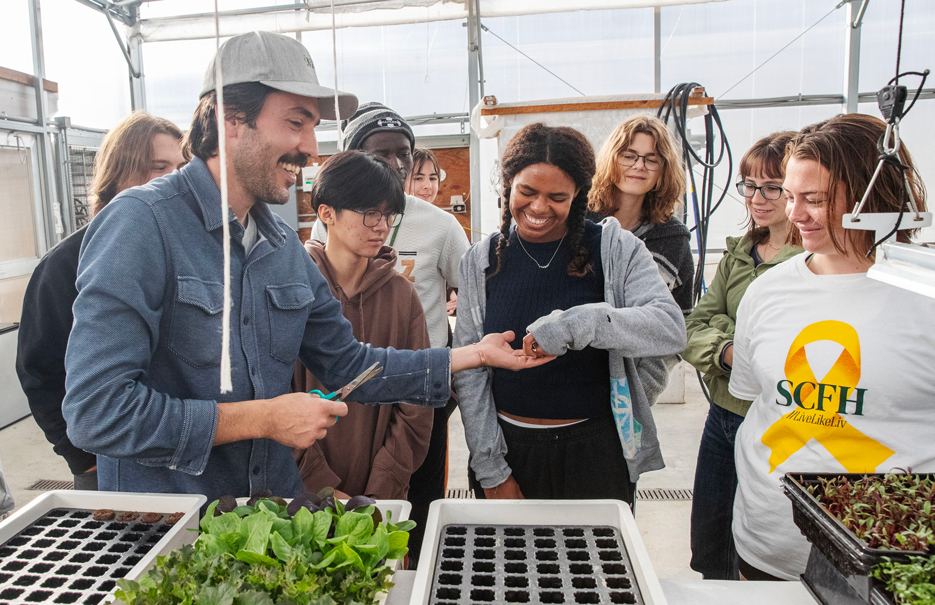
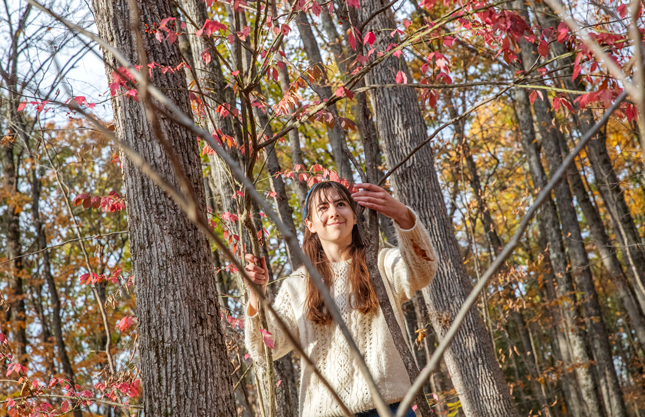
Along with weekly mini-lectures and discussions, students participate in tours and
hands-on “workdays” in the North Woods, Community Garden, and on-campus compost site.
“The class is really well structured,” says Carroll. “We learn about a topic and then
we’ll do something hands-on that relates to it. For instance, we learned all about
composting and then we turned the compost here on campus.”
Appel agrees. “It’s nice to see that the community I’m in at Skidmore is doing a lot
toward sustainable goals.”
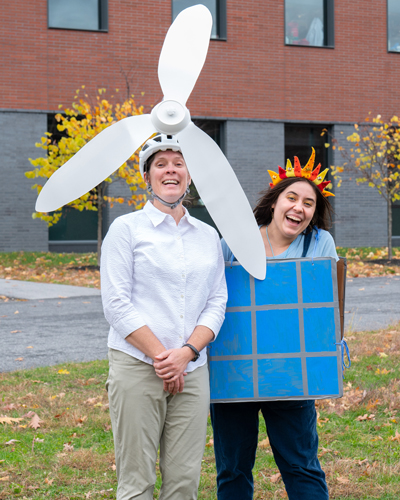
They’ve also enjoyed meeting student leaders and mentors, like the Skidmore Community Garden manager and the North Woods stewards.
“They’re very approachable and I liked being able to meet them in class,” says Appel. “It’s a good environment.”
The class also asks students to examine their own personal and collective behaviors,
on campus and in their residential experience, while building a shared sense of community
and contributing to student-run programs.
“We talk a lot about choices and what individuals can do, but then there are also
the systemic and structural changes that need to happen,” says Rowse.
“We want students to think about our campus system, how they are a part of it, and what we can do as a community to foster a more sustainable and just world.”- Tarah Rowse, Director of Sustainability and Environmental Initiatives
Local field trips — to a materials recovery facility, sustainable vertical container
farm, and hydroelectric plant — are also part of the curriculum.
The materials recovery facility (MRF) was especially memorable for Appel, Carroll,
and Loveman, who were excited to see the concept of recycling in action, on a grand
scale.
“The MRF very much feels like ‘Charlie and the Chocolate Factory,’ but for recycling,”
says Sustainability Coordinator Darling. “There are a lot of cool machines.”
Overall, Loveman says, being part of the Gardenside Living-Learning Community was
a great way to meet other people who are interested in sustainability and discover
opportunities to further those interests. She has since worked as a Community Garden
assistant and will become a Community Garden manager next year. She also joined EcoMore,
which plans and facilitates many sustainability-related events on campus.
“It just feels all encompassing,” she says. “It’s awesome that at Skidmore you can
connect different areas.”
Appel, a member of the JV polo team, has also been enjoying courses outside the sciences
— like Fantasy and Worldmaking through the English Department. “I’ve been trying different things out, which has been fun. One of the reasons I
picked Skidmore is because I’m not hemmed into one specific area.”
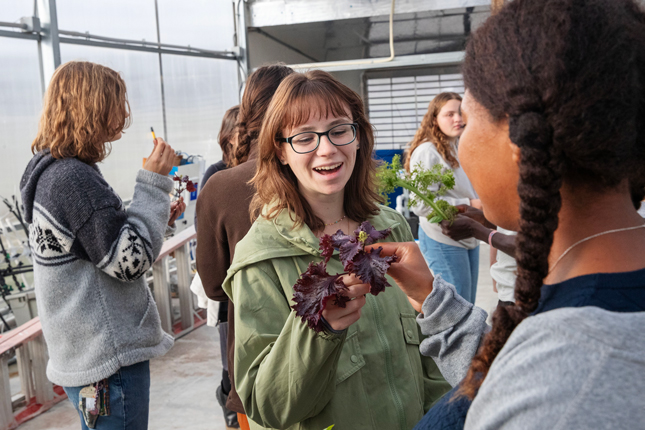
Carroll, an experienced violinist and member of Skidmore’s Small Strings Ensemble
alongside her strong interest in environmental science, has found motivation through
both Gardenside and her first-year Scribner Seminar, Pollinators in Peril. “In that course, we made a pollinator garden, so that has really inspired me to
want to improve the campus’s native plant selection even more,” she says.
The connections, friendships, and support she has already found at Skidmore are exciting,
Carroll reflects.
“Becoming part of the sustainability community right away has been a really great
head start.”