


The Super Bowl as cultural performance
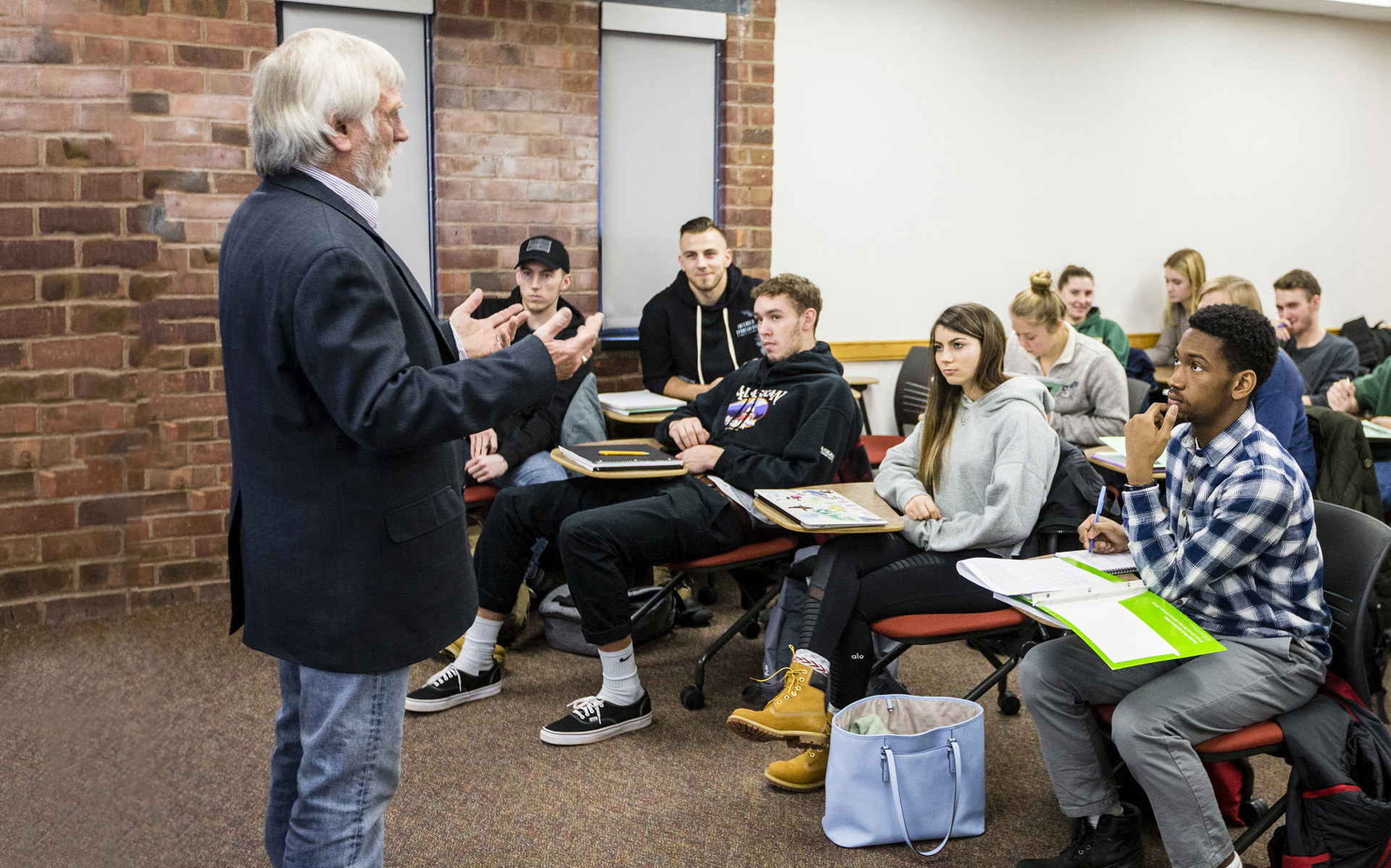


This Sunday's 52nd Super Bowl is a football game, of course. It pits the five-time Super Bowl champion New England Patriots and quarterback Tom Brady, maybe the greatest ever, against the Philadelphia Eagles, a team with a backup quarterback who has never won the NFL championship. With the Pats favored by 4.5 points, it's guaranteed to be an interesting game.

But if you ask Skidmore Professor Jeff Segrave, there's more happening on the screen
than just football.
"I think of the Super Bowl as a cultural performance," says the professor of health
and human physiological sciences whose "Sport and Social Issues" class has been asked
to critically watch the game. "It's American culture being performed in front of your
very eyes. Some call it the high-holy day of American sport."
Segrave suggests that as you watch alongside 110 million other viewers you consider
that roughly five percent of the entire NBC telecast will actually be live football.
So what are we really watching? A partial answer: 12 minutes for the halftime show
and more than an hour of commercials.
Segrave invited his students, and by extension our surrounding community, to take
a more analytical role.
"It's fine to have a jolly old good time while you're watching the game," Segrave
assures his students, "but I want you to read the audio-visual presentation of the
game as a text, a narrative, a portrait of America and American culture."
As we do our share to help consume 1.35 billion wings (an estimate by the National
Chicken Council), Segrave asks us to keep a few questions on our minds.
If they motivate you to think differently, you're invited to email your thoughts to
info@skidmore.edu.
Analyzing a "Portrait of American Culture": Five questions to ask yourself as you
watch the Super Bowl
- What does the Super Bowl say about America? Good? Not so good? What about those around the world that are watching, what do they think of America?
- What does the Super Bowl tell us about gender, race, class, ideology, and power in American society?
- In what ways is the Super Bowl a reflection of corporate America?
- Which companies advertise during the Super Bowl? Which segments of the population are they targeting?
- Beyond the teams, which well-known individuals are part of the cultural performance? Who are they? Why are they important to us as Americans?
About Jeff Segrave: Professor Segrave's main area of scholarly interest lies in the socio-cultural analysis of sport; hence, he embraces an interdisciplinary approach that seeks to study sport at the intersections of history, sociology and literature. His current areas of scholarly interest are the Olympics Games, sport in cartoons, and tennis in American literature.