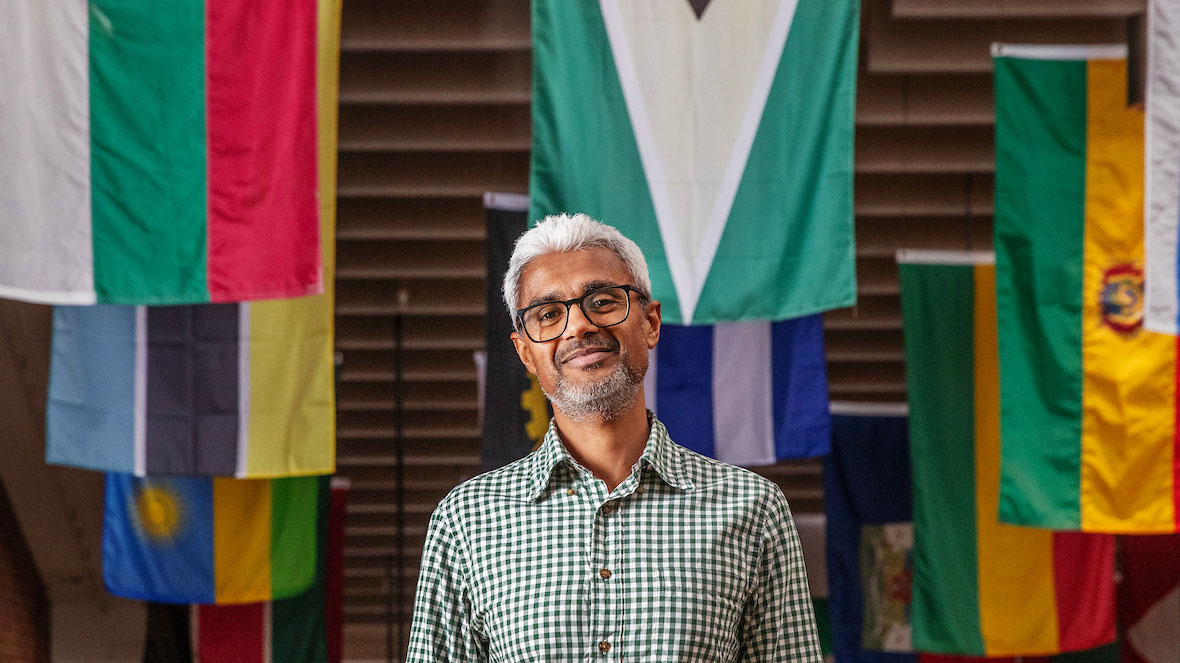
Professor Mahesh Shankar explains why everyone should study international affairs at Skidmore
I came into my first year at Skidmore without the slightest clue of what I wanted to study.
After dropping a class at the last minute, I found myself in International Affairs 101 because it was the only class left that fit into my schedule. I had no idea what to expect. IA 101 is a popular introductory class, but it’s also a hefty, four-credit course covering a broad range of material and taught by not one, but two professors. At first, I found all of this rather intimidating.
Little did I know that one year later I would be declaring a major in IA and sitting across from Mahesh Shankar, director of the International Affairs Program and my IA 101 professor, talking to him about what makes the program unique. Professor Shankar talks about what brought him to Skidmore, what he values about the IA Program, and why you — and everyone — should consider studying IA at Skidmore, too.
Q: Tell me a little bit about yourself. Where are you from and how long have you been at Skidmore?
My family is from India, but I grew up all over. I was born in China and spent later parts of middle school and high school years in Turkey, attending a U.S. Department of Defense school. After that, I completed both my undergraduate and master’s degrees at universities in New Delhi, India, before completing my Ph.D. at McGill University in Montreal, Quebec, Canada. Immediately before coming to Skidmore, I was teaching as part of a postdoctoral fellowship at a university in Singapore.
I came to Skidmore in 2013, when the International Affairs Program was still a relatively small program in the College, and colleagues here were trying to build up the IA program. I was the first full-time faculty hire. I taught for six or seven years and became the director of the program in 2018.
Q: What attracted you to Skidmore?
Before I came to Skidmore, I was in Singapore and was applying for jobs all over the world. I had taught in some really large classrooms — sometimes with hundreds of students. I came to realize that in the bigger classes, you just never get to know the students very well, and the students don’t get to know you.
I was particularly keen on Skidmore because I really liked teaching, and the idea of teaching at a liberal arts college with small classes where I could really get to know the students was super appealing.
Some of my research ideas often emerge from discussions that happen in class, so the close interactions with students are always fun in the smaller, discussion-based classes like we have at Skidmore.
Q: What are your favorite classes to teach?
As surprising as it may sound, I like teaching IA 101 a lot, and I teach it all the time. I think teaching first-year students or students taking an IA course for the first time can be super exciting because it comes at a point in students’ lives where they’re almost a blank slate and they’re very creative in terms of ideas. The questions that students have and the discussions that can happen are really exciting.
IA 101 is probably also the most diverse classroom that I teach in. Students come from a range of disciplines and are taking the course for a bunch of different reasons. There are tons of first-year students, but also some sophomores, some juniors, and some seniors, so there are a lot of different perspectives coming from all over the place.
I also really enjoy teaching courses that are more aligned with my own research interests and expertise, such as my two upper-level courses, Asian International Affairs and Causes of War, Paths to Peace.
Q: IA 101 has a reputation for being tough. Is that true?
I know the course has that reputation, and there’s no doubt it’s rigorous: Students learn about a wide range of ways to study international affairs that come from many different academic disciplines, including economics, political science, environmental studies, anthropology, and geography. It's also four-credit course, so it includes some extra work by default.
While the course definitely challenges students, it also gives students important skills and knowledge that are essential to understanding our world and that will be essential throughout the IA curriculum. A lot of our students also do really well, so the class is definitely doable.
Q: What do you tell a student considering Studying international affairs?
Given the moment we're in globally, nationally, and internationally, I think every student needs some kind of exposure to international affairs.
Let's say you're a business major: Having some background in international affairs will prepare you for what's out there in the world — whether you're thinking about tariffs and what that means for the business environment globally or what's happening with trade around the world. The same goes for other majors, from the arts and humanities to the natural sciences.
I think IA as a major or minor is particularly useful for students today in a world that's changing dramatically. Understanding what's going on, and having that broader context, prepares students in a range of disciplines for the world that they're entering after college.
Q: What distinguishes Skidmore's international affairs program?
In most other schools, international affairs is mostly about international politics and a little bit about international economics. At Skidmore, it's about more than that. You've got the climate and environment built in. We talk about culture a lot, and we focus on the intersections of all of these overlapping “worlds” — economic, political, physical, and cultural.
One thing that the International Affairs Program does really well is offer flexibility. It is open to your designing the major in the way that best fits your interests and your passions.
At the same time, the program also challenges you to do things that might be out of your comfort zone. The fact that we require students to study another language and study abroad are all major pluses for the program.
Q: What should prospective students know about studying IA here?
The IA program has become increasingly popular among students, and we've got an increasing number — and wide range — of professors engaged in and teaching in the program.
I'm a political scientist by training, but another full-time faculty member in the program, Assistant Professor (Rachel) Cantave, is an anthropologist. All of our faculty bring in various perspectives and ideas from a variety of disciplines. If you're a prospective student and you're even remotely interested in what's going on around the world, we encourage you to check out IA 101 and talk to us about it.
Regardless of whether you're going to major in IA or not, having some exposure to international affairs will prepare you better for the world you're going to enter after college.
Q: What kind of topics do you research?
As I mentioned, I’m a political scientist, and my areas of expertise broadly concern issues of war, peace, and conflict — particularly conflicts over territory. Regionally, I focus on Asia — primarily India, China, and their neighborhood.
My first book, “The Reputational Imperative: Nehru’s India in Territorial Conflict” asks the question of why countries fight wars over territory at some points and compromise over territory at other points. I was particularly interested in how India and China thought about those questions in the immediate postcolonial period. I rely on the concept of “reputational imperative” — the idea that countries treat territory in one way or the other depending on what they believe other countries will think about them if they act in certain ways and not others.
More recently, I've been working on a different, but related theme: status. My new research explores how countries think about status and how status impacts how countries behave internationally. You can think of China, India, or Turkey. All of these countries have a vision of the role that they think they deserve to play in international affairs.
Q: What do you like doing on campus outside the classroom?
The first few years that I was here, I used to play intramural soccer with students. We had a whole faculty and staff team, and we would play against the many student intramural teams. I'm still very interested in soccer, but I don't play it as much because of injuries.
I play tennis a lot though, and I follow Skidmore tennis teams quite a bit. My daughter also plays tennis, so that's an extra incentive. We especially enjoy watching the women’s tennis team play.
I also love the Zankel Music Center. I'm not so musical, but my wife, Archana Suresh, who teaches in the English Department, is a musician. My daughter is also learning the piano. We're at music concerts on campus all the time, and we think it's amazing to experience the range of concerts offered here at Skidmore.
Leila Ekendiz ’28 is an international affairs major with a minor in management and business.