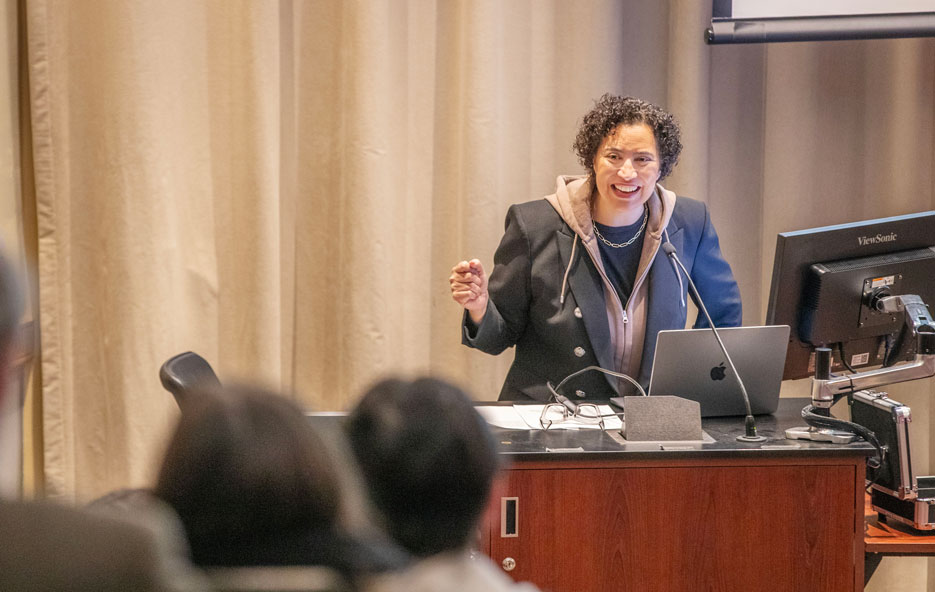
'It’s not magic': A conversation on AI, power, and responsibility
Artificial intelligence expert Meredith Broussard challenged the Skidmore community to confront the ethical realities of AI, emphasizing that its embedded biases have real-world consequences and calling for its responsible use.
The AI scholar and professor at the Arthur L. Carter Journalism Institute of New York University visited Skidmore’s campus to deliver her lecture, “Does AI Give Good Advice?”
Broussard showed that although the technology may seem revolutionary, it is at its core mathematics and functions by identifying patterns in datasets and predicting which word is statistically most likely to come next in a sequence.
“You can generate new things based on the old things, which is cool, but it’s not magic,” she said. “And it is not the solution to all the world’s problems.”
Broussard’s visit reflected Skidmore’s continuing efforts to educate students, faculty, and staff about emerging tools and technologies, including generative artificial intelligence, and to encourage its ethical use — a priority for the College.

Broussard is the author of “More Than A Glitch: Confronting Race, Gender, and Ability Bias in Tech” (2023) and “Artificial Unintelligence: How Computers Misunderstand the World” (2018).
She cautioned that although AI is based in mathematics, it should not be mistaken as objective. Broussard explained that these systems are only as neutral as the data behind it. That data, she argued, is shaped by a long history of discrimination and structural inequality.
“When we let go of the perception that AI is objective, it becomes easier to see that the problems of the past are embedded in the data that we use to train AI systems,” she said.
Pointing to real-world examples like mortgage approval algorithms, Broussard emphasized that the harms associated with AI affect people in tangible ways.
“When we talk about existential risk associated with AI, including that AI is going to take over the world, that is a narrative that distracts from the real harm that is being suffered by real people at the hands of AI systems."”- Meredith Broussard
As AI continues to integrate into more industries and spaces, Broussard urged the Skidmore community to focus less on becoming an advocate or critic and more on examining how to engage with the technology.
“You have a voice in how AI is used and in what context,” she said.
Broussard encouraged students, faculty, and staff to approach AI intentionally and responsibly.
Returning to the question that framed her lecture, “Does AI give good advice?” Broussard suggested that it’s not always the answer that you get, but the connection sparked between two people when exchanging ideas that matters.
“Next time you’re tempted to ask a chatbot for advice on exercise or what to have for dinner, just consider why you are asking and what role it plays in society,” she said.
The visit was presented by the Sub-Committee on Responsible Citizenship, the Computer Science Department, and the Faculty Director of Civic Engagement, with support from Brian Downing ’86.