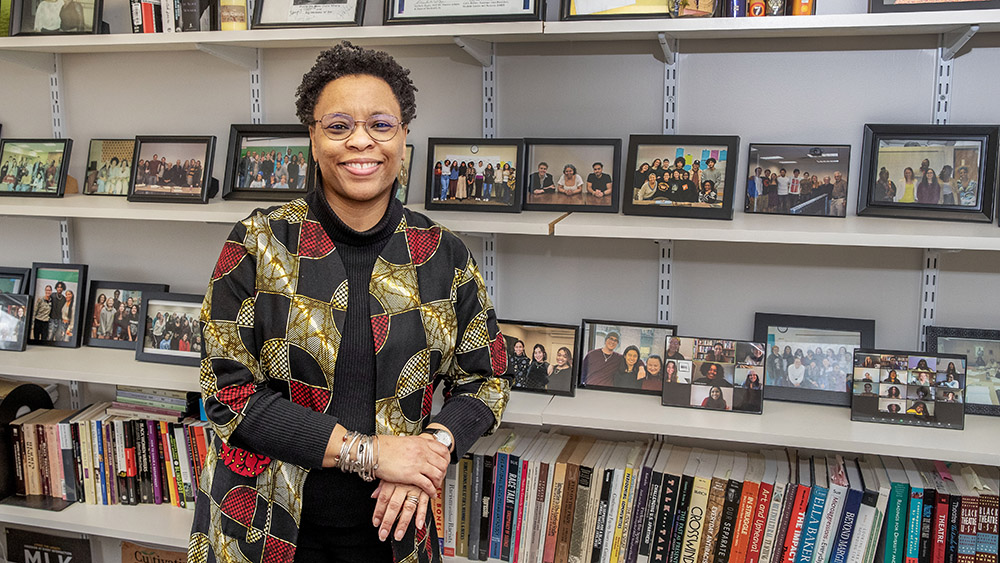
Dialogue that can change the future
I first learned about Intergroup Relations (IGR) at the Black Excellence Career Panel during the spring semester of my junior year. A Skidmore alumnus who was a panelist urged all students to take at least one IGR class before they graduate. I was curious about IGR but didn’t fully understand what it was all about.
Going into the fall of my senior year, I decided to register in the IGR course A Black Woman Speaks: Will You Fight With Me? because I had heard how amazing IGR Program Director Lisa Grady-Willis is as an instructor and how students leave the class with more confidence than when they entered.
I had no idea what to expect. The introductory class was different from any course I had ever taken — in high school or college. IGR courses are vibrant. They’re also challenging because they ask you to dive deeply into understanding who you are and why you think the way you do. It can be difficult for some to face themselves and do the inner work.
IGR builds leaders through dialogue and conversation. If you need help finding your voice, Intergroup Relations is a great place to start.
Q. First of all, what is IGR?
Lisa Grady-Willis: To me, Intergroup Relations is all about social justice and using an academic framework to ground students in the concept of dialogue as a movement. It challenges us to include our identities in what we study and to dismantle power dynamics. It’s not just talking for the sake of talking; we engage in dialogue with an eye toward the future: How do we come together? How does the world change? Identity is an important part of why the world is the way it is, and we need to understand and embrace that.
Q. How would you describe the goals of the program?
IGR really is a leadership-building space. Looking back at its origins, we saw clearly that students who took these courses felt more confident overall on campus and started making their voices known in other classrooms. We build specific skill sets around dialogue facilitation and communication. For me, being a leader is all about knowing when and how to use your voice to increase understanding rather than just trying to win a debate.
Q. How does IGR connect with Black Studies and other departments?
At its base, IGR is multidisciplinary. You can be in any discipline — from the sciences to the arts — and see the need for Intergroup Relations because we need dialogue and conflict resolution in every area. My expertise is in Africana studies and Black theater; IGR takes pieces from those fields (and many others) and grounds them as community-building tools.
I want students to use the IGR lens in whatever path they choose. If you decide to pursue medicine, law, business, or any field, I want you to pay attention to who is left out of conversations in those areas. Don’t just go with one master narrative; listen for multiple narratives, including those that may be hidden underneath.
Q. What are your favorite classes to teach?
I love all my classes, but if I had to choose one, it would be A Black Woman Speaks: Will You Fight With Me? In IGR, you can’t really have a true dialogue if all you do is agree; there needs to be tension.
“Students have to learn to be comfortable being uncomfortable. When you let the difficult stuff out, that’s when the real growth happens.”
I also teach Taking the Journey Home, which appeals to students who are away from home for the first time, and Social Justice Dialogue: Theory and Praxis together with Associate IGR Program Director Jennifer Mueller. Skidmore was the first college in the nation to offer an IGR minor, and we’re known for our Race, Power, and Dialogue course and the two-credit Peer-to-Peer Dialogues Across Difference series, which explores a range of issues related to identity.
Q. How would you describe your style of teaching?
I do a lot of singing and theatrical things because that is who I am. My challenge as an educator is to never leave myself outside the door; I try to bring all the pieces of me to my classroom. If I could lead a parade through my office, I’d have everyone come in with their theme song. What is the song you want people to hear when you walk into a room? What is the track playing in your head? I want to know what that is for every person.
Q. What topics do you research?
Right now, my research is focused on how intergroup relations and dialogue have been shifting since the pandemic. There is a heightened polarization and difficulty in getting people to want to engage with one another. I’m looking at how we can navigate that polarization to keep moving toward social justice.
Q. Why Skidmore?
This is actually my second time at Skidmore. I came back to campus in 2019 because I saw the institution starting to live up to who we are and who we say we want to be. There has been increasing attention paid to the resources needed to recruit and retain domestic students of color. The ability for an institution to say it is time to evolve and then actually do that work is significant.
Q. If you had an unlimited budget, who would you invite to campus as a guest speaker?
Without a budget, I wouldn’t just invite one person; I’d host a roundtable series. I would bring in an activist from each decade, going as far back as we can with people who are still with us. This intergenerational piece is so important. I want them to speak to what it meant in their specific moments to use their voices. We could represent so many different movements and talk about justice in many different ways.
Q. If you had a time machine, which time in the past would you visit?
I’d rather travel to the future. For me, it’s always about looking forward. I can study the past, but I can be the future. The future tells me that there is something out there that I have not even envisioned yet, and that is where the excitement lies.
Djeneba Sanogo ’26, a first-generation student from Harlem, New York, is pursuing a major in international affairs and a minor in French.