


Leadership training kicks off new semester


Techniques to avoid the 'bystander effect' the focus
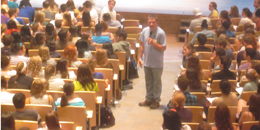 More than 400 students - nearly 20 percent of the student body - attended an "Everyday
Leadership" workshop on Skidmore College's campus on Wednesday. Organized by Student
Affairs and facilitated by consultant Duke Fisher, it focused on training student
leaders (including peer mentors, peer health educators, residential life staff, athletes,
student club and government leaders) to improve campus climate and student culture
by confronting inappropriate behavior instead of sitting on the sidelines.
More than 400 students - nearly 20 percent of the student body - attended an "Everyday
Leadership" workshop on Skidmore College's campus on Wednesday. Organized by Student
Affairs and facilitated by consultant Duke Fisher, it focused on training student
leaders (including peer mentors, peer health educators, residential life staff, athletes,
student club and government leaders) to improve campus climate and student culture
by confronting inappropriate behavior instead of sitting on the sidelines.
President Philip Glotzbach commended the students for participating, "What you're doing here today will change Skidmore."
The day-long workshop focused on building skills for bystander intervention - helping students to intervene confidently and competently when other students cross an unacceptable line - in cases involving racism, sexism, bullying, sexual harassment, hazing, or coercive pressure to drink alcohol, do drugs, or engage in intolerant behavior.
Associate Dean of Student Affairs David Karp described the "bystander effect" as a social phenomenon that occurs when a diffusion of responsibility prevents individuals from intervening in troubling situations. Research, he said, shows that individuals will look to others in a group instead of taking responsibility themselves.
Fisher, founder of Learning Laboratories, Inc., a mediation, conflict management, mentoring, and group training consulting firm, led the students through a series of exercises in which he demonstrated three different intervention techniques - be direct, delegate and distract - students can use to overcome the bystander effect and potentially save lives.
Students then divided into smaller groups and moved to classrooms to discuss the campus climate and intervention strategies.
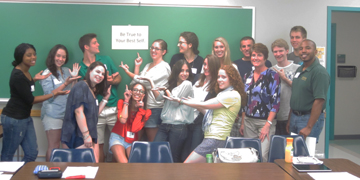 "It's important for me to be here today," said Nini Tsintsadz '14. "It's important
to talk about our problems and find solutions to resolve them."
"It's important for me to be here today," said Nini Tsintsadz '14. "It's important
to talk about our problems and find solutions to resolve them."
Students continued discussing and honing their intervention skills into the afternoon. "I want to take a more active role in the Skidmore community," said Dylan Adelman '13. "Attending this workshop allows me to delve deeper into the community and give back."
After the smaller discussion groups, students returned to the Zankel Music Center for a "synthesis" of the workshop. "The tools and techniques we learn here today will set the tone for new school year," said Rachel Fisher '12. "I remember how awkward and uncomfortable it was to come in as a new student, and anything I can do to help someone feel comfortable talking to me about anything, no matter how uncomfortable, will help me be a better mentor."
For more about the Division of Student Affairs, click here.