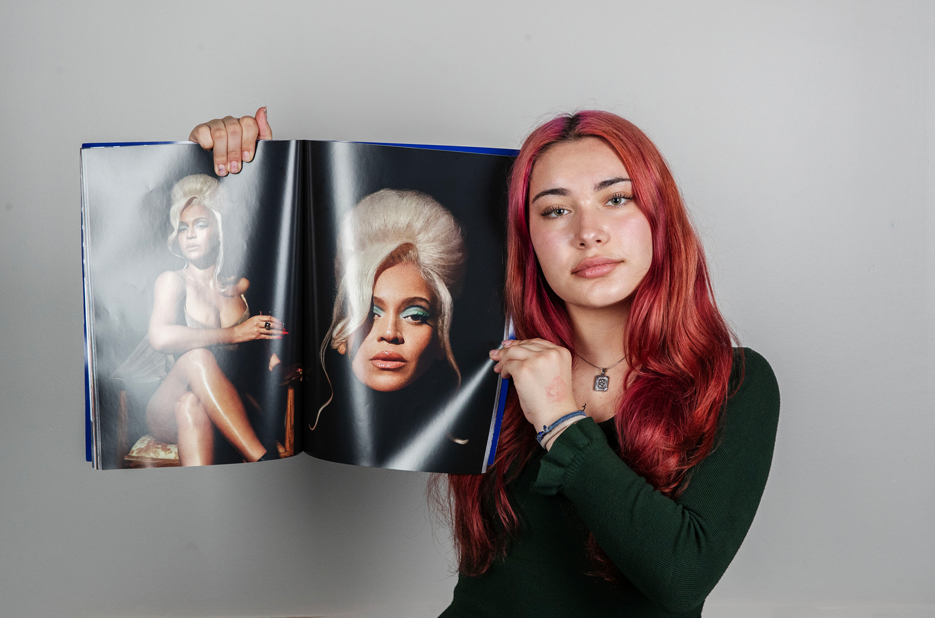
Being seen in a course about Beyoncé
For Tammy Owens, assistant professor of American studies and director of gender studies, offering a course about Beyoncé is about more than studying Queen Bey. It’s about showing up for her students by teaching scholarly topics that align with their lived realities.
Centered on the theme “the politics of being seen,” her Becoming Beyoncé course this spring paid special attention to the artist’s most recent project, “Cowboy Carter,” as a reimagining of “America’s music.” By the end of the semester, students curated their own digital archives on Beyoncé that combined scholarship, cultural critique, and personal reflection.

“I was finding in all my classes that if I even briefly mentioned Beyoncé, we talked about her for a long time,” Owens says. “I realized it was time that I give Beyoncé her course.”
As a cultural icon throughout Owens’ high school and college years and into her career in academia, Beyoncé holds personal and professional significance for the professor. She frequently points to the artist in her other American studies and gender studies courses to analyze race, womanhood, motherhood, and the construction of a pop icon image — especially as a Black woman from the South who has achieved sustained global recognition over decades.
“She has been a part of my academic, professional, and social worlds for a long time,” Owens says.
The course engages with Beyoncé’s life and career as a lens to discuss topics as varied as U.S. politics, transnational feminism and global economies, Southern Black girlhood, diverse forms of love beyond heteronormativity, and social media and AI strategy.
The “politics of being seen” theme — exploring how individuals grapple with visibility versus invisibility — has been particularly fruitful, Owens says. For one of the assignments, she has each of her students keep a journal throughout the semester.

“They put their personalities into them, they get to tell me who they are, and I write back to them,” she says. “It’s been really nice to watch students find themselves in this course and what they care about through this theme. It has afforded us a fearless intellectual space and a fearless curiosity around being human and real in our dialogue with each other.”
Alanna Herbert ’29 says she also likes how the course treats albums, videos, and performances as texts for critical analysis, reinforcing the importance of creative work in academia and public discourse.
For the final class project — a digital book — Herbert and her group analyzed Beyoncé’s political activism and the messages she sends through her music. “We looked at how the public sphere views her as an icon in this country, and the different things that come into play in politics and media.”
 In her first year at Skidmore, Herbert has found herself strongly drawn to sociology and Black studies, with potential overlap in gender studies.
She has also found supportive, inclusive communities at Skidmore as co-president of the QuestBridge Scholar Network, a singer in the Bandersnatchers a cappella group, a performer in theater productions, and a member of the club Ujima.
Herbert appreciates how Professor Owens builds community in the classroom as well, modeling respectful engagement, feedback, and collaboration.
“We can talk to her freely, and when we have check-ins, they’re personalized. She actually cares about what we’re doing outside of class too. I feel like it makes the community of the classroom better because it’s free, honest, and welcoming.”
The Becoming Beyoncé course fulfills credit in gender studies, American studies, and humanistic inquiry. And Beyoncé isn’t the only cultural icon with a course at Skidmore: Dean of Students and Vice President for Student Affairs Adrian Bautista regularly teaches a popular Prince course for American studies.
To Owens, Creative Thought Matters is about showing students how to analyze current issues that matter to them.
“I put real energy into meeting students where they are and helping them develop timeless skills through topics that are relevant to their lives today.”