


Skidmore team earns patent for use of antioxidant compound



Jonathan Brestoff Parker ’08
A Skidmore alumnus and professor have been awarded U.S. Patent No. 8,598,150 for use of an antioxidant compound that shows promise in the treatment of obesity and related disorders, such as type-2 diabetes.
The researchers—Jonathan R. Brestoff Parker, a 2008 graduate who is currently a trustee of the College, and Thomas H. Reynolds, associate professor of health and exercise sciences—discovered that treating obese mice with an antioxidant called MnTBAP* decreases obesity and improves type-2 diabetes.
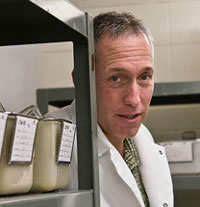
T.H. Reynolds
Obese mice that received the compound lost 40 percent of their body weight. “To put that number in context, if a 300-pound obese person lost 40 percent of their body weight, they would have lost 120 pounds,” said Brestoff Parker.
The compound works by breaking down triglycerides, which are stored in excess in fat
tissue of obese people. The researchers’ next step, according to Reynolds, is “to
figure out how that happens. What are the cellular and molecular events that result
in weight loss?” He calls this stage of drug development “the fun part of science—trying
to design the next study that will yield information about how a biological system
responds to a drug.”